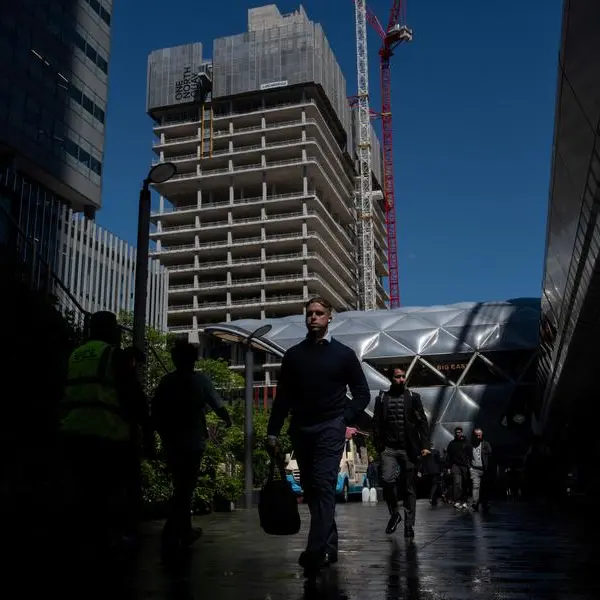
PHOTO
British inflation rose by more than expected in December, pushed higher by air fares and tobacco prices, but the fastest rate of price growth among the world's big, rich economies is still likely to slow sharply in the coming months.
Investors held steady on their bets on the Bank of England cutting interest rates later this year with services price inflation, which is closely watched by the central bank, edging up in line with analysts' forecasts. Headline inflation headed up for the first time since July, climbing to 3.4% from 3.2% in November, the Office for National Statistics said, above a median forecast of a rise in consumer price inflation to 3.3% in a Reuters poll of economists.
"Although the uptick is larger than expected, for now it's a speed-bump, rather than an indication we are veering off course on the road to price stability," Adam Deasy, an economist at PwC, said.
BANK OF ENGLAND EXPECTED TO CUT RATES IN 2026
Services inflation rose to 4.5% in December from 4.4% in November, as expected in the Reuters poll.
Inflation in Britain remains the highest in the Group of Seven, despite the country's sluggish economic growth.
But the pace of price increases is expected to slow sharply in the coming months as last year's rises in utility costs and other government-controlled tariffs fall out of the annual comparison.
BoE Governor Andrew Bailey has said inflation is likely to be close to the central bank's 2% target in April or May.
The pound and market expectations for BoE interest rates were little changed by the data.
"The Bank of England will ... not be worried by these numbers," said Nicholas Crittenden, economist from the National Institute of Economic and Social Research think tank.
"We still predict one cut in Bank Rate in the first half of this year, provided renewed geopolitical tensions do not blow the current path of inflation off course."
Bailey said on Tuesday the BoE worried "considerably" about how markets react to geopolitical developments, with U.S. President Donald Trump threatening tariffs on historic European allies who oppose his plan to take over Greenland.
British natural gas futures have soared by around 25% over the last two weeks, in part due to the deterioration in the relationship with the United States, a major supplier of liquefied natural gas to European countries.
As many economists had predicted, tobacco and airfares were the biggest contributors to the headline rise in consumer prices in December, pushed up by an increase in duty charged on tobacco products and the timing of flights around Christmas.
Still, Britain's consumer price and services inflation rates are running slightly below those projected by the BoE in its November forecasts.
Financial markets are pricing one or possibly two quarter-point interest rate cuts by the BoE in 2026.
In December, the BoE's Monetary Policy Committee cut Bank Rate to 3.75% but almost half its members voted for no change due to worries about the persistence of inflation pressure.
Producer prices data, which measure prices charged by businesses, showed a sharp uptick in the services sector during the fourth quarter, rising to 2.9% from 2.0% in the third quarter.
Output price inflation for manufacturers was stable.
(Writing by Andy Bruce, graphic by Pasit Kongkunakornkul Editing by William Schomberg, Andrew Heavens and Toby Chopra)