PHOTO
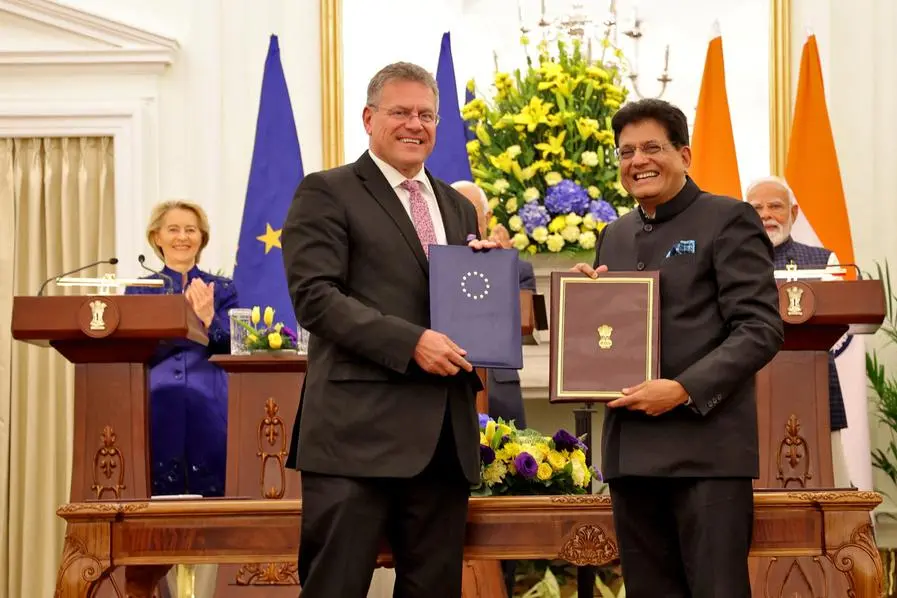
A landmark trade deal struck by India and the European Union on Tuesday will not trigger any changes to the bloc's carbon border tariff, EU officials said, despite India's concerns over the scheme.
India has sharply criticised the world-first policy since the EU announced it in 2021, warning that the levy could hamper steel trade. The scheme this month began imposing fees on EU imports of steel, cement and other high-carbon goods.
"Nothing will be phased out in terms of CBAM's implementation," an EU official said on Tuesday. The EU levy is known as the carbon border adjustment mechanism.
EU PLEDGES NO ONE WILL GET FAVOURABLE TREATMENT
India had appeared concerned during trade negotiations that the EU might offer exemptions to the U.S. as part of its trade deal with President Donald Trump, the official added.
A second EU official told Reuters the bloc had declined to change the levy, or offer more flexible CBAM rules to Indian companies.
Instead, Brussels and New Delhi agreed to hold talks on technical questions around the carbon levy, and the EU committed that it would not grant other countries more favourable treatment than India under the scheme.
That pledge changes nothing in practice, since EU legislation already states the bloc cannot give special treatment on CBAM to certain countries.
"We have neither the intention, nor even the possibility to start discriminating between countries when we implement the CBAM," the first official said.
The EU carbon levy is designed to put imports on a level footing with products manufactured in Europe, where factories already pay for their CO2 emissions.
But it has angered trading partners, including South Africa and Brazil, who say it penalises their economies and imposes EU standards on developing nations without the means to meet them.
The EU also agreed in the trade deal to provide 500 million euros in support to help India reduce emissions. India will also receive 1.6 million metric tons of duty-free steel exports to the EU, about half of its annual shipments to the bloc.
Industry executives and analysts have said the CBAM is likely to curb Indian steel exports to Europe, and prompt mills to seek alternative buyers in Africa and the Middle East.
Initially, imports will only face CBAM costs on a limited share of emissions, as the EU gradually phases in the levy.
(Reporting by Kate Abnett and Philip Blenkinsop in Brussels. Additional reporting by Shivangi Acharya in New Delhi. Editing by Mark Potter)