PHOTO
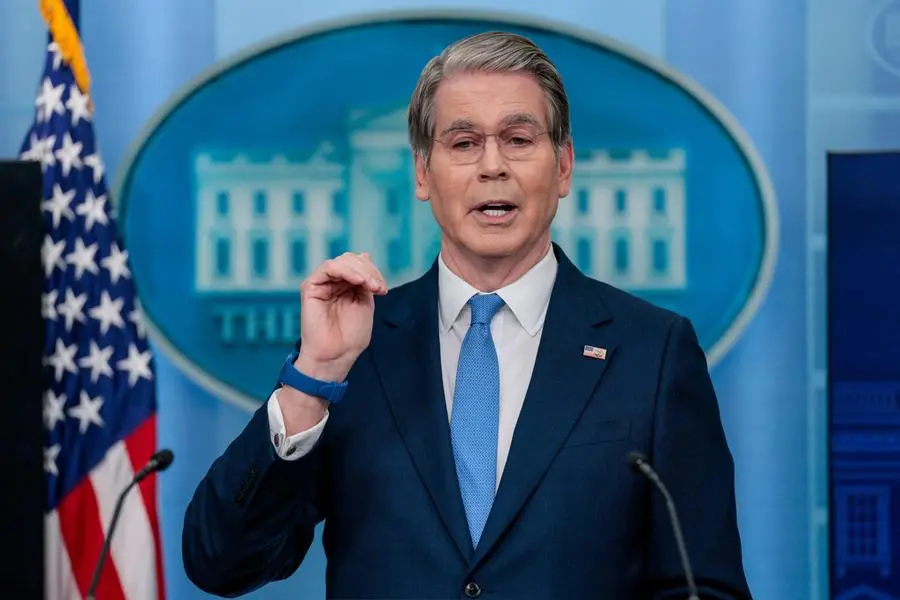
U.S. Treasury Secretary Scott Bessent will argue on Friday that President Donald Trump's economic policies are helping to reverse decades of policy failures that left U.S. supply chains vulnerable and its economy too dependent on adversaries including China.
In prepared remarks laying out his views on economic security seen by Reuters, Bessent said that America has long been "asleep," mistaking comfort and consumption for strength and prosperity, with too big a focus on efficiency at the expense of resilience. "Somewhere along the way, we lost sight of a foundational principle that previous generations understood instinctively: economic security is national security," Bessent said in the speech to be delivered at the Ronald Reagan Presidential Library in Simi Valley, California.
"For a nation that cannot manufacture, mine, ship or refine its needs gradually cedes its strength — and sovereignty — to others," he added.
"That is a dangerous dependency for any country. It is an unacceptable one for the United States," added Bessent, who often describes himself as an "economic historian."
A series of bipartisan policy mistakes, including allowing China into the World Trade Organization and putting too much faith in the-rules based trading system to police non-market economic policies led to the erosion of the U.S. industrial base and dependence on foreign suppliers, Bessent said.
Reliance on rivals for critical inputs, financing the rise of countries that don't share U.S. interests and an eroding industrial base are incompatible with defending the international order, he said.
Bessent's remarks come two weeks after Trump's summit with Chinese President Xi Jinping in Beijing, which reaffirmed the economic and strategic standoff between the two superpowers and produced agreements for managed trade and investment and some purchases of U.S. farm goods and aircraft.
He said Trump's America First Agenda, encompassing tariff actions framed around national and economic security, would start to correct past mistakes, along with the administration's efforts to rebuild American shipbuilding capability and U.S. supply chains for critical minerals and pharmaceuticals.
His prepared remarks did not lay out any new initiatives or address economic threats created by the war in Iran and the closure of the Strait of Hormuz. But he said Trump's agenda is based on the principle that "economic security is national security."
"But let me be direct about what this doctrine does not mean. It does not mean retreating from the world. On the contrary, it means engaging with it on stronger, fairer, and more sustainable terms," Bessent said.
The U.S. will not indiscriminately sever ties with trading partners, but will distinguish "healthy interdependence from dangerous overdependence." The U.S. faces some challenges in reducing its dependence on China given Beijing's dominance in critical minerals, electronics manufacturing and industrial policies targeting several critical industries. Beijing also has imposed new regulations that could punish companies that try to shift supply chains away from China.
Bessent said reducing dependence on adversaries does not mean rejecting efficiency, adding: "It means refusing to worship efficiency when efficiency leaves our nation exposed."
(Reporting by David Lawder; Editing by Chizu Nomiyama )