PHOTO
- According to UNICEF, an estimated 120 million girls from around the world have suffered some form of forced sexual contact before the age of 20 years.
- The World Health Organization (WHO) says up to 1 billion children aged 2–17 years, have experienced physical, sexual, or emotional violence in the past year, globally.
This year’s national James Dyson Award winners in the UAE is the Shield device – a smart, wearable system that detects when a child is being physically or emotional abused and automatically alerts their guardians. With bullying, which includes cyber bulling, on the rise and 1 out of 10 children being sexually abused before their 18th birthday[1], the need for preventive measures has never been more important. Particularly when the effects of child abuse can be long-lasting and affect the victim's mental health.
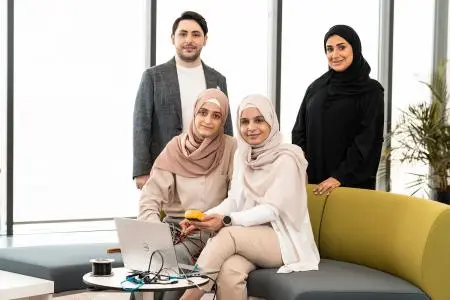
Invented by a five-strong team from Ajman University, Shield is made up of three main elements, a smartwatch, galvanic skin response (GSR) sensors, and software. Leveraging GPS and Bluetooth capabilities, found in common smartwatches, the system sounds an alarm while simultaneously capturing an image of the assaulter. It then automatically messages the image along with the GPS location of the child to the mobile device of the guardians.
Dr. Eng. Suaad Al Shamsi, one of the judges for the competition in the UAE, said, “The winning team demonstrated impressive creativity and dedication in the way they approached and designed a solution to a prevalent problem. The invention uses existing technology to detect and deter abuse while also providing an opportunity for a quick response from caregivers when required. It delivers an effective tool for parents across the globe looking to better protect their children and ensure their safety, wellbeing, and happiness.”
Core to this invention is a studied algorithm that factors in the heart rate, temperature, and skin’s conductance of a person experiencing traumatising abuse. Shield is a simple yet smart solution that can discretely protect the wearer, unlike other devices on the market that focus on collecting forensic evidence and the identification of the abuser. Shield aims to prevent abuse from taking place and has been designed to be an accessible system that can be discretely worn by a child on daily basis.
The Invention
Ajman University students Shamma Alaryani, Somaya Samra, Wessam Shehieb, Marwa Alshouli, and Bashayer Alasfour are the team behind Shield. The inventors were encouraged to participate in the award when they realised how important awareness about this topic is.
“We all firmly believe in using our education to make a real difference in the lives of others. When we were looking for impactful ideas, we couldn’t help but notice the amount of news related to child abuse and kept thinking, what if this was a relative. The idea of protecting the ones I love motivated me to push past taboos and design a solution that safeguards children and feel comfortable to talk about it,” said inventor Shamma Alaryani.
In addition to public sensitivity on the topic, the group also faced challenges collaborating due to pandemic-related restrictions. Not only did they have the usual challenges that designers face when prototyping, like reworking designs to fit within industry standard components, they were having to also work around lockdown and travel restrictions. This proved especially difficult when some of the students had to relocate to different Emirates and frustration with remote learning mounted as different modules failed and required the team to start prototyping from the beginning.
For inventor Marwa Alshouli, working on this project has helped her fine tune her critical thinking skills. “Engineering often involves looking into a problem and finding a practical solution. We had several challenges during the development of Shield, but we learned a lot about ideation and problem solving. It has also been a trying process to realise how many prototypes you need to create before you’re able to get a working solution.”
Winning the national leg of the James Dyson Award will inject AED 10,000 into the Shield system and enable the inventors to continue to further finetune the sensors and redesign the device so it is as discrete as possible. Eventually the aim is to have a consumer-friendly system.
“We began working on the system in September 2020 and spent an average of five hours a day researching and prototyping, as we progressively improved the design and weight with each version. Soon we hope to implement AI and deep learning to the software which will increase accuracy and responsiveness,” said fellow inventor Somaya Samra.
The Shield, along with runners up AgriDrone and Ultra SolarStill will progress to the international stage of the James Dyson Award. The international shortlist will be announced on 13th October, and the international winners on 17th November.
The Runners Up
AgriDrone
Problem: Optimising crop yields is a high priority as food security increasingly impacts the world’s growing population.
Solution: The AgriDrone allows for early detection of plant deficiency to help prevent damage to plants and crop waste. The AgriDrone is a drone that is equipped with a 3D mapping remote camera capable of monitoring large areas farmland by analysing nutrient deficiencies and pest growth in crops. Once a problem is detected, a command is sent to the app and AgriDrone which then guides farmers to the problem.
Inventor: Nasim Ashoobi, Omid Muhammad Ali and Mohammad Latifi
University: American University of Sharjah
ULTRA SolarStill
Problem: More than 800 million people globally do not have access to clean water, and it is expected that this number will increase up to 1.8 billion by 2025. A lack of clean drinking water causes diseases such as diarrhoea and cholera.
Solution: The ULTRA SolarStill is a sustainable domestic product that is designed to reliably and durably convert brackish and salt water to drinkable water. The low-cost device can desalinate water into clean freshwater using sunlight and ultrasonic waves, making it ideal for communities in remote and rural areas.
Inventor: Baha Alshwaiki, Anas Ghannam, Omar Ghannam and Louai Maghrabi
University: University of Sharjah
James Dyson Award
The James Dyson Award forms part of a wider commitment by Sir James Dyson, to demonstrate the power of engineers to change the world. The Dyson Institute of Engineering and Technology, the James Dyson Foundation and James Dyson Award encourage aspiring engineers, to apply their knowledge and discover new ways to improve lives through technology. Since the Award first opened in 2005, James Dyson has contributed over £100m to boundary-breaking concepts in education and other charitable causes. The competition has supported nearly 250 inventions with prize money, and is run by the James Dyson Foundation, an engineering-education charity funded by Dyson profits.
Recent past winners
- 2020 International winner – The Blue Box (Spain)
Invented by 23-year-old Judit Giró Benet, The Blue Box is a new way to detect breast cancer, at-home, using a urine sample and an AI algorithm.
- 2020 Sustainability winner – AuREUS System Technology (The Philippines)
Invented by 27-year-old Carvey Ehren Maigue, AuREUS is a new material, made from waste crop, which converts UV light into renewable energy.
- 2020 International runners-up:
- The Tyre Collective (GB) – A device that captures tyre-wear particles at the wheel of a vehicle, to be recycled for future applications.
- Scope (Canada) – A new lens using liquid crystals enabling a lossless camera zoom.
What is the prize?
- The International winner receives a prize of £30,000, plus £5,000 for the winner’s university.
- The Sustainability winner receives a prize of £30,000.
- The two International runners-up receive £5,000.
- Each National winner receives £2,000.
What happens next? All national finalists will proceed to the international stages of the competition. A panel of Dyson engineers will create a Top 20 shortlist from these finalists. Sir James Dyson will then choose an International winner and two runners-up. He will also appoint a Sustainability winner for the national finalist that best pays attention to their inventions part in today’s sustainable agenda. This could be through its materials, design process, methods of manufacture, or even the solution to the invention itself.
Who can enter the James Dyson Award? The James Dyson Award runs in 28 countries and regions worldwide. These are: Australia, Austria, Belgium, Canada, China, France, Germany, Hong Kong, India, Ireland, Italy, Japan, Korea, Malaysia, Mexico, Netherlands, New Zealand, Philippines, Poland, Russia, Singapore, Spain, Sweden, Switzerland, Taiwan, UAE, UK, and USA. The Award launches for the first time in Poland in 2021. Entrants must be, or have been within the last four years, enrolled for at least one semester in an undergraduate or graduate engineering/design related course. This course must be at a university in a country or region chosen to participate in the James Dyson Award.
Entrants must be, or have been within the last four years, enrolled for at least one semester in an undergraduate or graduate engineering/design related course. This course must be at a university in a country or region chosen to participate in the James Dyson Award. Those participating in a degree level apprenticeship at Level 6 or Level 7, and those who have completed said apprenticeship in the past four years, are now eligible to enter the award.
For more information and regular updates on the progress of the James Dyson Award, check out the Award’s website, Facebook and Instagram. You can also view past winners stories on the Dyson Newsroom here.
© Press Release 2021
Disclaimer: The contents of this press release was provided from an external third party provider. This website is not responsible for, and does not control, such external content. This content is provided on an “as is” and “as available” basis and has not been edited in any way. Neither this website nor our affiliates guarantee the accuracy of or endorse the views or opinions expressed in this press release.
The press release is provided for informational purposes only. The content does not provide tax, legal or investment advice or opinion regarding the suitability, value or profitability of any particular security, portfolio or investment strategy. Neither this website nor our affiliates shall be liable for any errors or inaccuracies in the content, or for any actions taken by you in reliance thereon. You expressly agree that your use of the information within this article is at your sole risk.
To the fullest extent permitted by applicable law, this website, its parent company, its subsidiaries, its affiliates and the respective shareholders, directors, officers, employees, agents, advertisers, content providers and licensors will not be liable (jointly or severally) to you for any direct, indirect, consequential, special, incidental, punitive or exemplary damages, including without limitation, lost profits, lost savings and lost revenues, whether in negligence, tort, contract or any other theory of liability, even if the parties have been advised of the possibility or could have foreseen any such damages.