PHOTO
“These results tell us that when you speak consistently, clearly, and through the right channels, people listen and they act. We are genuinely encouraged to see our community not only receiving the message but embracing it and passing it on.”
- Najla Aleisa, Chief Marketing Officer, Gulf Bank
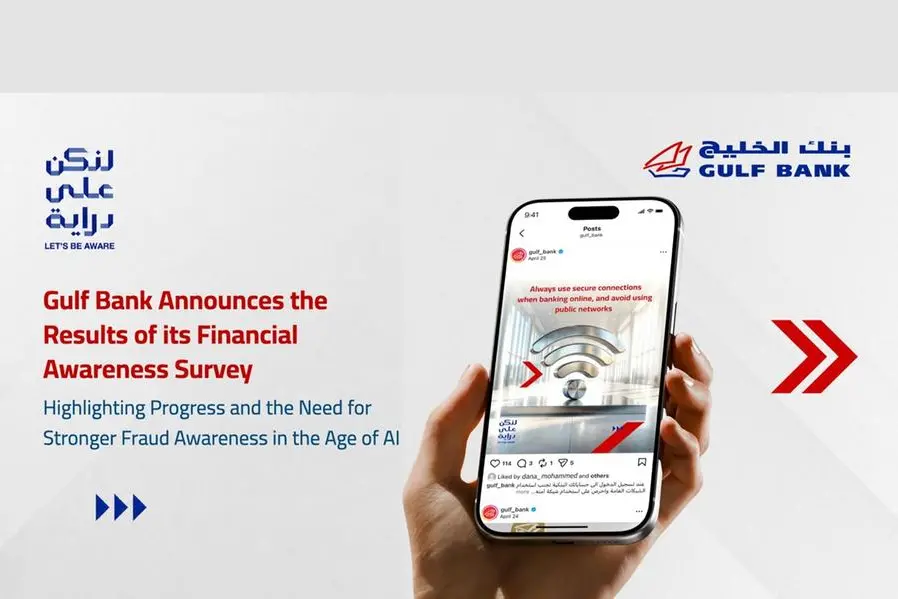
Gulf Bank has announced the findings of a comprehensive financial awareness survey conducted among its customers as part of the nationwide “Diraya” (Let’s Be Aware) campaign led by the Central Bank of Kuwait. Conducted over one month, the study surveyed 189 customers who voluntarily participated through the bank’s Contact Center. The aim was to measure customer awareness of financial risks and digital fraud, while guiding the future direction of the bank’s awareness initiatives.
On this occasion, Najla Aleisa Chief Marketing Officer, Gulf Bank said: “Continuous communication is at the heart of everything we do through ‘Diraya.’ These results show that when awareness messages are delivered consistently, clearly, and through the right channels, people respond positively.”
Gulf Bank reaffirmed its commitment to protecting the financial security and digital well-being of its customers, emphasizing that the “Diraya” campaign remains a core part of that commitment and will continue evolving to address emerging risks effectively.
The “Diraya” campaign reflects Gulf Bank’s commitment to strengthening financial literacy and digital security in Kuwait. As fraudsters increasingly use artificial intelligence to create convincing scams, deepfake communications, and automated attacks, customer awareness has become more important than ever. With digital banking now part of everyday life, Gulf Bank considers informed customers a key line of defense against financial crime. The study provides measurable insight into customer behavior and identifies areas requiring stronger awareness efforts.
The survey examined customer behavior across several areas of digital financial safety, including phishing attempts, public Wi-Fi usage, OTP security, password management, fraud reporting awareness, and sources of financial information.
Study Findings
1. Progress in Recognizing and Ignoring Suspicious Communications
One of the most encouraging findings was that 82% of respondents reported ignoring suspicious messages and links. This reflects a positive behavioral shift and demonstrates the impact of Gulf Bank’s awareness campaigns in helping customers recognize phishing attempts and fraudulent communications.
Phishing remains one of the most widespread forms of digital fraud globally, making this level of customer vigilance an important achievement.
2. Safer Behavior on Public Networks
The study found that 72% of participants avoid using public Wi-Fi networks for banking transactions. This indicates increasing awareness of the risks associated with unsecured networks and the importance of protecting personal financial data.
The result also suggests that awareness messaging around secure digital banking practices has been effective.
3. OTP Sharing: A Persistent and Serious Risk
Despite the positive findings, the study highlighted several concerns requiring immediate attention. Most notably, 16% of respondents admitted sharing their one-time password (OTP) with another person.
Although the percentage may appear limited, OTP sharing presents a serious security threat because OTPs are designed as a final verification layer intended only for the account holder. Sharing them can lead to unauthorized account access and financial fraud. The findings underline the need for stronger and more frequent awareness messaging on OTP security.
4. Password Hygiene: A Significant Gap
The study also revealed that 52% of respondents do not regularly update their passwords or PINs. Maintaining static credentials significantly increases vulnerability to unauthorized access, especially following data breaches or credential theft.
The findings emphasize the need for focused campaigns encouraging customers to adopt stronger password habits and regularly update their login information.
5. Fraud Reporting Awareness: Room for Improvement
Another important finding showed that 50% of participants were unaware of the correct channel for reporting suspected fraud. This gap may delay fraud reporting and reduce the bank’s ability to respond quickly to emerging threats.
In response, Gulf Bank has increased the visibility of fraud reporting information across “Diraya” campaign materials, including SMS messages, in-app notifications, and ATM screens.
6. Social Media as the Dominant Awareness Channel
When asked where they receive financial awareness information, 54% of respondents identified social media as their primary source, ahead of traditional media, SMS, and in-branch communication.
This confirms the importance of Gulf Bank’s social media platforms as a key channel for delivering awareness content. The bank plans to continue investing in engaging and reliable digital communication to maximize customer reach.
Gulf Bank’s Response and Next Steps
Gulf Bank confirmed that the findings will shape the next phase of the “Diraya” campaign. Rather than applying a broad approach, the bank will focus on the highest-risk behaviors identified in the study, particularly OTP security, password management, and fraud reporting awareness.
The bank will develop targeted awareness content tailored to different customer segments and distributed mainly through social media, while also maintaining visibility across SMS, mobile applications, ATM screens, and Contact Center interactions.
Gulf Bank also emphasized its commitment to continuous evaluation and improvement. Future studies will measure progress against the current findings to ensure awareness efforts remain effective and evidence-based.
The Evolving Threat Landscape: AI-Powered Fraud
The importance of the “Diraya” campaign is reinforced by the rapidly evolving fraud landscape. Cybercriminals increasingly use artificial intelligence to launch sophisticated and difficult-to-detect attacks.
AI-generated phishing messages now closely resemble legitimate communications, while deepfake voice technology allows fraudsters to impersonate trusted individuals such as bank employees or government officials. Automated systems can also test stolen credentials rapidly, exploiting weak or unchanged passwords within seconds.
These developments make risky behaviors such as OTP sharing, weak passwords, and using unsecured public networks even more dangerous. Gulf Bank recognizes that awareness campaigns must continue evolving to keep pace with emerging threats and increasingly sophisticated fraud tactics.
Key Findings at a Glance
- 82% of customers now disregard suspicious messages and links
- 72% avoid conducting banking transactions over public Wi-Fi networks
- 16% of respondents admitted to sharing their one-time password (OTP) with third parties
- 52% do not regularly update their passwords or PINs
- 50% were unaware of the correct channel for reporting fraudulent activity
- 54% rely on social media as their primary source of financial awareness information
About Gulf Bank:
Gulf Bank is one of the leading conventional banks in Kuwait with KD 8.0 billion in total assets as of 31 March 2026 and provides a wide range of services including consumer banking, wholesale banking, treasury, and financial services through its large network of 45 branches and over 260 ATMs in Kuwait.
For more information, please visit www.e-gulfbank.com