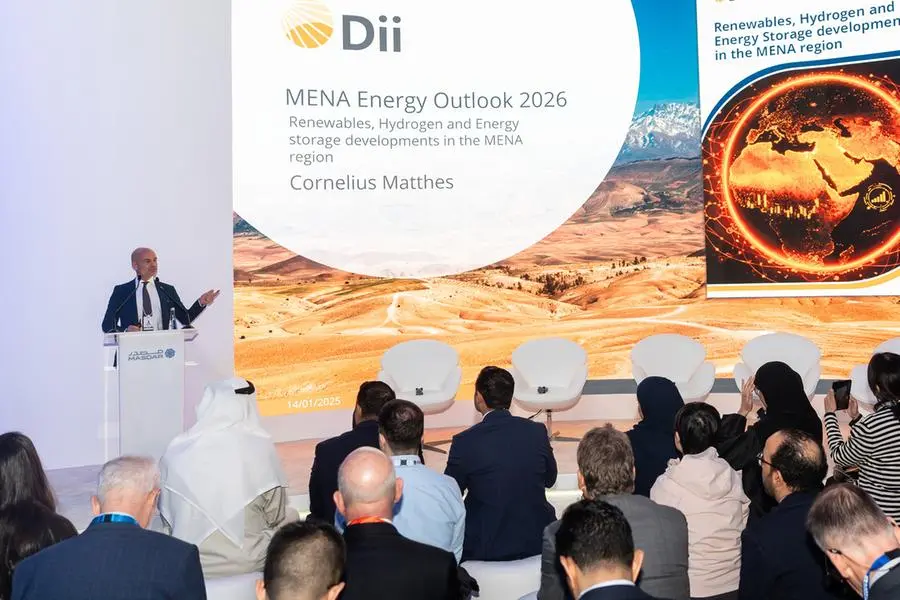
PHOTO
- Middle East North Africa finally enters the “exponential phase of growth” adding 15 GW of solar PV and wind capacity in just one year;
- The UAE continues to set global benchmarks, most notably with the start of construction by Masdar in partnership with EWEC of a 5.2 GW solar park coupled with 19 GWh of battery storage to deliver 1GW baseload renewable power;
- Saudi Arabia breaks global cost records with lowest prices for solar, wind and BESS.
Abu Dhabi: Dii Desert Energy, a leading energy transition think tank in the MENA region since 2009, is delighted to present its flagship annual report ‘MENA Energy Outlook 2026 - Renewables, Hydrogen and Energy Storage Insights 2030’. The key findings of the report were launched at the World Future Energy Summit during the Abu Dhabi Sustainability Week, hosted by Masdar.
Building on the success of the inaugural MENA Energy Outlook 2025 released last year, this 2026 edition serves as a critical update, showing faster growth than even optimistic models. The peer-reviewed report provides a comprehensive status across all relevant energy transformation technologies and countries in MENA. At the same time, a forward-looking picture with different scenarios of the energy transformation in MENA by 2030 has been modelled, leveraging insights from the decade-and-a-half-long Dii Renewable Projects Database, the MENA H2 tracker and the Energy Storage Projects database.
H.E. Eng. Sharif Al Olama, Undersecretary for Energy and Petroleum Affairs, Ministry of Energy and Infrastructure, said: “In light of the dual challenges of climate change and energy security, a rapid and sustained scale-up of renewable energy is no longer optional — it is essential. The UAE recognized this early, and we have committed to tripling our renewable energy capacity by 2030, strengthening our ambition by increasing the renewable energy target from 14.2 gigawatts to a clear target of more than 22 gigawatts of installed renewable energy capacity, including solar, concentrated solar power (CSP), wind, and waste-to-energy within the next five years.”
He added: “As we accelerate this transformation, access to reliable, high-quality data and forward-looking analysis becomes critical to sound policymaking, investment decisions, and regional coordination. In this context, the MENA Energy Outlook 2026 provides valuable and timely insights into the trends, risks, and opportunities shaping the energy future of our region, supporting evidence-based decisions as we build a more secure, resilient, and sustainable energy system.”
Cornelius Matthes, CEO of Dii Desert Energy, said: “2025 can be described as a breakthrough year for the energy transformation in the MENA region, with an unprecedented surge in new capacity for both solar PV, wind and BESS, all purely driven by market factors with the lowest prices globally.”
The report identifies a definitive breakthrough: the MENA region has officially entered an exponential phase of deployment. While it took five years for the region’s installed renewable capacity to grow from roughly 14 GW in 2020 to 30 GW in 2024, the market has surged in 2025, adding nearly 15 GW of new capacity in just 12 months.
Mohammed Jameel Al Ramahi, CEO of global clean energy leader, Masdar, said: “The MENA Energy Outlook 2026 clearly shows that the region has reached a decisive inflection point. The acceleration of renewable energy deployment now underway demonstrates the potential of renewables to outperform conventional energy on cost, speed of deployment, resilience, and returns. This reinforces MENA’s position as global leader in delivering affordable, scalable clean energy, while supporting energy security and long-term economic growth.”
Dii Desert Energy's unique insights and close connection to the latest developments in projects and markets make this report an invaluable resource for understanding the current landscape and future trajectory of renewable energy, hydrogen and energy storage in the MENA region.
Key findings from the report include:
- Entering the exponential phase: The region has added nearly 15 GW of capacity in 2025 alone, a massive leap compared to the growth recorded between 2020 (14 GW) and 2024 (30 GW).
- Projects pipeline surge: The total pipeline of projects has reached 202 GW, surpassing the 'Balanced Transition' scenario (165 GW) forecasted in the previous edition. This represents a significant acceleration, with the identified pipeline growing by 54% from the 131 GW recorded just one year ago.
- UAE & Masdar leadership: the UAE solidifies its position as a renewable energy powerhouse, ranking second in the region with 7.5 GW of operational capacity. This leadership is underpinned by bold new ambitions to reach 22 GW by 2031 and world-record execution: Masdar, in partnership with EWEC, is developing a 5.2 GW solar park integrated with 19 GWh of battery storage, the largest and most technologically advanced system of its kind and a world-first breakthrough for delivering clean around-the- clock power at giga-scale.
- KSA delivers record low prices: Saudi Arabia has emerged as a leader in the region, tripling its installed RE capacity and achieving global record low levelized costs of electricity (LCOE) for both technologies: 1.09 USDcent/kWh for solar PV (dipping below 1 EURcent/kWh) and 1.33 USDcent/kWh for wind. This cost leadership now extends to energy storage with capital costs in the range USD 73–75 per kWh.
- Hydrogen: Development continues at a more realistic pace, but execution is visible. The flagship NEOM Green Hydrogen project is now 80% complete. Furthermore, the newly announced Yanbu Green Hydrogen Hub (developed with Germany's EnBW) reinforces the strong energy connection between the MENA region and Europe.
- Iraq emerges: Iraq is transforming into a gigawatt-scale market, with a target of 12 GW by 2030 and a massive pipeline as well as projects already under construction
- Central Asia catching up: Late starters like Uzbekistan and Azerbaijan are showing dynamic growth. These nations are becoming strategic hubs, with plans to connect central Asia through the Caspian Sea to Azerbaijan, which already has a direct link to the European Union.
You can download the full report at www.dii-desertenergy.org/publications.
https://dii-desertenergy.org/publications/
About Dii Desert Energy
Dii Desert Energy is an independent, international, industry network operating from Dubai. With its footprint in MENA, it is connecting people, countries and clean energy markets globally, paving the way for“net, or sub, zero emission”, secure and affordable energy from the deserts. Dii’s platform of more than 120 companies and organizations from over 36 countries is mobilizing top executives, government decision makers, R&D institutions and academia.
Chiara Aruffo, PhD Director of Research
Dii Desert Energy
E: chiara@dii-desertenergy.org
www.dii-desertenergy.org
Tags: #DiiDesertEnergy #MENA #EnergyOutlook2030
Valeria Aruffo
Executive Director
Dii Desert Energy
E: valeria@dii-desertenergy.org
www.dii-desertenergy.org
About the Ministry of Energy and Infrastructure, UAE:
The Ministry of Energy and Infrastructure (MoEI) plays a key role in putting the energy, infrastructure, housing, and transport sectors on a sustainable, progressive path to achieve the aspirations of the government and enhance the UAE’s competitiveness across these key sectors. To this end, the Ministry forges meaningful partnerships at home and abroad, leverages advanced technologies, and develops innovative solutions. It contributes to the UAE’s efforts to shape a government of the future in line with the 'We the UAE 2031' vision.
About Masdar
Established in 2006, Masdar (Abu Dhabi Future Energy Company) is leading the global energy transformation by investing in, developing and operating renewable energy projects that deliver commercial returns while providing reliable, affordable clean power worldwide.
With over 20 years’ experience in renewables, Masdar has a diverse, derisked portfolio totaling over 65 gigawatts (GW) across six continents, including the world’s fastest-growing energy markets.
Jointly owned by TAQA, ADNOC and Mubadala, Masdar is driving the scale-up of renewables worldwide, targeting a portfolio capacity of 100GW by 2030.
Contact:
For media inquiries, please contact: press@masdar.aeF
For more information, please visit: https://www.masdar.ae and connect: facebook.com/Masdar.ae and twitter.com/Masdar