PHOTO
Hamdan bin Rashid: The Authority plays a key role in achieving economic diversity to prepare for the post-oil phase.
23 business community workshops to clarify tax laws and obligations conducted
All businesses must register for VAT if total revenues exceed the threshold of AED 375,000.
Businesses will be able to register for VAT during the third quarter of 2017
Selective tax will be implemented in the last quarter 2017, and VAT will be implemented in January 2018.
5% VAT to be imposed on the sale of goods and services, 100% selective tax on tobacco and energy drinks and 50% on soft drinks.
Dubai, May 25, 2017
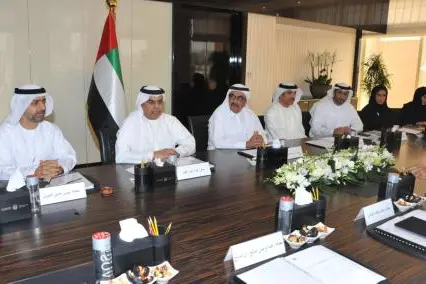
His Highness Sheikh Hamdan bin Rashid Al Maktoum, Deputy Ruler of Dubai and UAE Minister of Finance, headed the first meeting of the Federal Tax Authority (FTA) Board of Directors, which was held at the Ministry of Finance’s (MoF) premises in Dubai. The meeting marked the FTA’s first step in developing its strategic and operational plan, to support the UAE’s economic diversification. During the meeting, HE Obaid Humaid Al Tayer, Minister of State for Financial Affairs, was elected as Deputy Chairman of the FTA’s Board of Directors.
The meeting was attended by HE Obaid Humaid Al Tayer, Minister of State for Financial Affairs, HE Younis Haji Al Khoori, Undersecretary of MoF, and members of the Board of Directors which include: HE Sultan Ahmed bin Sulayem, DP World Group CEO & Chairman, Chairman of Ports, Customs and Free Zone Corporation (PCFC); Sheikh Mohammed bin Abdullah Al Nuaimi, Chairman of Ajman Ports and Customs Department; HE Mohammed Sultan Al Hameli, Director General of the Department of Finance – Abu Dhabi (DoF); HE Mohamed Khadem Al Hameli, Director General of the General Administration of Customs – Abu Dhabi; HE Abdulrahman Saleh Al Saleh, Director-General of DoF – Dubai; HE Waleed Ibrahim Al Sayegh, Director-General of the Central Finance Department of Sharjah; HE Khalifa Saeed Ghanim, Director-General of the Department of Finance and Administration of Umm Al Quwain; HE Yousuf Ali Al Blooshi, Acting Director General of DoF - Ras Al Khaimah; HE Ali Murshed Al Marar, Executive Vice President for Administrative Affairs at Abu Dhabi National Oil Company (ADNOC); HE Youssef Abdullah Al Awadi, Deputy Director of DoF in Fujairah; HE Saeed Rashid Al Yateem, Assistant Undersecretary of Resources and Budget Sector at MoF; Ms. Azza Mohammed Al Suwaidi, Director of Revenue Development at MoF; Ms. Alia Mohammed Al-Marmoum Director of Policy and Customs Affairs at the Federal Customs Authority; and Mr. Ali Khalfan Al Dhahiri, Deputy Director of Legal Affairs Department of Ministry of Presidential Affairs.
HH Sheikh Hamdan bin Rashid Al Maktoum highlighted the FTA’s role in managing, collecting and implementing federal tax, and diversifying the UAE’s economy by adopting international best practices to increase non-oil revenues, reduce oil dependency and prepare for the post-oil phase.
His Highness said: "The establishment of the Federal Tax Authority comes under the Federal Law by Decree No. 13 of 2016, issued on 26 September 2016. The Authority will provide the necessary support for taxpayers to commit to tax laws and procedures which will govern the process between the Authority and taxpayers."
HH Sheikh Hamdan highlighted the UAE’s adoption of best practices in implementing taxes and collecting them electronically. HH Sheikh Hamdan also stressed the UAE’s efforts in facilitating the FTA’s registration channels for tax purposes, as well as working to the highest levels of transparency with tax payers, and standards of auditing and assessing tax returns.
During the meeting, HH Sheikh Hamdan clarified the tax laws and regulations which include tax procedures, VAT, and selective tax; prepared in line with the UAE Government’s vision to maintain the country’s competitiveness in business practices. This will be achieved through facilitating procedures for tax payers, communicating with the FTA for technical assistance and through FTA’s efficiency in delivering tax returns, processing taxes online and implementing auditing procedures.
HH Sheikh Hamdan also reviewed the developments of the draft tax laws on a UAE and GCC level. HH clarified that following the agreement of the two unified VAT and selective tax agreements amongst GCC Ministers of Finance, two federal decrees have been issued for approval from the GCC General Secretariat.
His Highness said that the draft law of tax procedures is in its final stages of the legislative process and is being issued and published. The VAT draft law is being discussed by the Legislation Technical Committee to be approved by UAE Cabinet, followed by the selective tax draft law which will be discussed in the future by the Committee.
HH Sheikh Hamdan also highlighted that MoF launched the first phase of the awareness campaign for taxes in the UAE on 21 March 2017. The first phase concluded with 23 workshops for the business community, to clarify tax laws and obligations such as: registering at the Authority for tax purposes, calculating and imposing taxes, submitting tax returns, and paying taxes in line with the specified deadlines.
VAT:
VAT will be levied on the sale of all goods and services unless they are subject to a zero rate or tax exemption such as food, commercial property, hotel services, etc. VAT will either be the basic 5% tax or zero-rate tax, which is tax-free. Businesses will be able to recover VAT on the purchase of goods and services used for business purposes. Businesses exempt from VAT will not be able to recover the tax incurred on the cost of a good or service that is not exempt.
Zero-rated supplies include local transportation, imports and exports, the majority of healthcare and education services, investment gold, and sales and leasing of residential properties i.e. the sale or lease of a property for the first time within 3 years of completion of construction.
Some financial services, residential buildings, and vacant land will also be exempted.
Businesses with taxable goods over the threshold of AED 375,000 will be required to register. Businesses with taxable supplies below AED 375,000 but over AED 187,500 will also have the option to register. Businesses not required to register have non-taxable goods and services that are subject to zero-rate or exempted from taxation.
The Federal Tax Authority will open registration for businesses with taxable income exceeding the yearly threshold in the third quarter of 2017. Registration will be compulsory during the fourth quarter of 2017.
VAT will be applied on the 1st of January 2018. Concerned businesses must have completed their registration beforehand.
Selective Tax:
Selective tax will be imposed on specific commodities which are harmful to human health, including tobacco and energy drinks, which will be subject to 100% tax, while 50% tax will be imposed on soft drinks. This tax will be charged as a percentage of the pre-tax retail price, and will have to be paid at the time they are imported, or once they leave the factory if locally manufactured.
The payment of taxes is suspended when excisable goods are placed in a tax warehouse. In these cases, the selective tax will be imposed once the excisable goods are released for consumption.
The FTA will open registration for businesses that import, produce or store selective goods during the third quarter of 2017. Registration will be compulsory during the fourth quarter of 2017.
Selective tax will be implemented in the last quarter of 2017.
-Ends-
For further information please contact:
Mary Khamasmieh
Weber Shandwick
Mobile: +971 50 2731 753
Email: mkhamasmieh@webershandwick.com
Mira Assaf
Weber Shandwick
Mobile: +971 50 312 3518
Email: MAssaf@webershandwick.com
Mirna Hammoud
Weber Shandwick
Mobile: +971 56 371 0116
Email: MHammoud@webershandwick.com
© Press Release 2017