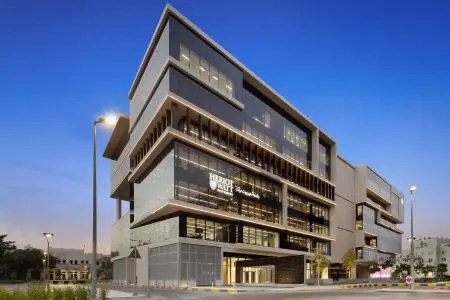
PHOTO
- It is the first and only architecture programme in Dubai to receive this accreditation
Dubai, UAE – Heriot-Watt University’s BA (Hons) Architecture degree has earned the Royal Institute of British Architects (RIBA) Part 1 accreditation, which provides students with the opportunity to develop core architectural skills and understanding, prepares for post Part 1 practical experience, further study or to undertake full time work. It is the first four-year programme in the UAE to receive a RIBA Part 1 honour and the only one in Dubai to receive this validation.
Speaking on receiving the accreditation, Matt Smith Associate Head of School, School of Energy, Geoscience, Infrastructure and Society (EGIS), at Heriot-Watt University Dubai, said, “It is a privilege for our BA (Hons) Architecture degree to be accredited by the Royal Institute of British Architects. As we continue to equip students with the necessary architectural knowledge, be it theoretical or practical, it definitely is a proud moment. Furthermore, the accreditation will serve as a benchmark for the courses that architecture students need to complete to have a successful career in the field. Our courses are delivered by best-in-class faculty, and the accreditation is a testament to our teaching excellence.”
“As the second programme to receive this accolade in the UAE, it gives me immense pleasure in congratulating the faculty and staff of Heriot-Watt University Dubai for making this happen. As a global body, RIBA maintains the highest standards of professional conduct for architects from across the world. We hope to continue to prepare our students to be part of the growing workforce through this validation,” he added.
Dr. Harpreet Seth, Head of Architecture at Heriot-Watt University Dubai, said, “We are delighted to receive the much-awaited validation by RIBA, the first in Dubai. The Architecture programme at Heriot-Watt University, one of the UK’s and UAE’S leading institutions for multidisciplinary teaching and research, is designed to operate as a nexus between the global and local contexts. RIBA accreditation reinforces the programme’s aim to educate critical thinkers, that is fundamental to addressing critically important contemporary challenges facing humanity. UAE as a fast-developing nation inspires a new generation of creative professionals, from across the world, making UAE their long-term atelier. It is the new Constantinople of the world at a crossroad between the East and the West, offering opportunities for our fresh graduates to create architecture for change and positive impact. We look forward to continuing our collaborations with RIBA Gulf and RIBA International.”
Students at Heriot-Watt work across technical and humanities disciplines, testing the knowledge and skills from the architectural course through a series of core design projects taught in a studio environment. The course also provides students with key analytical and practical skills and knowledge required in line with the RIBA Part 1 level, the first step towards formal chartership as an architect. The combination of lectures and studio delivery encourages excellent self-motivation and the development of transferable skills that are valuable across the built environment industry.
After graduating with the Architecture degree, Heriot-Watt students are equipped to work for consultants, contractors, or government at the architectural assistant level. They can also apply for a RIBA Part 2 postgraduate course at international universities, which provides enhanced architectural knowledge and project complexity. As the only other accredited university in the UAE and the first one in Dubai, Heriot-Watt is now in the ranks of only seven accredited universities in the Middle East. The accreditation is unconditionally validated and subject to ratification by the RIBA Education Committee.
As a peer-reviewed process that monitors compliance with internationally recognised minimum standards in architectural education, RIBA encourages excellence and diversity in student education. In addition, RIBA serves members and society to deliver better buildings and places, stronger communities, and a sustainable environment. As an inclusive, ethical, environmentally aware, and collaborative global organisation, RIBA creates architectural societies that are standardised and serve the communities better.
According to an IBISWorld report, the total revenue of the architecture industry was estimated to be USD292 billion in 2019 globally. In fact, according to Statista, closer home in the UAE the industry revenue was USD 3.1 billion. The growing sector continues to be one of the most sort after educational paths for young minds. Heriot-Watt University Dubai remains committed to building the next generation of architects that will contribute to the structural landscape and do so in a sustainable manner.
© Press Release 2021
Disclaimer: The contents of this press release was provided from an external third party provider. This website is not responsible for, and does not control, such external content. This content is provided on an “as is” and “as available” basis and has not been edited in any way. Neither this website nor our affiliates guarantee the accuracy of or endorse the views or opinions expressed in this press release.
The press release is provided for informational purposes only. The content does not provide tax, legal or investment advice or opinion regarding the suitability, value or profitability of any particular security, portfolio or investment strategy. Neither this website nor our affiliates shall be liable for any errors or inaccuracies in the content, or for any actions taken by you in reliance thereon. You expressly agree that your use of the information within this article is at your sole risk.
To the fullest extent permitted by applicable law, this website, its parent company, its subsidiaries, its affiliates and the respective shareholders, directors, officers, employees, agents, advertisers, content providers and licensors will not be liable (jointly or severally) to you for any direct, indirect, consequential, special, incidental, punitive or exemplary damages, including without limitation, lost profits, lost savings and lost revenues, whether in negligence, tort, contract or any other theory of liability, even if the parties have been advised of the possibility or could have foreseen any such damages.