PHOTO
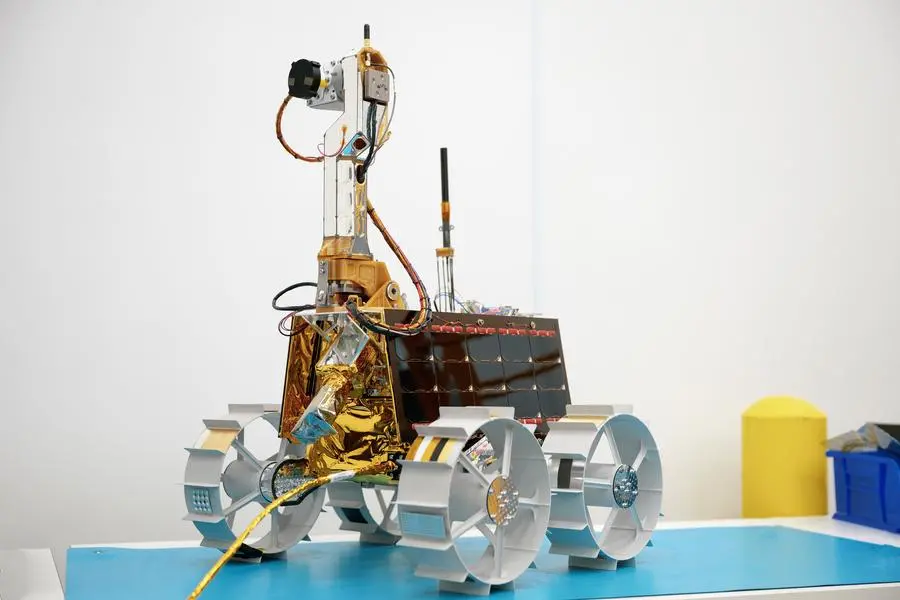
Dubai – UAE: The Mohammed Bin Rashid Space Centre (MBRSC) successfully conducted a new series of tests on Rashid Rover 2 in the USA, in collaboration with Firefly Aerospace as part of the Emirates Lunar Mission’s ongoing preparations for launch to the far side of the Moon onboard Firefly’s Blue Ghost Mission 2 in 2026.
The comprehensive tests included electrical, software, and mechanical interface checks with Firefly’s Blue Ghost lander, as well as wireless performance testing between the rover and the lander. Furthermore, the Emirates Lunar Mission team worked alongside Firefly Aerospace’s engineers to perform deployment and drive-off trials, to ensure the successful release of the Rashid Rover 2 onto the lunar surface under different scenarios and conditions.
These tests represent a crucial step in validating the integration between the rover and Firefly Aerospace’s lunar lander, ensuring seamless operations during the journey to the Moon and after the rover’s arrival on the lunar surface.
Dr. Hamad AlMarzooqi, Project Manager, Emirates Lunar Mission, MBRSC said, “These latest tests mark an important milestone to ensure a seamless integration between the rover and the lander systems. Our joint efforts with Firefly Aerospace are guided by a shared focus on precision and innovation, ensuring the mission’s scientific and technical goals are achieved with the highest standards of reliability. Rashid Rover 2 embodies the dedication of our engineers and the UAE’s continued drive to contribute to global lunar exploration through purposeful, knowledge-led progress.”
The Rashid Rover 2 will be deployed to the far side of the Moon on Firefly Aerospace’s Blue Ghost lander. Alongside payloads from Australia, the European Space Agency (ESA), and NASA, the Rashid Rover 2 will join Blue Ghost Mission 2 in 2026, which will be Firefly’s second lunar mission following Blue Ghost Mission 1 in March 2025 that achieved the first successful commercial Moon landing.
Once on the Moon, Rashid Rover 2, which has been equipped with multiple cameras and scientific probes will study its plasma environment, geology, and thermal conditions. The rover will also investigate the properties of lunar soil, surface structure temperatures, and the lunar photoelectron sheath, which will provide valuable insights to support future in-situ resource utilisation and advance further exploration of deep space.
Farah Zuberi, Director of Spacecraft Mission Management, Firefly Aerospace said, “Firefly is proud to onboard the MBRSC Rashid Rover 2 on Blue Ghost Mission 2, which has evolved into an international mission representing countries across the globe. Now that the rover has been successfully delivered and tested in our cleanroom, we’re one step closer to deploying the rover on the lunar surface and unlocking new insights on the far side of the Moon.”
The Emirates Lunar Mission is funded by the ICT Fund of the Telecommunications and Digital Government Regulatory Authority (TDRA), which aims to support research and development in the ICT sector in the UAE.
For Media Queries:
MBRSC Media Team - mbrsc@quillmena.com
ABOUT MOHAMMED BIN RASHID SPACE CENTRE (MBSRC):
MBRSC is an advanced scientific and technological hub, responsible for making the UAE a world leader in space services and exploration.
Starting with a small team of dedicated engineers in 2006, MBRSC has grown into the incubator of the UAE National Space Programme, fostering scientific research, and building a sustainable space sector in the UAE. MBRSC is home to the Satellite Development Programme, UAE Astronaut Programme, and Emirates Lunar Mission, among others. Under its satellite programme, the Centre has built, developed, and operated several Earth observation satellites, including DubaiSat-1; DubaiSat-2; KhalifaSat, the first satellite that was fully built by Emiratis; MBZ-SAT, the most advanced satellite in the region and Etihad-SAT, the Centre’s first SAR satellite.
Under the UAE Astronaut Programme, MBRSC currently has four astronauts, two of who have undertaken missions to the International Space Station, including the longest Arab space mission in history by H.E. Dr. Sultan Saif AlNeyadi.