PHOTO
Dubai, UAE : Artificial limbs made from plastic water bottles that could save healthcare providers millions of dollars and help tackle pollution at the same time were showcased by De Montfort University Leicester (DMU) at Expo2020 yesterday.
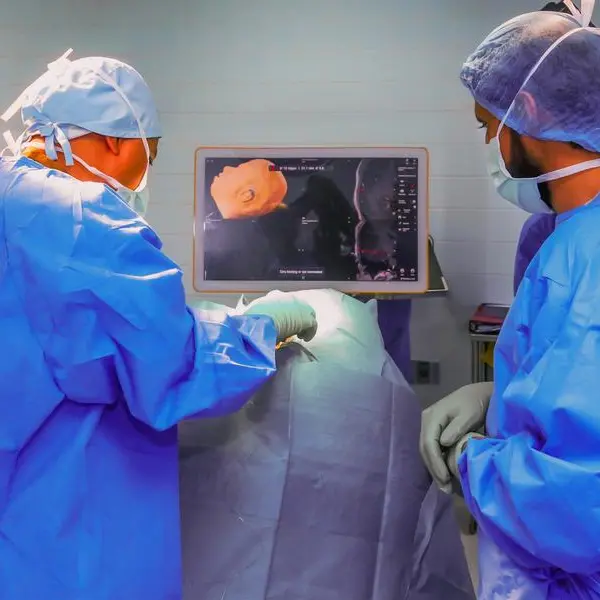
Dr Karthikeyan Kandan, senior lecturer in Mechanical Engineering at DMU, a founding partner of the UK Pavilion, found he could grind the plastic bottles down and use the granulated material to spin polyester yarns. The could then be heated up to form a solid yet lightweight material that can be moulded into prosthetic limbs.
The cost of producing a prosthetic socket this way is just £10, compared to the current industry average of around £5,000 each. This breakthrough could help address the gap between high-performance prosthesis that cost thousands of pounds and affordable prostheses that lack quality and durability – as well as helping to solve the problem of plastic pollution.
“Upcycling of recycled plastics and offering affordable prosthesis are two major global issues that we need to tackle. We wanted to develop a prosthetic limb that was cost effective yet comfortable and durable for amputee patients,” Dr. Kandan said at a demonstration organised at the UK Pavilion as part of the Arab Health Reception.
It is estimated that more than 100 million people worldwide have had a limb amputated. Diabetes and traffic accidents are two of the biggest causes of lower-limb amputation – both of which are continuously on the rise. Meanwhile, around one million plastic water bottles are bought every minute yet only 7% are recycled, with the rest leaking into landfill or the ocean.
“There are some really scary statistics about how much plastic there is polluting our oceans and the planet. One of the biggest problems is that the plastic bottles cannot be recycled and re-used for the same purpose, so it’s up to us to find new uses for them. Our design has significant potential to promote the circular economy for plastic by using recycled plastic yarns to manufacture affordable prosthetic limbs – especially for amputees in developing countries,” Dr. Kandan added.
-Ends-
© Press Release 2022
Disclaimer: The contents of this press release was provided from an external third party provider. This website is not responsible for, and does not control, such external content. This content is provided on an “as is” and “as available” basis and has not been edited in any way. Neither this website nor our affiliates guarantee the accuracy of or endorse the views or opinions expressed in this press release.
The press release is provided for informational purposes only. The content does not provide tax, legal or investment advice or opinion regarding the suitability, value or profitability of any particular security, portfolio or investment strategy. Neither this website nor our affiliates shall be liable for any errors or inaccuracies in the content, or for any actions taken by you in reliance thereon. You expressly agree that your use of the information within this article is at your sole risk.
To the fullest extent permitted by applicable law, this website, its parent company, its subsidiaries, its affiliates and the respective shareholders, directors, officers, employees, agents, advertisers, content providers and licensors will not be liable (jointly or severally) to you for any direct, indirect, consequential, special, incidental, punitive or exemplary damages, including without limitation, lost profits, lost savings and lost revenues, whether in negligence, tort, contract or any other theory of liability, even if the parties have been advised of the possibility or could have foreseen any such damages.