PHOTO
WATG is delighted to share an update on their work with the Egyptian government to lead an internationally significant master-planning initiative for the Giza Pyramids region. This project represents a key cornerstone of Egypt’s nationwide tourism vision and economic growth strategy.
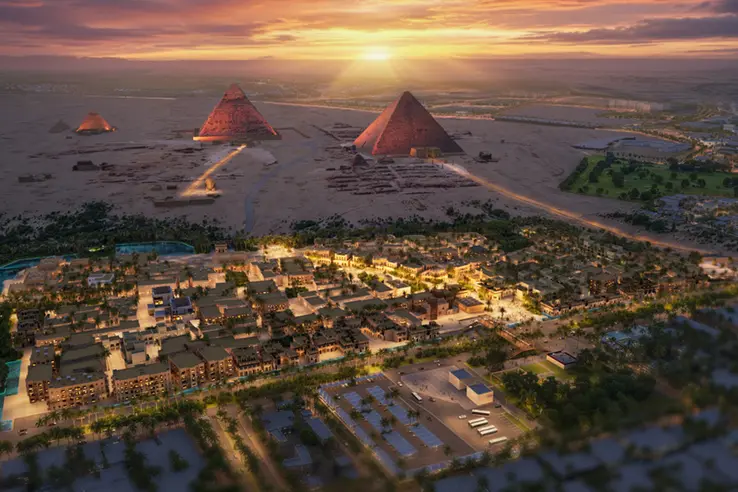
From WATG’s advisory and planning teams, the proposed master plan will reimagine a significant area covering the Western Desert plateau overlooking the Nile Valley, with the aim of delivering a more impactful and sustainable visitor experience. The plan aims to conserve one of the world’s most well-known UNESCO sites and culturally significant landscapes, while supporting Egypt’s tourism boom, infrastructure development, and local communities.
Integrating Global Best Practice with Local Expertise
This project offers a once-in-a-lifetime opportunity to protect these major cultural assets and reimagine how both residents and travelers can engage with this iconic aspect of Egypt’s past.
WATG’s multi-disciplinary team includes international heritage planners and local Egyptologists. By integrating global best practices with deep local expertise, the team has developed a master plan that is both visionary and sensitive to the unique historic and cultural fabric of the region.
Over two intensive site visits, WATG has conducted detailed analysis of the plateau, necropolises, and floodplain, covering all major sites — Giza, South Saqqara, Dahshur — and their surrounding communities. The plan also emphasizes an implementation framework, which ensures an adaptable, future-proofed process that enables Egypt to evolve this region sustainably for decades to come.
This week, the WATG team will present the final package to the Ministry of Tourism, the Ministry of Housing, New Urban Communities Authority, the Deputy Governor of Giza, and others. The master plan will also be presented to Prime Minister Mostafa Madbouly.
Rob Sykes, Associate Principal and Director of Advisory at WATG, comments: “It is a rare privilege to engage with a place that holds such immense meaning for humanity. Helping to reimagine this cultural landscape — with respect, sensitivity, and a commitment to its long-term stewardship — has been an honour for everyone on our team. We are excited to have unlocked a wide range of compelling tourism investment opportunities, and we look forward to working with the private sector to realise their potential in the coming years.”
Bassem Fahmy, Head of the Scientific Committee, states: “This project is a strategic move to protect, organize, and elevate the area sustainably and competitively on a global scale, while carefully unlocking opportunities for investment, infrastructure, and community benefits. Our main focus now is to turn these strategies into concrete actions, ensuring every development honours the site's sanctity while providing the modern efficiency needed to handle millions of future visitors.”
Major steps in this development are already being made, with the opening of the Grand Egyptian Museum in November 2025. Looking ahead, this plan is designed to guide tourism development over the next 15 years and contribute to Egypt’s 2040 vision.
For further media inquiries
Alexandra Hellyer – Regional Marketing Manager EMEA, WATG
E: ahellyer@watg.com
M: +44 (0)753 422 2097
About WATG and Wimberly Interiors
Founded in 1945 and celebrating its 80th anniversary this year (2025), WATG is one of the world’s leading design firms specializing in hospitality, entertainment and gaming, urban and mixed-use, branded residential, renovation and repurposing, and multifamily residential design. They are widely recognized within the industry, garnering accolades and features in prominent publications and awards programs such as Condé Nast Traveler, Travel + Leisure, Forbes, Hospitality Design magazine, AHEAD, Gold Key Awards, and the World Architecture Festival (WAF). WATG’s interior design firm, Wimberly Interiors, launched in 2008 and is consistently ranked among the Top 20 in Interior Design magazine's Hospitality Giants survey.
Since George “Pete” Wimberly founded the firm in Honolulu in 1945, WATG has grown to offer integrated design services, including Advisory, Planning, Architecture, Landscape Architecture, and Interiors, for urban, tourism, and resort destinations. WATG and Wimberly Interiors operate offices in Honolulu, Tustin (California), Los Angeles, Dallas, Atlantic City, New York, London, Singapore, and Shanghai. They are best known for creating internationally acclaimed destinations in more than 170 countries across six continents. WATG’s projects are celebrated not only for their timeless design and strong sense of place but also for their proven bottom-line success.
Over the decades, WATG and Wimberly Interiors have designed more than 500 built projects on behalf of distinguished clients and brands, including Accor, Aspen Hospitality, Belmond, Blackstone Group, China Jinmao Group, China Merchant, Chimelong, Emaar, Four Seasons, Hilton Worldwide, Huafa Group, Hyatt Hotels Corporation, InterContinental Hotels Group, intu Properties, JLL, Kempinski, Keppel Land, Mandarin Oriental Hotel Group, Marassi, Marriott International, MGM Resorts International, Minor Hotels, Mont Choisy Group, New Century Tourism Group, RCD Hotels, R.D. Olson Development, The Red Sea Development Company, Rosewood Hotel Group, Shangri-La Hotels and Resorts, Suning, Viceroy Hotels & Resorts, and Walt Disney Parks and Resorts. Learn more at watg.com and watg.com/wimberly.
Introduction
Egypt is embarking on an ambitious nationwide initiative to reimagine a thriving tourism industry. As a key element of its economic growth strategy, significant investments are now being channelled into destinations across the country, reflecting a bold vision to strengthen Egypt’s global tourism offering.
Within this context, the Egyptian government has recognised that the value and integrity of the Giza Pyramids destination including one of the world’s most iconic UNESCO World Heritage Sites: Memphis and its Necropolis, the Pyramid Fields from Giza to Dahshur has been diminished over time due primarily to uncontrolled urban sprawl surrounding this globally significant cultural landscape. This acknowledgement presents a major opportunity to revitalize these cultural heritage assets and the surrounding urban and agricultural areas, helping it to become a world-class destination that appeals to both cultural heritage tourists and travelers of every kind.
This project represents a once-in-a-lifetime opportunity for WATG’s planning, advisory team and conservation team, who are leading the charge on this venture of extraordinary national and global significance for all of humanity.
Trusted to Protect the Past and Shape the Future
WATG’s planning and advisory teams were originally appointed in 2024 by the government, tasked with developing a major tourism masterplan around the perimeter of the 162 sqm UNESCO WHS — including the Great Sphinx and the Great Pyramid of Khufu, the only remaining Wonder of the Ancient World — to influence a more holistic, diverse, and sustainable destination experience in this part of Egypt.
The master plan framework area spans both brownfield and greenfield sites on the plateau of the Western Desert, overlooking the Nile River valley and the city of Cairo. It involves complex challenges around cultural heritage and environmental conservation, community development and growth, and infrastructure and land ownership, while balancing the needs of a wide range of stakeholders.
WATG has been chosen to lead this internationally significant master plan for our integrated advisory and planning approach. As global tourism specialists, we combine international experience with a genuine commitment to understand and respect the unique local culture and context of every project.
Having worked in Egypt for many years, WATG has witnessed the country’s remarkable transformation firsthand, driven by a new generation seeking higher quality, authentic experiences and a more sustainable future. Tourism sits at the heart of Egypt’s economic ambitions, and the government is committed to developing this sector as a key driver of growth. Despite its global prominence, unparalleled history and vast potential, the Pyramids region faces significant challenges related to the urban sprawl, infrastructure and cultural heritage conservation.
WATG has been engaged to identify the key issues, consider optimal tourism and development potential, and deliver a clear roadmap for the region’s future. We’ve created an implementable framework that can protect the heritage assets, shape governance, strengthen public engagement, and provide for a more robust tourism potential. Rather than delivering a fixed plan, we have offered a more future-proofed process; something that is adaptable and that can evolve as time goes on.
Our advisory arm understands how developers think, ensuring our work goes beyond design. By defining the key development pillars and aligning them with strategic priorities, we are delivering solution that enhances Egypt’s global tourism appeal while ensuring meaningful, lasting impact for its people, cultural heritage treasures and economy.
A Collective Effort: Bringing Together Global and Local Expertise
The international significance of this project necessitated bringing together a team of the leading experts in the world, including locally based subject matter experts to complement our international team members. Despite being on opposite sides of the world, WATG’s Tustin HQ and London offices joined forces to provide a seamless integrated approach. Together these teams carefully selected our cultural heritage experts (PUD), branding consultants (Luxury Partners), and engineers (Shaker) to ensure we had the best possible team for this job, while also considering multiple stakeholder groups.
While WATG brings a global perspective, it was our local teams’ decades of experience within the region and vast experience that provided the best possible understanding of the cultural context, ensuring authenticity and sensitivity within our proposed master plan. The insights of our clients, community members, and regional experts were central to shaping a plan that is both visionary and grounded in authenticity and integrity while respecting the international guidance and best practices of UNESCO and ICOMOS (International Council of Monuments and Sites). Local Egyptologists Dr. Fekri Hassan and Dr. Michael Jones, together with heritage architect Professor Dalila ElKerdy were brought onto the team under the guidance of Amr Attia, and they provided invaluable insight to help the team understand the true value and cultural resonance of the entire pyramids cultural landscape.
The cultural heritage component of the project was overseen by Andrew Anderson, our landscape architecture and heritage planning consultant, who worked closely with the planning team from the onset of the project to ensure that the recommendations of the master plan align with UNESCO World Heritage guidelines and will result in a newfound reverence and respect for the necropolises and pyramids in the study area that span the 31 dynasties of Ancient Egypt. His dual understanding of both the cultural heritage context and WATG’s planning methodology allows him to bridge gaps between what we know and what we need to learn, making him a vital link within the project. Together with the local experts and the WATG planning team, Andrew identified the larger cultural landscape context of the study site spanning millennia from the prehistoric era to present day perched atop the escarpment of the Western Desert and overlooking the agricultural landscape of the Nile River valley. The resultant master plan reunifies a fragmented series of necropolises and pyramids, through a proposed series of differentiated tourism gateways, while offering a renewed tourism offering without equal in the world that seeks to not only better protect the heritage assets but tell their full stories.
This project represents an unprecedented scale for us, and while no two tourism regions are alike, we drew lessons from successful global WATG precedent projects, including the Red Sea Project and the recently completed Sharaan National Park master plan in Saudi Arabia. Our goal has always been to find the right balance: preserving and improving the authenticity and integrity of UNESCO World Heritage Sites while creating meaningful, sustainable tourism opportunities that generate long-term economic value and offer unforgettable, respectful visitor experiences.
During the team’s most recent site visit, we facilitated a workshop with our direct client and participated in a cross-Ministry platform that included representatives from the Giza Governor’s Office, the Ministry of Tourism, the Ministry of Agriculture, the Ministry of Water, and others. This level of collaboration signals a promising move toward a more integrated and unified approach to the project’s future.
Our Approach: From Discovery to Design
The “inside out” strategy for this project has required a deep understanding of the site, its heritage assets and its wider context. From the outset, our focus has been on understanding the necropolises, pyramids and cultural landscapes within and surrounding the existing boundary of the UNESCO World Heritage Site: their locations, significance, relationships to the ancient capital at Memphis, and how they tell the story of the 31 dynasties of Ancient Egypt. This understanding was layered on top of literally the palaeolithic and neolithic history of the study area, and the story continued after the dynastic era of Ancient Egypt through the Roman and byzantine periods, Islamic dynasties, Ottoman rule and into the modern Arab Republic of Egypt.
During the first eight weeks, our team conducted an intensive analysis guided by the local heritage team, gathering insights into each necropolis, the overall cultural landscape and the relationships between the plateau and the Nile River floodplain below. We wanted to know who built it, why, and how it fits within the broader story of Egyptian civilization. This research has allowed us to identify the main necropolises and determine which elements would most appeal to visitors. From there, we established the key tourism gateways to connect travelers with these experiences, without compromising on the protection and conservation of cultural heritage.
We spent a lot of time interacting with our local Egyptology expert team on the ground over two trips, exploring every major site, from the towering pyramids of Giza to the necropolises of South Saqqara and Dahshur, along with their surrounding tourism villages. Each location revealed distinct environmental and cultural conditions: Giza’s urban edge, Saqqara’s agrarian setting, and Dahshur’s unique environmental position between the desert and the Nile River valley.
Alongside this, we have crafted a tourism development vision for three priority action areas, defined by the government, spanning some 8,000 acres. Our Advisory team worked closely with Egypt’s main tourism bodies, pouring over projected visitor numbers, potential keys needed, and future demand. This data shaped a robust bottom-up framework for development, which our planning team used to shape the overall tourism master plan and action areas.
Looking Ahead
This week, the WATG team will present the final package to the Ministry of Tourism, the Ministry of Housing, New Urban Communities Authority, the Deputy Governor of Giza, and others. The master plan will also be presented to Prime Minister Mostafa Madbouly.
Major steps in this development are already being made, with the opening of the Grand Egyptian Museum in November 2025. Looking ahead, this plan is designed to guide tourism development over the next 15 years, contributing to Egypt’s 2040 vision. While we are currently marking the completion of our planning and advisory role, it also represents the beginning of the project’s implementation. We hope our recommendations, including phasing strategies and governance frameworks, will inform the next stages of development.
We are already exploring ways to support further planning and asset development initiatives and look forward to the possibility of continuing our involvement as custodians of the tourism master plan, ensuring its vision is carried forward with integrity and care.