PHOTO
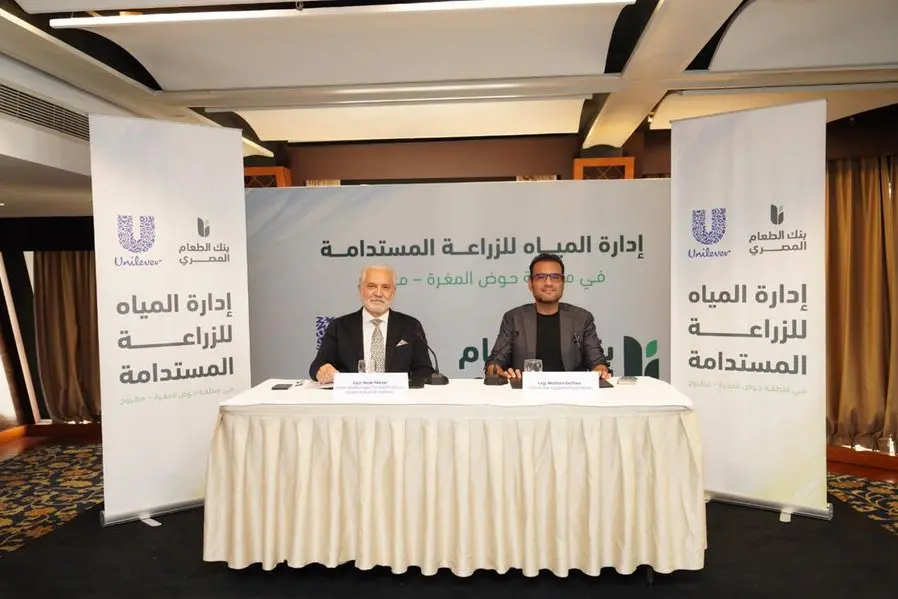
Cairo, Egypt – Unilever Egypt, in partnership with the Egyptian Food Bank (EFB), has launched the Sustainable Agricultural Water Efficiency Project for Farmers in the Moghra Aquifer Region, Matrouh Governorate. This marks the first programme of its kind by Unilever in Egypt, aimed at conserving water resources and promoting their efficient use, in line with the company’s Sustainability Goals.
The launch ceremony was attended by representatives of the Ministry of Social Solidarity and Ministry of Agriculture and Land Reclamation, underscoring government support for the project and its alignment with national water management priorities and sustainability goals.
The 12-month project, fully funded by Unilever and implemented by EFB, targets 153 farmers in its first phase across approximately 200 feddans in Al Alamein, Matrouh Governorate. The programme will introduce smart irrigation, fertigation systems, and farmer training on sustainable practices to conserve water, reduce agricultural consumption, and promote forestation. Accordingly, it is expected to deliver measurable savings around 720,000 m³ of water annually, with the potential to scale up to 5 million m³ per year through the continued adoption and implementation of the practices introduced by the project. To put it into context, 720,000 m³ is equivalent to the annual drinking water needs of almost 1 million people. Moreover, promoting efficient irrigation and climate-smart agricultural practices also strengthens farmers’ resilience to drought and extreme weather, ensuring more stable harvests even under challenging conditions.
The initiative aligns with Unilever’s Sustainability Goals, which encompass Climate, Nature, Plastics, and Livelihoods. As part of the Nature pillar, it focuses on conserving water through systems and practices that protect the environment. In doing so, it helps strengthen the resilience and regenerative potential of agriculture, while safeguarding green spaces and preventing deforestation.
Tackling water scarcity through sustainable agriculture
The Moghra Aquifer, one of the primary irrigation sources for Matrouh’s farmers, is under increasing pressure due to over-abstraction, land reclamation, and population growth. By optimising existing drip irrigation systems and equipping farmers with knowledge and training, the initiative aligns with Egypt’s New Delta Strategy, the Alliance for Water Stewardship (AWS) Framework, and the Volumetric Water Benefit Accounting (VWBA) methodology.
Cem Tarık Yüksel, General Manager for North Africa, Levant & Iraq at Unilever, said: “Water stewardship is critical for water-intensive industries and Egypt’s agricultural future. With this project, we aim to advance sustainability efforts beyond the walls of our factories and production sites by directly investing in the support of the most vulnerable communities. This initiative is grounded in the four pillars of Unilever’s sustainability strategy, particularly the pillar of agriculture which falls under the nature pillar. By integrating proven scientific applications in farming, irrigation, and fertilization with active community engagement, we can design a scalable and replicable model that drives wide-reaching social and productive impact while achieving significant water savings. Unilever has been part of Egypt’s growth story since 2001, and our commitment remains steadfast: To invest, to manufacture, to partner, and to contribute to a more sustainable and resilient future for the country.”
Eng. Mohsen Sarhan, CEO of the Egyptian Food Bank, added: “This unique partnership will empower farmers in Matrouh to adopt sustainable environmental and agricultural practices, helping them enhance their livelihoods and food security. This project embodies the holistic approach adopted by the Egyptian Food Bank to alleviate hunger, not only by providing food, but by addressing the root challenges that threaten food security. At the same time, by improving water-use efficiency in agriculture, farmers will achieve more sustainable harvests, which supports the Egyptian Food Bank’s mission to ensure that food reaches the most vulnerable families in a reliable and sustainable manner. Through our fruitful collaboration with Unilever, Matrouh Governorate, and other government entities, this initiative will contribute to building the long-term capacity of local communities, creating impact that lasts well beyond the duration of the project.”
Partnership to enhance agricultural resilience and sustainable water management
The project is implemented in coordination with the Alamein Agricultural Authority, a number local community-based organizations, and technical experts. By embedding sustainability practices into underserved regions like Matrouh, it strengthens farmers to be resilient against climate change while contributing to Egypt’s national development priorities.
Unilever Egypt’s wider sustainability impact
Unilever Egypt has cut its Scope 1 and 2 emissions from its own operations by 74% since 2008, reduced water consumption by 54%, and lowered energy use by 24% across its operations. These are considered significant strides towards the company's four primary areas for sustainability action within its value chain. Today, with four factories and a workforce of more than 1,200 employees, the company serves millions of Egyptian consumers, while exporting about half of its local production size to more than 30 countries across five continents, positioning Egypt as a strategic global supply hub. Beyond its industrial footprint, Unilever continues to invest in projects that strengthen resilience, food security, and environmental stewardship.