PHOTO
Geneva, Switzerland: The Digital Cooperation Organization (DCO), the world’s first standalone international intergovernmental organization dedicated to accelerating inclusive and sustainable digital economies, officially launched its flagship DCO AI Ethics Evaluator Policy Tool at the AI for Good Summit 2025 and the World Summit on the Information Society (WSIS+20) in Geneva.
The Policy Tool represents a significant step forward in translating the DCO Principles for Ethical AI, which were endorsed by the Organization’s 16 Member States earlier this year.
The DCO AI Ethics Evaluator is a comprehensive tool designed to assist individuals, organizations, governments, public and private sectors to systematically assess and address ethical considerations related to their AI systems with a focus on human rights risks. Producing a report with visual profile and actionable recommendations.
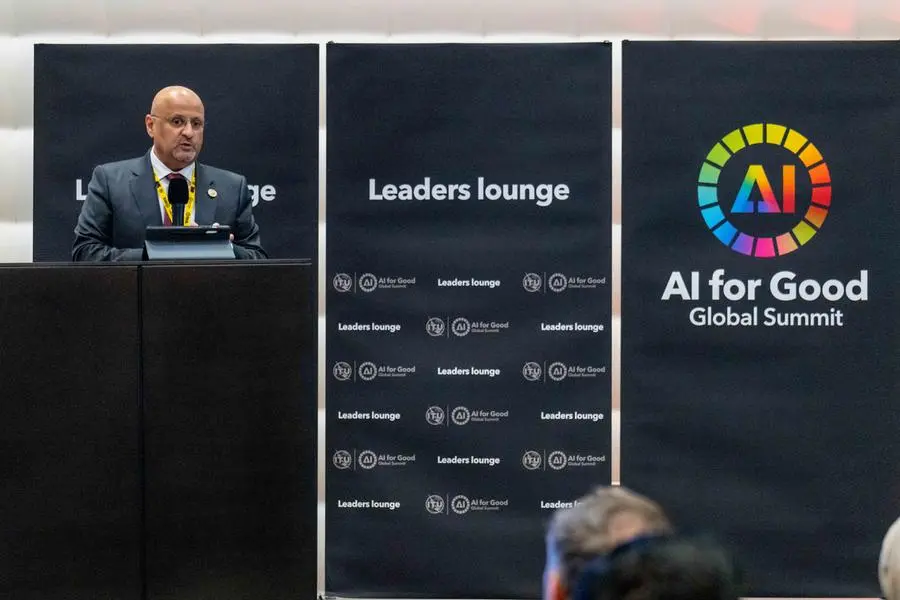
During the event, Omar Saud Al-Omar, Minister of State for Communication Affairs of the State of Kuwait, and current Chairperson of the DCO Council for the current term of 2025, announced the launch of the "DCO AI Ethics Evaluator Policy Tool".
In his speech during the tool's launch at the high-level forum of the World Summit on the Information Society (WSIS + 2025), Al-Omar emphasized that the tool aims to guide developers and users of AI technologies regarding the potential impact on human rights, alignment with ethical standards, and the application of strategies to mitigate these impacts through a structured self-assessment questionnaire covering six categories of risks based on the DCO's principles for Ethical AI. The tool was developed based on DCO research in AI governance and extensive consultations with experts and relevant stakeholders.
In conclusion, Al-Omar noted that the organization is making steady progress toward achieving its goals by turning its commitments into actions, one of which has been realized today with the launch of the DCO AI Ethics Evaluator.
“We are laying down a shared ethical foundation,” said Deemah AlYahya, Secretary-General of the DCO. “Because AI without ethics is not progress, it’s a threat. A threat to human dignity, to public trust, and to the very values that bind our societies together.” She emphasized that the Policy Tool was designed not just for governments, but for everyone shaping the digital economy, ensuring that innovation drives us forward without leaving our principles behind.
“This is not just another checklist. This is a principled stand.” AlYahya declared. “The DCO AI Ethics Evaluator takes our Member States’ shared values and turns them into real, enforceable action, confronting algorithmic bias, data exploitation, and the hidden ethical blind spots of AI. It is built on global best practices and grounded in the fundamentals of human rights. This tool gives developers, regulators, and innovators the power to transform abstract ethics into tangible accountability.”
“From fairness audits and privacy safeguards to transparency scoring and accountability mechanisms, the Evaluator guides users through real risk assessments across six critical dimensions, delivering tailored recommendations for every role in the AI lifecycle.” She added, “This isn’t just a diagnostic, it’s a compass. A tool to help nations and innovators stay on course toward human-centered, rights-driven AI. We launched it because ethical AI is not a luxury, it is urgent. It is non-negotiable. And it is a responsibility we all share.”
Following the Minister’s remarks, Alaa Abdulaal, Chief of Digital Economy Intelligence at the DCO, offered a quick walk-through of the AI Ethics Evaluator.
“The future of AI will not be shaped by how fast we code, but by the values that we choose to encode. The AI Ethics Evaluator Policy Tool operationalizes the DCO principles through structured self-assessments that guide AI developers and deployers in identifying, evaluating, and mitigating ethical and human rights risks,” said Abdulaal.
The launch event brought together ministers, policymakers, AI experts, and representatives from civil society worldwide, making meaningful contributions to the global dialogue on AI governance.
The event concluded with a strong call for cross-sector collaboration to ensure the ethical development and deployment of AI technologies. Delegates from several Member States and the private sector have already expressed interest in piloting the DCO AI Ethics Evaluator in their AI governance endeavors.
With the launch of the AI Ethics Evaluator, the DCO reaffirms its leadership in promoting inclusive digital cooperation and ensuring that emerging technologies serve the interests of people, societies, and sustainable development.
About the Digital Cooperation Organization (DCO)
The Digital Cooperation Organization is the world's first standalone international intergovernmental organization focusing on the acceleration of the growth of an inclusive and sustainable digital economy. It is a global multilateral organization founded in November 2020 that aims to enable digital prosperity for all.
The DCO brings together the Ministries of Communications and Information Technology of its Member States, and is focused on empowering youth, women, and entrepreneurs, leveraging the accelerative power of the digital economy, and leapfrogging with innovation to drive economic growth and increase social prosperity.
The Digital Cooperation Organization (DCO) brings together ministries of communications and information technology in 16 countries: the Kingdom of Bahrain, the People's Republic of Bangladesh, the Republic of Cyprus, the Republic of Djibouti, the Republic of The Gambia, the Republic of Ghana, the Hellenic Republic (Greece), the Hashemite Kingdom of Jordan, the State of Kuwait, the Kingdom of Morocco, the Federal Republic of Nigeria, the Sultanate of Oman, the Islamic Republic of Pakistan, the State of Qatar, the Republic of Rwanda, and the Kingdom of Saudi Arabia - collectively representing nearly $3.5 trillion in GDP and a market of nearly 800 million people, more than 70% of whom are under the age of 35.
Through cooperation and strategic dialogue, we drive the facilitation of mutually advantageous cross-border legislation. The DCO seeks to establish within its Member States the optimal infrastructure and policies for the rapid creation of inclusive and equitable digital economies within which all people, businesses, and societies can innovate and thrive. The DCO’s vision is to work towards a world in which every nation, business, and person has a fair opportunity to prosper in the digital economy.
In pursuit of the Member States’ common interests, the DCO works collaboratively with governments, the private sector, international organizations, NGOs, and civil society to enable more inclusive digital transformation and the growth of the digital economy.
The DCO’s key initiatives include programs to enhance cross-border data flows, promote market expansion for SMEs, empower digital entrepreneurs, and advance digital inclusion among women, and the youth, and other underrepresented populations. Since 2022, the DCO has also been granted observer status to organizations such as the United Nations General Assembly, private sector, civil society and academia, allowing them to engage in initiatives and collaborate on digital economy advancements.