PHOTO
- Sheikh Fahim Al Qasimi: Traceability and transparency are fundamental to how global markets assess quality, build trust, and determine competitiveness.
Fujairah: The UAE’s fisheries sector is moving toward a unified, data-driven operating model, as Fujairah becomes the latest emirate to adopt SFS Fisheries, the country’s first integrated digital platform for tracking fishing operations and verifying the origin of local catch. The expansion builds on the system’s initial deployment in Sharjah and signals a broader national shift toward transparency, efficiency, and long-term resource management across marine supply chains.
Developed by Seafood Souq, the platform was first introduced at Souq Al Jubail five months ago, where it established a new benchmark for how seafood is monitored, verified, and traded. Its rollout to Fujairah reflects growing institutional alignment around the need to modernise fisheries governance while preserving the sector’s economic and cultural significance.
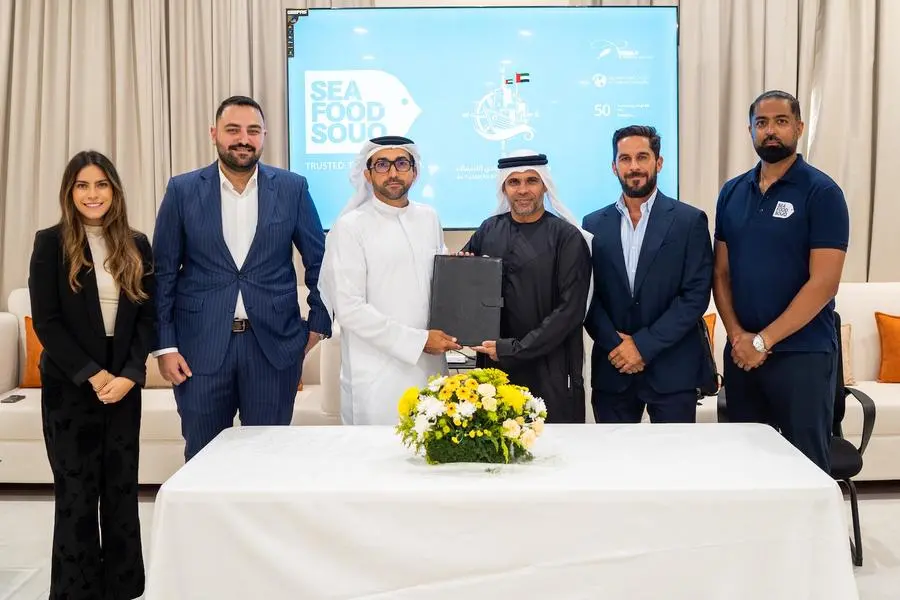
The expansion to Fujairah follows the signing of an MoU between the Fujairah Fishermen Association and Seafood Souq, formalising collaboration on digitising fisheries operations in the emirate. The agreement, signed by Sheikh Fahim Al Qasimi, co-founder of Seafood Souq and H.E Mahmood Hassan Al Ali, Chairman Fujeirah Fisherman Coop, forms part of a wider national effort, supported by the Ministry of Climate Change and Environment, to establish a unified framework for sustainable fisheries management across all seven emirates.
The signing ceremony was attended by H.E. Dr. Ibrahim Al Jamali is the Regional Director – Northern Region at the UAE Ministry of Climate Change and Environment; H.E Sulaiman Rashid Al Khadeem, Chairman of the UAE federation of fisherman associations.
From pilot to national model
At its core, SFS Fisheries integrates a mobile application, digital logbook, and landing validation system to document fishing activity in real time. Each registered vessel is assigned a unique QR code, allowing regulators, traders, and consumers to instantly access verified data on licence status, catch type, origin, landing time, and quantity. The result is full traceability from sea to point of sale, replacing fragmented manual processes with a consistent, verifiable digital record.
The system’s early performance in Sharjah has demonstrated both operational and commercial value. More than 140,000 kilograms of seafood from over 130 vessels, spanning more than 50 local species, have already been digitally verified at a single landing site. The data has enabled faster validation processes, reduced administrative errors, and improved market access for fishermen by allowing them to compete on verified quality rather than informal pricing dynamics.
An integrated system for trust and competitiveness
Under the Fujairah agreement, fish landings will now be recorded digitally at approved sites, with each shipment linked to vessel data and supported by digital catch certificates. These certificates provide verified proof of origin, enabling buyers and end consumers to confirm product authenticity, freshness, and sourcing practices.
Commenting on the partnership, Sheikh Fahim Al Qasimi, co-founder of Seafood Souq, said: “Partnerships in vital sectors such as food and seafood are essential to building more efficient production systems, bringing together scientific knowledge and operational expertise across the value chain. Traceability and transparency are no longer optional; they are fundamental to how global markets assess quality, build trust, and determine competitiveness.”
He added that adopting advanced digital solutions will not only strengthen quality standards but also expand opportunities for UAE-caught seafood to access higher-value markets.
In parallel with system deployment, the partnership includes provisions for data sharing, technical advisory, and joint research and training programmes. With Fujairah now onboard, SFS Fisheries moves closer to its stated ambition of becoming a national platform, positioning the UAE among a small group of countries adopting end-to-end digital oversight of fisheries.
The UAE’s seafood market, currently valued at approximately $1.49 billion and projected to grow steadily over the coming decade, is being shaped by rising demand for high-quality protein, expanding hospitality sectors, and increasing consumer awareness around sourcing and sustainability. Within this context, digital traceability is emerging not as a technical upgrade, but as a structural requirement for future growth.