PHOTO
Manama, Kingdom of Bahrain – The Central Bank of Bahrain’s (CBB) Board of Directors held its first meeting for the year 2026, chaired by Mr. Hassan Khalifa Al Jalahma.
The Board commenced its meeting by condemning and denouncing the Iranian attacks that targeted civilian infrastructure, residential neighbourhoods, and vital facilities in the Kingdom of Bahrain, affirming that the Kingdom’s security and stability remain safeguarded under the leadership of His Majesty King Hamad bin Isa Al Khalifa and the directives of His Royal Highness Prince Salman bin Hamad Al Khalifa, the Crown Prince and Prime Minister.
The Board also commended the banking sector for continuing to record strong financial soundness indicators, and for the continued efficient and secure operation of financial systems, including payment systems. It is worth noting that since the start of the regional developments, the Central Bank has strengthened its supervisory and oversight measures in coordination with banks, insurance companies, and financial institutions to ensure the continuity of financial services under all circumstances.
The Board reviewed the items on the agenda, and approved CBB’s audited financial statements for 2025. The Board also reviewed CBB’s key activities during the previous year, and performance report thus far in 2026, in addition to the latest developments in the financial sector up to February 2026.
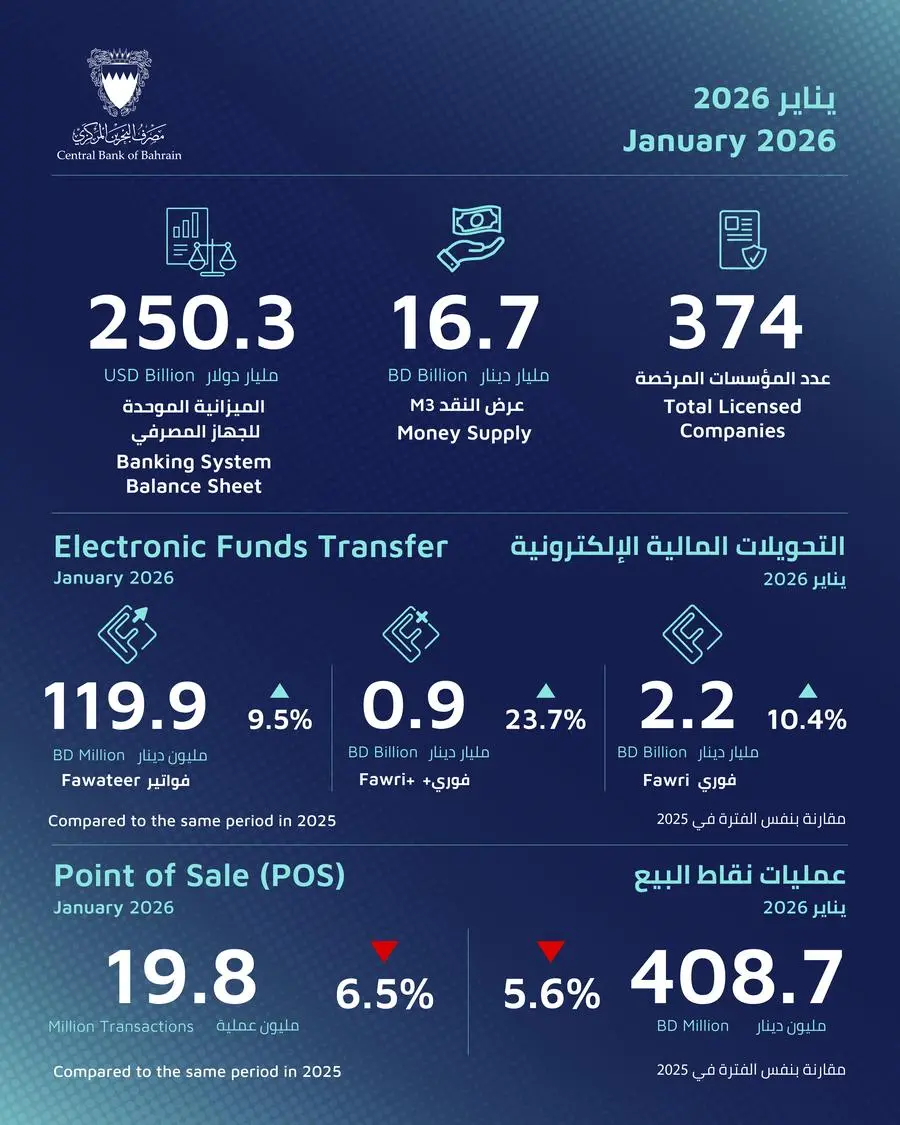
The Board also reviewed key monetary and banking indicators for the period up to January 2026 including the money supply, which increased by BD 0.7 billion to reach BD 16.7 billion at the end of January 2026, compared to the same period in 2025. As for retail banks, total private deposits increased to reach BD 14.1 billion at the end of January 2026, an increase of 6.2% compared to the end of January 2025. The outstanding balance of total loans and credit facilities extended to resident economic sectors increased to BD 12.9 billion at the end of January 2026, an increase of 5.4% compared January 2025, with the Business Sector accounting for 39.7% and the Personal Sector at 48.4% of total loans and credit facilities. The balance sheet of the banking system (retail banks and wholesale sector banks) increased to $250.3 billion at the end of January 2026, an increase of 1.6% compared to the end January of 2025.
Point of Sales (POS) data in January 2026 totaled 19.8 million transactions (73.6% of which were contactless), a decrease of 6.5% compared to the same period in 2025. The total value of POS transactions for the period January 2026 totaled BD 408.7 million (50.2% of which were contactless), a decrease of 5.6% compared to the same period in 2025.
The banking sector’s capital adequacy ratio reached 21.8% in Q4 2025 compared with 21.2% in Q4 2024. The capital adequacy ratio for the various banking sectors was 27.5% for conventional retail banks, 17.2% for conventional wholesale banks, 27.7% for Islamic retail banks, and 19.7% for Islamic wholesale banks in Q4 2025.
The total number of registered Collective Investment Undertakings (CIUs) as of December 2025 stood at 1745 CIUs, compared to 1741 CIUs as of December 2024, reflecting an increase of 0.23%. The net asset value (NAV) of the CIUs decreased from US $11.170 billion in Q4 2024 to US $11.060 billion in Q4 2025, reflecting a decrease of 0.98%. The NAV of Shari’a-compliant CIUs increased from US $1.925 billion in Q4 2024 to US $2.338 billion in Q4 2025, reflecting an increase of 21.45%. The NAV of Bahrain domiciled CIUs increased from US $4.268 billion in Q4 2024 to US $4.404 billion in Q4 2025, reflecting an increase of 3.19%. Additionally, the NAV of overseas domiciled CIUs decreased from US $6.902 billion in Q4 2024 to US $6.656 billion in Q4 2025, reflecting a decrease of 3.56%.