Courts are emerging as a critical frontline in the fight to end female genital mutilation (FGM). Over the past two decades, international recognition of FGM as a human rights violation has grown, alongside a shift toward criminal bans. A new report by Equality Now (www.EqualityNow.org) - with legal research support facilitated through the Thomson Reuters Foundation’s global pro bono service, TrustLaw - reveals how women’s rights advocates and FGM survivors are increasingly using strategic litigation to strengthen implementation of laws, close legal gaps, and defend hard-won protections from rollback.
Towards Justice: Global Challenges and Opportunities in Litigating Cases of Female Genital Mutilation (https://apo-opa.co/4rzdxio), outlines lessons from strategic litigation in Burkina Faso, India, Kenya, Liberia, The Gambia, and the United States. The report also analyses barriers to justice in ten countries: Australia, Burkina Faso, Egypt, France, Kenya, Liberia, Sierra Leone, Uganda, the United Kingdom, and the United States.
Equality Now’s Divya Srinivasan explains, “By examining how the law works in practice, we can better understand how to harness it effectively. Our research finds that strategic litigation is one of the most powerful ways to challenge FGM by exposing gaps in protection, setting legal precedents, and driving wider reform. But litigation alone is not enough. To deliver real justice and lasting change, it must be backed by well-implemented, sufficiently funded enforcement of laws alongside legal systems that shield survivors from harm.”
Female genital mutilation is a global problem
FGM is internationally recognised as a serious human rights violation involving the partial or complete removal of external female genitalia for non-medical reasons. The practice is associated with severe physical and psychological problems, and stems from gender inequality.
UNICEF estimates that 230 million women and girls (https://apo-opa.co/4asXCw6) are impacted by FGM globally. Equality Now and its partners have collated evidence of FGM in 94 countries (https://apo-opa.co/4qhwrZV), but of these, only 59 have a specific law prohibiting the practice, and considerable improvement is needed to ensure better access to justice and support for survivors.
Strategic litigation can strengthen access to justice for FGM survivors
Strategic criminal, civil, and constitutional litigation can strengthen state responses to FGM by exposing systemic failures and clarifying the law, setting legal precedents, and driving legal and policy reforms that have an impact beyond individual cases.
Strategic litigation can empower survivors to speak out and seek remedies. High-profile prosecutions raise public awareness that FGM is a socially and legally unacceptable form of violence against women and girls. Other survivors are encouraged to come forward, and critical conversations are sparked within affected communities, helping drive social change that prevents future harm.
Crucially, strategic litigation can compel States to uphold their human rights obligations to protect women and girls, particularly where national protections are weak or political will has faltered. It also assists civil society advocacy efforts by equipping them with legal instruments and authoritative court rulings that facilitate campaigning, prevention work, and accountability for FGM.
An illustration of a country’s obligations being clarified under constitutional and international law is the 2025 ruling by the Economic Community of West African States (ECOWAS) Court against Sierra Leone, where FGM remains widespread. The judgment specified Sierra Leone’s binding legal duties, calling on the country to criminalise FGM, adopt measures to prevent and prohibit the practice, protect those at risk, compensate survivors, investigate cases, and prosecute perpetrators.
Defending FGM legal protections against rollback
Strategic litigation can be critical in preventing rollback of legal protections. In Kenya, coordinated legal action successfully defended the Prohibition of Female Genital Mutilation Act after a constitutional challenge sought to legitimise the practice by framing it as a matter of consent, culture, and bodily autonomy. The High Court’s 2021 ruling preserved one of the strongest anti-FGM laws in Africa and reaffirmed that such arguments cannot override the rights of women and girls.
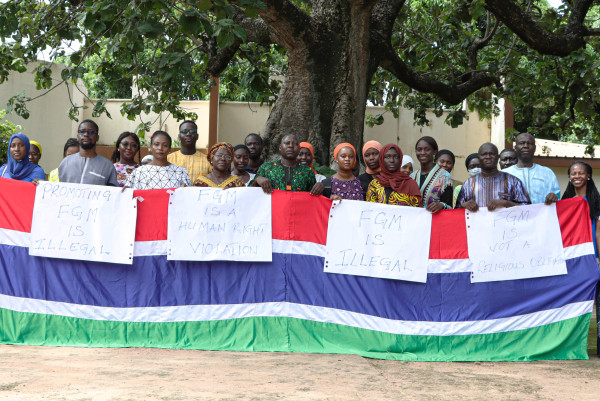
Similar arguments are now being tested in The Gambia. After lawmakers rejected a bill in 2024 seeking to repeal the ban on FGM, the law is now being challenged before the Supreme Court on constitutional grounds. If the Court rules in favour of repeal, it would set a dangerous precedent by prioritising religious or cultural rights above the fundamental human rights to equality, dignity, and freedom from violence. Such a decision could weaken protections for women and girls in The Gambia and embolden efforts to roll back anti-FGM laws elsewhere.
Legal gaps and systemic failures in prosecuting FGM
Despite the number of countries with anti-FGM laws, prosecution for FGM remains rare, with weak enforcement of laws and legal loopholes undermining the ability to bring cases to court. Reporting of FGM is low, partly due to stigma, fear, and weak victim and witness protection. Other concerns include poor investigations, mishandled evidence, and limited political or institutional prioritisation of FGM cases.
These shortcomings are compounded by delays in investigations and court proceedings, alongside inaccessible court processes. For the few cases that do make it to court, justice is far from guaranteed, and in some instances, inconsistent or lenient sentencing fails to reflect the seriousness of the harm caused.
Survivors often experience stigma, intimidation, discrimination, and re-traumatisation during court proceedings. In some contexts, a lack of survivor-centred approaches has contributed to survivors themselves being criminalised under the very laws meant to protect them.
Judges, prosecutors, police, healthcare professionals, and social services often lack adequate training on FGM and relevant legal frameworks. This lack of understanding contributes to cases being poorly handled and laws being incorrectly applied.
Poor enforcement of court decisions allows perpetrators to avoid meaningful consequences despite conviction. This undermines the credibility of the justice system, contributes to a broader pattern of impunity, and discourages survivors from pursuing legal action.
A multi-sectoral approach to ending FGM
Governments must strengthen and clarify laws to ensure that all forms of FGM are explicitly prohibited and existing legislation is well enforced. This includes pursuing investigations effectively, ensuring sentencing reflects the gravity of the crime, and enforcing court rulings consistently. Targeted investment in professional training is needed to improve evidence handling, case management, and survivor-sensitive responses.
Laws work best when paired with prevention efforts that address the root causes of FGM. Ending this harmful practice requires a multi-sectoral approach that combines legal action with health, education, child protection, and community-based responses.
Underfunding undermines efforts to implement FGM laws. Sustained public investment, awareness-raising, and community engagement are essential. Survivors need access to free legal aid and support services. Civil remedies must also be guaranteed, allowing individuals to seek compensation, protection orders, or other forms of redress through the civil courts, independent of criminal proceedings.
Kathryn Beck, Head of Legal for TrustLaw at the Thomson Reuters Foundation, commented, “Legal pro bono has a unique power to support the critical missions of organisations such as Equality Now. We hope that this important report lays the groundwork to strengthen anti-FGM laws and empowers frontline professionals working to protect the rights of women and girls around the world.”
Distributed by APO Group on behalf of Equality Now.Notes to editors:
For media enquired contact
Tara Carey
Global Head of Media
Tcarey@equalitynow.org
+44 (0)7971556340 (WhatsApp)
Aakasha Saxena
Communications Officer
asaxena@equalitynow.org
About Equality Now:
Equality Now is a worldwide human rights organisation dedicated to securing the legal and systemic change needed to end discrimination against all women and girls. Since its inception in 1992, it has played a role in reforming 120 discriminatory laws globally, positively impacting the lives of hundreds of millions of women and girls, their communities and nations, both now and for generations to come.
Working with partners at national, regional and global levels, Equality Now draws on deep legal expertise and a diverse range of social, political and cultural perspectives to continue to lead the way in steering, shaping and driving the change needed to achieve enduring gender equality, to the benefit of all. For more details, go to www.EqualityNow.org and LinkedIn Equality Now. For more information about FGM around the world, please see our 2025 report, The Time Is Now: End Female Genital Mutilation/Cutting, An Urgent Need for a Global Response – Five Year Update (https://apo-opa.co/3ZcTlqn).
About The Thomson Reuters Foundation:
The Thomson Reuters Foundation is the corporate foundation of Thomson Reuters, using its expertise in media, law, and data to advance free, fair, and informed societies. Through journalism, legal support, and research, the Foundation works to uphold human rights, foster transparency, and promote inclusive economies.
Its global pro bono service, TrustLaw, is the world’s largest network of legal professionals providing free legal assistance to NGOs, social enterprises, and independent media in over 190 countries. By facilitating access to legal support and producing pioneering legal research, TrustLaw helps strengthen civil society and drive systemic, lasting change. For details, go to www.Trust.org, LinkedIn Thomson Reuters Foundation.