PHOTO
(The opinions expressed here are those of the author, a columnist for Reuters.)
LONDON - Amid the consternation about the U.S. Supreme Court's quashing of President Donald Trump's emergency tariffs, markets may have missed a surprising take on Federal Reserve policy - that it's not inconceivable the next interest rate shift could be up.
A blizzard of information from early Friday onward - a big GDP miss, a hot inflation reading, the court judgment and then Trump doubling down on higher global tariffs - left most investors bewildered as the new week began.
That flood of data and drama may also explain why a very pointed warning from a retiring regional Fed boss failed to get much spotlight.
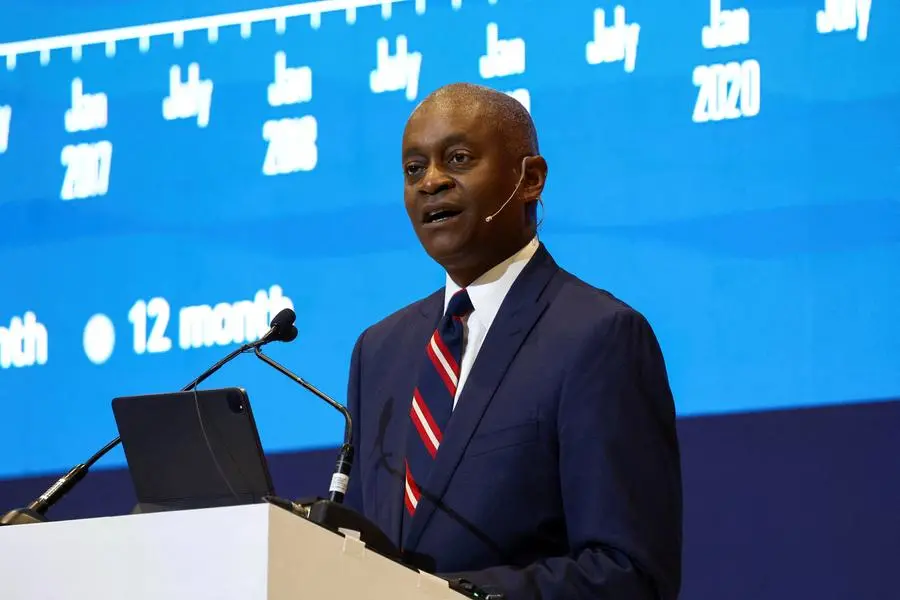
A centrist-turned-hawk, Atlanta Fed chief Raphael Bostic steps down at the end of this month after almost nine years at the helm. But his Friday parting shot underlined just how much resistance there is within the Fed to any further easing – let alone the deep rate cuts Trump is demanding and some of his appointees to the Fed appear willing to endorse.
Bostic argued the economy has been "remarkably resilient" to last year's trade shocks and is now getting a big tailwind from artificial intelligence spending. That, he said, is why "mildly restrictive" policy should remain so.
However, he raised a big red flag about any sign of resurgent inflation. "If it starts to move in the opposite direction again, which it hasn't for several years, that would be super concerning and, for me, you'd have to have hikes on the table."
For a market priced for almost 60 basis points of further cuts this year, that's a sobering prospect – and the latest inflation data give his warning more heft.
Despite initial hoopla in the bond market after a soft headline reading for January's consumer price index (CPI), the inflation gauge that's actually targeted by the Fed - a "core" measure of the personal consumption expenditures (PCE) inflation basket stripping out food and energy - has been moving in the wrong direction.
Slightly buried under a surprising fourth-quarter GDP miss and Friday's tariff farrago, December's core PCE data showed inflation climbed to 3.0% again for the first time in almost two years – above forecast and a full percentage point above the Fed's target.
What's more, components of the CPI that feed into the PCE calculation, such as core goods prices, point to a January core PCE reading at least as high.
And as the PCE reading also riffs off components of the producer price index (PPI) - such as airfares, medical services and portfolio management fees - there's a chance that core PCE estimates for January could rise to 3.1% after the PPI is released on Friday.
"Incoming data raises concerns that core inflation will prove stickier than the December SEP (Fed's Summary of Economic Projections) assumed," wrote SGH Macro Advisors' Fed watcher Tim Duy, pointing out that Chair Jerome Powell has quietly shifted his own estimate of peak tariff inflation further into the year.
FED STOKING INFLATION ALREADY?
To be sure, the impact of tariffs on inflation to date is debated - but there are indications that a "pass-through" of last year's tariff hikes to goods prices is now hitting with a lag.
The Supreme Court judgment to strike down Trump's emergency levies could have been some relief on that score. But Trump's insistence he will replace all those tariffs eventually means any relief will be fleeting and the process of pass-through may even be elongated.
The fear among Bostic and his more hawkish colleagues is that the longer core inflation remains above target, the more business and the public will assume the Fed is tolerating it and it then gets baked into expectations.
Having spent most of the prior decade below 2%, core PCE inflation has now spent almost five years solid above target.
Doggedly dovish market thinking leans heavily on an assumption that the arrival of Trump appointee Kevin Warsh as new Fed Chair in May will build a stronger case at the central bank for rate cuts to resume.
That case will likely rest on a mix of arguments: that tariff-related price hits are temporary, that the labour market is soft, and that AI-driven productivity gains are just around the corner – even as trillions of dollars are being ploughed into real sector infrastructure to accommodate the AI boom.
The AI case is flimsy in many eyes, as history shows real interest rates tend to rise during such tech-related investment surges - a move that's necessary to cope with overheating before the disinflationary effects of any productivity lift eventually emerge.
Even dovish Fed Governor Christopher Waller acknowledged that on Monday. "The more productive and the higher the growth in the economy typically you have higher real interest rates."
And there's a thorny issue of whether current Fed policy is stimulating economic activity and prices already.
A hawkish Bostic claims Fed rates of 3.62% are still slightly restrictive. But Minneapolis Fed chief Neel Kashkari last week said he saw them basically at neutral already.
And that really matters. Does the Fed really want to start spurring the economy at this juncture?
Based on different models co-authored by New York Fed President John Williams, current real Fed rates are running some 50-100 bps below estimates of neutral.
Bostic may have raised a red flag while walking out the door. It may be foolish to dismiss it completely.
(The opinions expressed here are those of the author, a columnist for Reuters.)
Enjoying this column? Check out Reuters Open Interest (ROI), your essential new source for global financial commentary. Follow ROI on LinkedIn, and X.
Plus, sign up for my weekday newsletter, Morning Bid U.S. and listen to the Morning Bid daily podcast on Apple, Spotify, or the Reuters app. Subscribe to hear Reuters journalists discuss the biggest news in markets and finance seven days a week.
(by Mike Dolan; Editing by Marguerita Choy)