PHOTO
(The opinions expressed here are those of the author, a columnist for Reuters.)
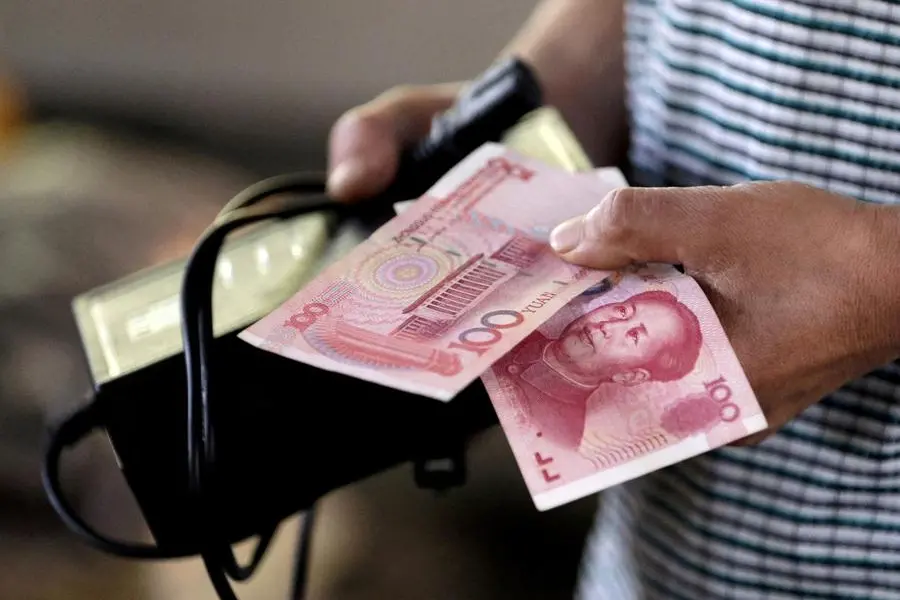
ORLANDO, Florida - How undervalued is China's yuan, and how much is this driving the renewed widening of global imbalances? The answer is a bit more complicated than Beijing's massive surpluses might suggest.
Although the yuan, also known as the renminbi, is currently trading at its strongest nominal level against the U.S. dollar in more than three years at around 6.80 per dollar, most observers agree it should still be a lot stronger based on accepted economic fundamentals.
China's official current account surplus last year was $735 billion, just over 3% of gross domestic product, or roughly 30% of combined global current account surpluses. And its official trade surplus was $1.2 trillion, about 6% of GDP and nearly 40% of all global trade surpluses. These figures are both at record levels in nominal terms, and represent huge footprints for just one country.
If these data points were the sole determinants of the yuan's value, the case for a significantly stronger exchange rate would be irrefutable.
But the wider flow of funds has not been exclusively one way.
Accumulated capital outflow from China over the last few years has been huge, as the economy has struggled to escape the deflationary funk of an historic property crash, and domestic money - from investors, businesses and institutions - has poured overseas.
This suggests the argument surrounding the Chinese currency is a little more nuanced.
30% UNDERVALUED?
It's hard to argue that the yuan isn't undervalued.
As the International Monetary Fund noted in its country report published in February, China's external position "is assessed to be stronger than the level implied by medium-term fundamentals and desirable policies." The yuan has nonetheless fallen in real terms due to China's low inflation.
Indeed, the renminbi has depreciated in real terms four years in a row, registering a cumulative 14% decline since 2021, according to IMF economists. They estimate China's real effective exchange rate could potentially be up to 20% undervalued.
China watchers Brad Setser and Mark Sobel, both former U.S. Treasury officials, go further and say the yuan is probably undervalued by as much as 30%. Setser has long argued that China's official balance of payments data understates the country's real surplus and that customs data is the more accurate barometer. By that measure, the trade surplus would be a percentage point of GDP wider.
TRILLIONS GO THE OTHER WAY
While there is no denying that China's external surpluses are large, by any measure, this also means that capital outflows from the country's financial account – the mirror of the current account – must also be enormous.
Portfolio outflows have been particularly strong in recent years. Concerns over China's growth, trade tensions with the U.S., and the widening interest rate gap between China and developed economies have pulled domestic capital overseas.
Since the start of this decade, China has posted cumulative net capital outflows of $2.85 trillion, Institute of International Finance figures show. This comprehensive picture comprises portfolio flows, direct investment, banking and other investment flows from residents and non-residents.
It shows that China can still run huge external surpluses while domestic households, firms, and institutions continue to seek investment opportunities abroad because growth and returns are better elsewhere, or because they want to diversify.
"The financial account dynamics do make it harder to argue for a very large, persistent undervaluation, even if they do not rule out something more moderate," says the IIF's Jonathan Fortun.
This is worth bearing in mind when discussing the yuan's fair value. One China expert at the IMF Spring Meetings in Washington last week said the yuan's undervaluation may be closer to 15% rather than 25-30% as a result.
BIGGEST DRIVER OF IMBALANCES? LOOK ELSEWHERE
For all the heat on Beijing - much of it justified - for maintaining an undervalued exchange rate in the face of huge external surpluses, the biggest single driver of the widening global imbalances currently eliciting warnings from the IMF and others appears not to be China, but the U.S.
U.S. deficits, as a share of combined trade and current account global deficits, are significantly larger than China's corresponding share of combined global surpluses, reports from the IMF, Brookings Institution and Centre for Economic Policy Research have found.
When global imbalances were at their peak in 2006, the U.S. accounted for around 60% of combined current account deficits, when measured as a share of global GDP. That's now closer to 70%.
So even though noise around the undervaluation of the yuan may grow louder, the overvaluation of the dollar – even after last year's roughly 10% drop – arguably remains just as pivotal a point of concern.
(The opinions expressed here are those of Jamie McGeever, a columnist for Reuters)
Save the date: On April 23 at 1300 GMT/9 a.m. EDT, ROI columnists Mike Dolan and Jamie McGeever will join LSEG for a webinar discussion, "Markets Unpacked with Reuters Open Interest: Rethinking safe havens in uncertain times." Click here to sign up.
Enjoying this column? Check out Reuters Open Interest (ROI), your essential new source for global financial commentary. Follow ROI on LinkedIn, and X.
And listen to the Morning Bid daily podcast on Apple, Spotify, or the Reuters app. Subscribe to hear Reuters journalists discuss the biggest news in markets and finance seven days a week.
(By Jamie McGeever; Editing by Marguerita Choy)