PHOTO
(The views expressed here are those of the author, a columnist for Reuters.)
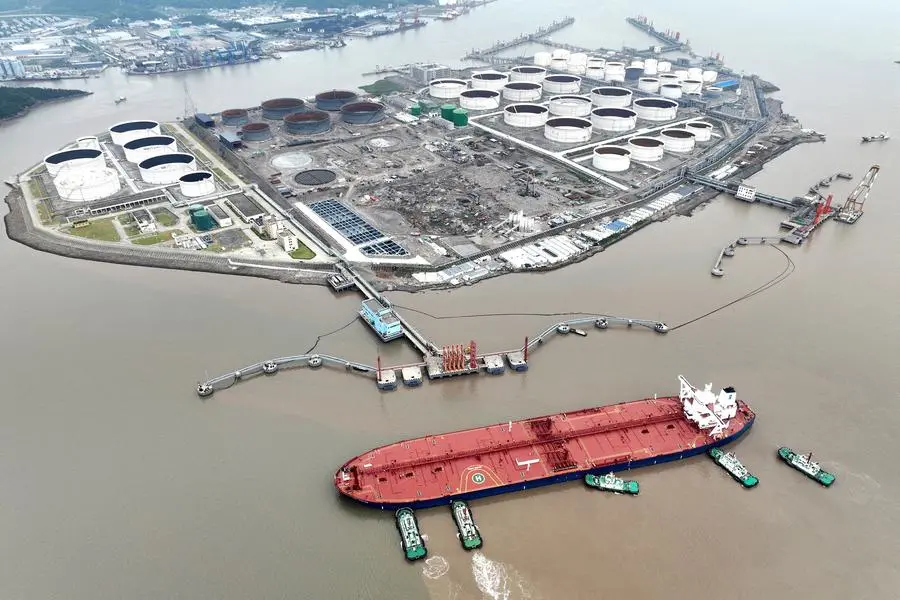
ADELAIDE - China continued to build its massive stockpile of crude oil in April, even though imports dropped to the lowest in nearly four years.
China's surplus crude amounted to about 430,000 barrels per day in April as the 20% drop in imports was outweighed by refinery processing sliding to the lowest since August 2022.
The ongoing building of inventories by the world's biggest crude importer underlines that China is in quite a different situation to the rest of the world, which is burning through oil stockpiles in order to compensate for the loss of about 12 million bpd of supply to the effective closure of the Strait of Hormuz.
China does not disclose the volumes of crude flowing into or out of its strategic and commercial stockpiles, but an estimate can be made by deducting the amount of oil processed from the total crude available from imports and domestic output.
It is worth noting that not all the surplus crude was likely to have been added to storage, with some being processed in plants not captured by the official data.
But even allowing for those gaps, it is clear that from March 2025 onwards, China has been importing crude at a far higher rate than necessary to meet domestic fuel demand.
China's imports of crude oil were 9.37 million bpd in April, down 20% from the same month a year earlier and the lowest since July 2022.
Domestic output was 4.37 million bpd, meaning a total of 13.73 million bpd was available for refiners to process.
Refinery throughput was 13.3 million bpd in April, down 5.8% from the same month in 2025.
Subtracting the refinery processing from the total available crude leaves a surplus of 430,000 bpd available for commercial or strategic storage.
For the first four months of the year, China's surplus crude was about 1.16 million bpd, given imports of about 11.27 million bpd, domestic output of 4.43 million bpd and refinery throughput of 14.54 million bpd.
This means that China has kept building its total crude stockpile, which is estimated by most analysts as holding at least 1.2 billion barrels, and possibly as much as 1.5 billion barrels.
FUEL EXPORTS
Another point to note about the April data is that the drop in refinery processing was not necessarily a story of weak domestic demand, it was more a reflection of China's unofficial restrictions on exports of refined products.
Shipments of fuels such as diesel, jet fuel and gasoline dropped to 3.1 million metric tons in April, the lowest in at least a decade. It's also likely that figure is something of an overstatement as China's official export data includes shipments to Hong Kong.
The question for the market is what does China do in coming months, given a full and sustained re-opening of the Strait of Hormuz is far from certain, as the United States and Iran still appear far apart on the terms of a peace agreement.
China can continue to constrain its imports, which fits the pattern of recent years of cutting back on arrivals when prices rise, but boosting imports when prices decline.
It can also boost its refinery processing and exports of fuel shipments in order to allow its refiners to capture some of the elevated margins on offer in Asia, especially for diesel and jet fuel.
This would also help ease the supply worries of fuel-importing nations such as Pakistan and Bangladesh, which are also seen as friendly toward Beijing.
If China dipped into stockpiles at a rate of 1 million bpd, it could do this for three years before exhausting its inventories.
It's likely that China's crude imports will decline in May, with commodity analysts Kpler estimating seaborne arrivals of just 6.32 million bpd.
This figure is likely to be revised higher by the end of the month as more cargoes are tracked, and it also excludes pipeline crude from Russia. But the available data suggest that May will see China's crude imports drop to multi-year lows.
This means that it is likely that China will start to draw on inventories, but how much will be determined by the volumes of fuel its refiners are allowed to export.
Enjoying this column? Check out Reuters Open Interest (ROI), your essential new source for global financial commentary. ROI delivers thought-provoking, data-driven analysis of everything from swap rates to soybeans. Markets are moving faster than ever. ROI can help you keep up. Follow ROI on LinkedIn and X.
The views expressed here are those of the author, a columnist for Reuters.
(Editing by Christian Schmollinger)