PHOTO
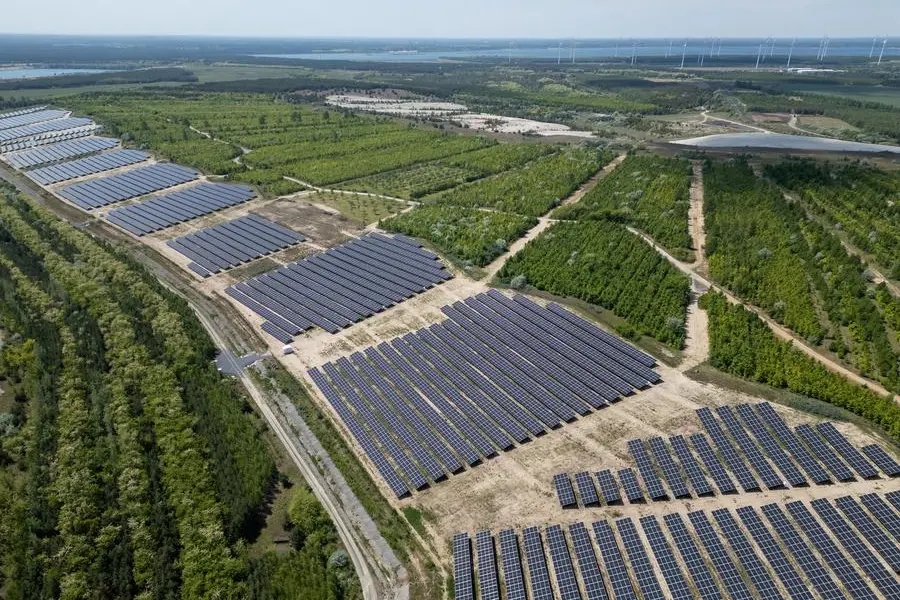
MILAN - Investors in European clean-energy producers are bracing for fresh turbulence as a months-long rally, fuelled by hopes of AI-driven power demand, collides with a resurgence of policy risk.
The sector had surged on bets that data-centre expansion would finally revive electricity use after years of stagnation, echoing trends in the U.S., where renewables have shifted from a subsidies-led market to one driven by firm demand.
But that narrative is under strain. Policy tremors are emerging before any clear evidence of a demand upturn, with Europe still far behind the U.S. in AI infrastructure.
Amundi analyst Timothy Ho said renewed debate over carbon policy could prompt investors to revisit assumptions about valuations and earnings, while pushing Europe's energy "trilemma" back into view.
"You want energy to be affordable, you want security of supply and you want it to be green. Doing all three is very difficult, so policymakers have to choose which to prioritise. Right now, affordability and security are top of the agenda," said Ho.
This month, Germany and others signalled openness to reform the EU carbon-trading system — a pillar of Brussels' climate strategy — while Italy moved to cut power bills as governments focus on competitiveness against the U.S. and China.
The prospect of Emissions Trading System reform has already knocked carbon prices more than 20% off recent highs to their lowest since May, pressuring generators' earnings once hedges roll off.
Ho said regulated network operators remain "relatively attractive" due to predictable earnings and rising grid-investment needs. But he noted some generators had re-rated on hopes of an AI-driven rise in demand despite limited "tangible evidence" so far.
The International Energy Agency says European electricity demand is unlikely to return to 2021 levels before 2028, after sharp falls in 2022-2023 and only a "lacklustre" recovery thereafter. It forecasts average annual growth of 2.3% in 2025–2030, eventually matching North American rates.
UNCERTAINTY MAY LAST FOR MONTHS
Angelo Meda, head of equities at Banor SIM, said electricity use remained constrained, partly due to efficiency gains. AI data-centre expansion may help, but is unlikely to reverse the trend soon.
"The rally reflects expectations of demand growth that are unlikely to materialise ... Even EV adoption is slowing," he said, adding that valuations of some utilities stocks in Spain, Italy, Germany and Britain looked stretched.
Europe's utilities index has seen valuation multiples expand sharply over the past year, showing investors' willingness to pay up even as earnings forecasts for 2025-2027 have stayed broadly unchanged, according to LSEG/Datastream. The index has swung more in recent weeks but is still up over 40% in the last year near record highs.
Luca Moro, CIO at energy-transition fund SpesX, said renewables should keep growing as Europe cuts reliance on imported fuels, but expects volatility in carbon prices and utilities until the ETS review, expected in July, gives clearer policy signals.
The stakes are high. According to Bank of America, in the "highly unlikely" event the EU scrapped carbon cost pass-through to power prices, long-term earnings for pure-play generators and renewable developers such as Verbund, ERG and Acciona Energia could fall by more than 30%.
Although policy "noise" is expected to stay elevated, the bank said its bullish view on European utilities remains intact.
"If governments need to lower power prices to keep industry competitive, someone has to pay," Meda said. "So a review of the ETS is inevitable. But a radical overhaul? I really don’t see it."
(Reporting by Danilo Masoni. Editing by Amanda Cooper and Mark Potter)