PHOTO
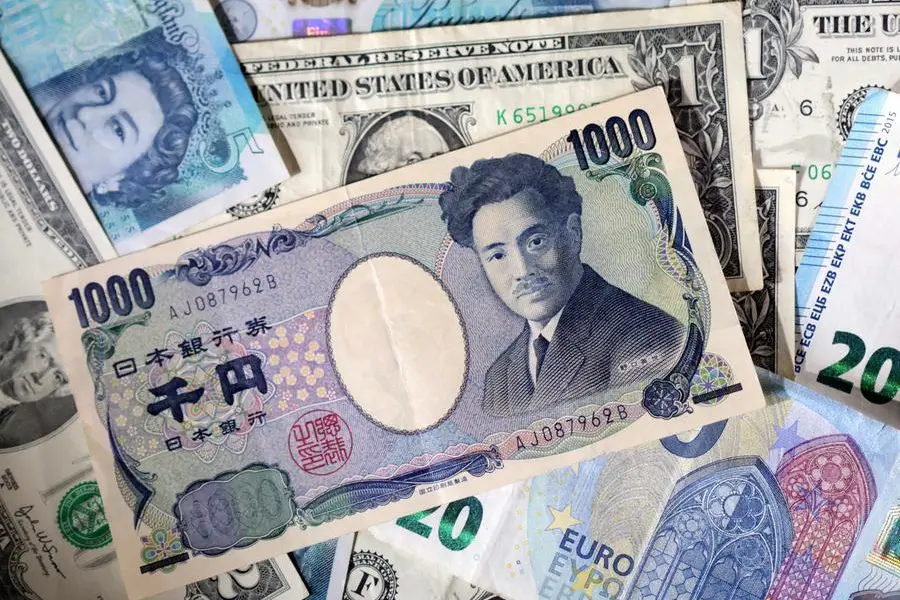
LONDON/TAIPEI - The yen bounced off lows on Thursday as investors assessed the latest signals from the Bank of Japan for clues on the rate outlook, while taking stock of Nvidia's earnings for insights into demand for AI.
The Japanese currency was up 0.2% against the dollar at 155.99 yen, on course to snap a two-day losing streak, after BOJ Governor Kazuo Ueda kept prospects of a near-term rate hike alive.
In an interview with the Yomiuri newspaper, Ueda said the central bank will look at data at its March and April meetings to decide the path for interest rates, days after a report that Japanese Prime Minister Sanae Takaichi had expressed reservations about additional monetary tightening during her meeting with the governor.
"It's kind of a push and pull, and the BOJ is walking a very fine line," said David Chao, Invesco's global market strategist for Asia Pacific.
"However, we still believe that the central bank will hike rates twice this year, and the yen is likely to be one of the best performing currencies," he added.
The Japanese government on Wednesday also appointed two academics who are viewed as strong advocates of economic stimulus, to the central bank's board.
"Leaving yen depreciation unchecked carries political risks, and FX intervention alone would be insufficient. Policy inaction remains unlikely," analysts at BofA Securities wrote.
Meanwhile, hawkish board member Hajime Takata said in a speech that the central bank must focus on the risk of an inflation overshoot in guiding monetary policy and called for a gradual rise in interest rates.
MUTED REACTION TO NVIDIA
Futures tracking the S&P 500 < ESc1> and the tech-heavy Nasdaq in the U.S. dipped 0.1% each, even after solid quarterly results from Nvidia.
The AI heavyweight extended its run of strong earnings but did not spark an immediate shift toward risk-on sentiment.
The U.S. dollar index, which measures the greenback's strength against a basket of six currencies, was steady at 97.678.
Financial markets continue to believe almost unanimously that U.S. interest rates are going nowhere at the Federal Reserve's next meeting.
Fed funds futures are pricing an implied 98% probability the U.S. central bank will keep rates on hold at its next two-day meeting on March 18, little changed from a day earlier, according to the CME Group's FedWatch tool.
The yield on the U.S. 10-year Treasury bond was up 0.2 basis points at 4.0518%.
Uncertainty also persisted over how U.S. President Donald Trump would respond to the Supreme Court's ruling on February 20 that struck down his emergency tariffs.
The U.S. tariff rate for some countries will rise to 15% or higher from the newly imposed 10%, U.S. Trade Representative Jamieson Greer said on Wednesday, without naming any specific trading partners or giving further details.
Geopolitics also remained in focus for markets as the U.S. and Iran prepared for another round of negotiations in Geneva to resolve their longstanding nuclear dispute.
"Geopolitical developments more broadly pose risks worth watching, especially as tensions in the Middle East continue, a potential Russia-Ukraine peace deal remains uncertain, and U.S.-China relations remain fragile," Goldman economists wrote.
The euro was largely unchanged at $1.18. European Central Bank President Christine Lagarde said policymakers continue to expect inflation to stabilise at their target rate of 2% in the near term.
The British pound inched 0.3% lower at $1.35. Domestic political risks remained a key driver, with traders focused on the local election in Manchester, widely viewed as a key test for Prime Minister Keir Starmer and his Labour Party.
In China, the yuan strengthened against the dollar in offshore trade, rising 0.3% to 6.8344 yuan, the strongest level in almost three years despite the central bank signalling it wanted to curb the currency's rapid gains.