The region loses $40-50-billion in economic loss due to youth unemployment, notes a McKinsey report. The problem will only get worse due to huge mismatch between the skills required for jobs and those on offer.
The economic loss of youth unemployment exceeds US$40-50 billion annually across the Arab world, equivalent to the GDP of countries like Tunisia or Lebanon, says McKinsey in a report commissioned by the International Finance Corporation and Islamic Development Bank.
The report covers countries with some of the most acute unemployment issues: Algeria, Egypt, Iraq, Jordan, Morocco, Oman, Saudi Arabia, Yemen, and Palestinian Territories.
Here are the key findings of the report, which show the enormity of the problems faced by the regional states:
* The Middle East suffers from the highest youth unemployment in the world, currently recorded at over 25 per cent, with North Africa reporting approximately 24 per cent.
* Female youth unemployment is far worse, reaching and exceeding 30 per cent across the Arab world, says McKinsey.
* The region's labour force youth participation rates are among the lowest globally, currently standing at around 35 percent, compared to the global average of 52 per cent.
* The large number of youth in the Arab world will continue to add pressure on the labour market over the coming years - approximately a third of the total population is currently below the age of 15, and a further third is aged 15-29. In consequence, tens of millions of young people will enter the region's work force over the next ten years needing to find jobs either at home or through regional labour mobility
Tackling the youth unemployment challenge will require a dual focus on creating employment opportunities, including self-employment, and ensuring the youth have the right skills for the jobs being created. To date, governments in the region have not focused sufficiently on the latter.
"Our research on this challenge reveals three messages: demand for e4e is substantial, supply of education for employment (e4e) is nascent, and critical enablers for e4e are missing," says McKinsey. E4e stands for education that leads for improved employment prospects.
"There is wide recognition that if nothing is done, unemployment levels are likely to rise further as a result of a demographic bubble: about one-third of the population is below age 15. As a result, millions of young people will enter the region's workforce over the next ten years," says McKinsey.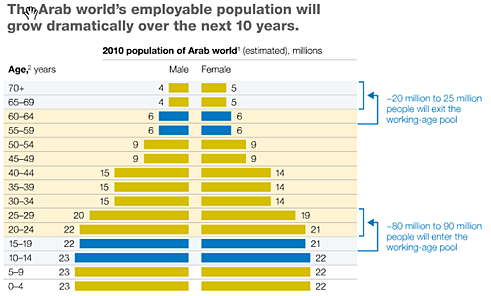
The report, which included interviews of 1,500 youths, is littered with comments about students completing their education only to find that their education does not fit the skillsets required by employers. The great skill mismatch is what's holding back the youth and leading to massive frustration among the population. This anger has already spilled out in countries as diverse as Egypt, Saudi Arabia, Jordan and Tunisia.
What is worrying is that that this development took regional governments by surprise, even though they could see the storm coming for years as the region's population dynamics went through a well-documented transformation.
That also means that governments can not resolve the problems overnight either. The departure of Ben Ali from Tunisia and Hosni Mubarak from Egypt will not solve the youth unemployment crisis overnight.
"So far, the region's governments haven't focused sufficiently on a vital component of the employment picture: how to ensure that the region's young people have the right skills for the jobs being created," McKinseys says in a report. "To do so, it will be necessary to orient education directly to work opportunities--full- or part-time or even self-employment. There is even less focus on how to encourage the private sector (both employers and education providers) to play a role complementary to that of the government in addressing the region's pressing needs."
What comes through in the report is the aspiration of the Arab youth, and the equal frustration of employers who can not employ them as their skillsets remain inadequate, despite their obvious enthusiasm.
The surveyed private employers estimated that only one third of new graduate employees are ready for the workplace when hired, a much lower rate than employers in other regions. Consequently, more than half of all employers provide substantial training for their new hires, to ensure work readiness, the report notes.
However, the supply of services that enable students to make their 'work-ready' are still in their infancy. Only 15-20% of students are enrolled in private institutions in the MENA region, compared to 50-75% in Brazil and Malaysia.
Meanwhile, structures that allow willing workers to get jobs are missing: there are few independent education standards, funding mechanism for students is insufficient, education providers are few and information on jobs are not easy to come by.
The challenge is big, significant, and urgent, warns McKinsey. "Action is required now: unless all stakeholders come together and embark on ambitious plans to address the employment gaps jointly, the Arab world's young people face potentially dire consequences."
© alifarabia.com 2011