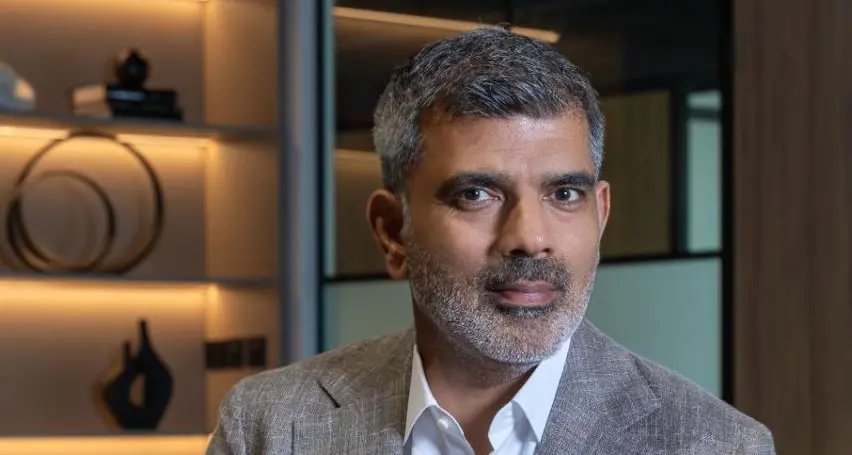
John Malcolm took over as Managing Director of Petroleum Development Oman (PDO) in November. PDO is a joint venture company that is majority owned by the Government of Oman. Shell holds a 34 per cent shareholding in the company and is its Technical Adviser. John has come to the job at a time when PDO has been working hard to overcome falling oil production. 'Shell in the Middle East' went to Oman to ask him questions about his credentials for the job, as well as PDO's short-term and long-term plans for addressing the challenges...
Q. What is your educational background and previous job experience?
I am a Process Control Engineer by education, and began my career in the British chemicals industry before working in the Middle East refinery industry. I then took a couple of years off to teach at the Heriot-Watt University in Edinburgh before joining Shell in 1986.
Believe it or not, my first job with Shell was here at PDO, as Head of Instrumentation and Process Control. I stayed at PDO for just over two years before taking up a range of different positions in the UK and Holland.
In 1999 I moved to Syria to take up the position of General Manager of AFPC [Al Furat Petroleum Company], a joint venture between Shell, the Syria Petroleum Company [SPC] and Petro Canada. Later, I also became the Shell Country Chairman in Syria and the General Manager of SSPD [Syria Shell Petroleum Development].
Q. Why do you think you were chosen for the job at PDO?
I am not really the one to answer that. However, I have been working for the last three years in Syria, where AFPC, like PDO, had been suffering from falling oil production. AFPC, like PDO, is a joint venture between Shell and the State, and the oil from the reservoirs in the two countries is similarly difficult to produce.
With the help of many extremely good people from SPC, AFPC and Shell, we were able to turn AFPC around. From being a company which had suffered declining oil production for10 years, AFPC is today a company which has a plateau of sustainable oil production at around 300,000 barrels of oil a day.
This came about because we were able to achieve an excellent level of alignment between all the parties concerned. Certainly, without the support of Dr Ahmad Mualla, General Manager of SPC, the leadership of Haytham Ghanem, the Chairman of AFPC, or the guidance of His Excellency Dr Ibrahim Haddad, Minister of Petroleum and Mineral Resources, that turnaround would have been impossible. Their co-operation enabled us to bring in the right technology and the right people to operate it, and to develop and use the abundant local talent, which we had in Syria.
Q. There has been much written about PDO's falling oil production figures in the press recently. Can you put these figures into perspective?
PDO's black-oil production level has fallen by some 10 per cent in the last 18 months; the production target we have set for 2003 - an annual average of 703,000 barrels of oil per day - reflects a further drop of 8 per cent. However, this should be seen against the company's substantial rise in gas and condensate production over the past few years, which is equivalent to about 240,000 bpd of oil.
The underlying reasons for the fall in oil production are now understood - in particular those related to the maturity of PDO's oil fields, many of which have been in production for over 30 years. And we plan to increase our black-oil production to 800,000 bpd in the coming years.
Q. What do you see as the main production challenges confronting PDO?
The main challenges in Oman are presented by its tremendously diverse portfolio of hydrocarbons, ranging from heavy to light. There is a wide variety of geological formations ranging from carbonates to sandstone. All of these factors combine to make the job of getting oil and gas out of the ground in Oman a little more complex than in many other places in the region.
PDO's oil production will not be increased by a quick fix. The planned solution is one which will take time, with the first results becoming apparent in 2004.
Q. His Excellency Dr Mohammed bin Hamad Al Rumhy, Oman's Minister of Oil and Gas, was quoted in 'Al-Fahal', PDO's internal newsletter, as saying, "I believe that part of our problem is that we are fire-fighting at the moment… We have been too preoccupied with trying to get that extra barrel rather than formulating a plan for the long term." Do you agree?
Oil and gas production is indeed a long-term business, and I fully agree with his viewpoint that PDO needs long-term strategies. PDO holds technical representatives meetings each year prior to the annual meetings of the Board of Directors. At the technical representatives meeting, representatives from the Ministry of Oil and Gas, the Ministry of National Economy, PDO, Shell and the other private shareholders discuss the company's five-year plan. The plan is updated every year to take into account new developments and opportunities. Our latest five-year plan was presented to the Board at a meeting last October.
So I fully agree that we must develop a short-term plan within a long-term plan and carry them both forward, focusing on the execution of the plans.
Q. What part will technology play in PDO's enhanced oil recovery programme?
The oil and gas industry is founded on technology and its application. What we can be certain of is that the technology we are using today will be outdated in another five years. We only have to look back at what technology we were using five years ago. PDO has long been a leader in the application of many types of advanced technology in the oil and gas industry - from reservoir modelling through to artificial lift techniques. One technology we are currently testing, which has tremendous possibilities and potential, is Under Balanced Drilling [UBD]. This is not a catch-all technology but it can be very successful when used in certain applications. One thing that is extremely important for all oil companies is not just to have access to the transfer of technology but access to the transfer of the expertise to use it properly. This may be carried out through the employment of expatriate workers with the relevant experience, either by having them train local staff or by having them do the work themselves, and through the cross-posting of local staff overseas to gain the necessary experience.
This is an essential part of the development of staff. Look at EP in Shell Malaysia. There are more Malaysians who were trained and developed by Shell Malaysia working in Shell outside Malaysia than there are expatriates inside the company. That is a success story of the development of local talent.
Q. His Excellency also said, "With regard to enhanced oil recovery [EOR], you must look at risk management in your need to find more oil. You have to ask yourself, which is easier - to go for oil you know exists or to find structures that may or may not contain oil?" How do you respond to his statement?
Our number one goal is to stop the decline in oil production and introduce enhanced reservoir management and enhanced oil recovery techniques. We will be developing plans to make the best possible use of our existing reservoirs to stabilise oil production at a targeted level to deliver oil for today and for tomorrow. We will also be looking to introduce technologies to deliver oil for the future. We expect EOR techniques, which may include steam-based thermal recovery, to play a much bigger role in contributing to the level of future oil production compared with the very small role EOR techniques play now.
In the short term, there will be a major move towards better and more controlled reservoir management. Secondary recovery, through such techniques as waterflooding, will also play a lead role.
And while these reservoir- management and EOR efforts make the most of the oil fields that we already have, we will continue to rely on exploration to find new fields. The Gharif formation in central Oman has been singled out as a promising area for exploration activities.
Q. Moving on to the subject of localisation, can you comment on His Excellency's following statement: "People are the solution to our problems. But people are not born experts - they have to be developed"?
PDO is a very large company with about 140 oil and gas fields. It has a daily combined oil and gas production of over one million barrels of oil equivalent. It is a massive enterprise, which today runs with a level of Omanisation in excess of 80 per cent at nearly all levels of the business.
I take on board the challenge to develop the existing Omani staff and to recruit even more Omanis. One of my main focuses will be to make PDO a place where people want to come to work. It is my belief that people want to work in both a place and a job they enjoy. I believe that one of the real secrets of good management is to use the talents of the people available to you and to recognise people's capabilities and develop these accordingly.
PDO must continue to aggressively develop Omanis to fill even more positions in the company. However, the real questions are: How many people do we need now? How many do we need in the future? And how quickly can we bring them along and develop their abilities so that they can play an effective role within the organisation?
I believe that we must be careful not to get too caught up in the statistics game. Instead, we need to look at what is best for PDO and so ultimately for Oman. There must be a balance between maintaining the efficient and profitable development of the company and staff development.
So, yes, I fully agree with His Excellency that people are the solution to our problems. PDO will be turned around only with the co-operation and help of the thousands of experienced, qualified and highly professional staff we are fortunate enough to have within the organisation and its contractors.
Q. On the subject of making better use of local contractors, His Excellency said, "I think that the people at PDO need to talk to contractors more. Contractors know of the production difficulties but they need to know more about the strategies and plans of the Company." What is your response to this statement?
If you look at any industry today you can see a very clear theme developing. If any aspect of a business can be performed by outside contractors in a more economical and more efficient manner than by the host company, then external contractors are being used more and more.
So, yes, I believe that this is the right way to go and to focus on what you do best, and in the future we will be communicating more with our contractors.
I also believe that PDO has to improve its levels of communication to stakeholders in general. We have to talk much more to the Ministry of Oil and Gas. We must communicate a consistent and clear message.
Q. PDO's concession agreement with the Government of Oman expires in the year 2012. What do you think lies in store for PDO - and Shell - in the future?
We will work with all PDO stakeholders not only to stabilise but to grow oil production and to develop PDO's resources, people and technologies for the future.
PDO is a highly integrated exploration and production company, which is where its strength lies. PDO has the resources to find a small pocket of oil way out in the desert and put in place the necessary personnel and equipment to extract that oil in a very short period of time.
The company is an integral part of Oman. It is one of the largest employers outside the Government sector, and its contribution to Oman's total Gross Domestic Product is in excess of 35 per cent.
The aspiration of the Government is that, over the next five years, PDO will be able to raise its oil production to 800,000 bpd and maintain this level for the foreseeable future. We agree that this is possible.
We will be concentrating on finding new oil and gas reserves and especially on the development of existing gas reserves for both domestic and industrial users in Oman, as well as on providing a steady and reliable supply of gas for export by Oman Liquefied Natural Gas. Oman has considerable gas in place, roughly equivalent to the amount of oil originally in place.
The relationship between Shell and the Government of Oman is a well-established and close one, having enabled the development of the country's energy resources.
So, the oil and gas are there, and we will use all of our experience and resources and draw on Shell's expertise from its worldwide operations to deliver them. We are confident that PDO production will be restored to the aspired levels. The application of technologies such as EOR will ensure that Oman sees maximum benefit from its natural resources and we look forward to PDO continuing to deliver for Oman well beyond 2012.
© Shell in the Middle East 2003