Middle Eastern and North African airlines face a challenging 2012 as they come to grips with the possibility of a global economic slowdown, again, and increasing competition, especially from Turkey and Asia.
After MENA airlines' net profit recovered in 2010 with an average increase of 7% year-on-year), 2011 brought weak economic conditions and political unrest.
The MENA airline industry performance picked up the slack in 2010 with operating margins increasing nearly 81% on-year.
UAE-based Emirates led the way with a 111% increase in the fiscal year ending March 2010. Emirates' impressive performance is mainly due to the increase in gross revenue by 22% and decrease in cost of goods sold (COGS) by 4%. The airline's average debt-to-assets ratio increased by 34% on-year in 2010.
Air Arabia significantly increased its leverage as the group entered into a leasing arrangement for USD 69.13 million with a Cayman Islands' leasing company to finance the purchase of two aircraft.
Although the industry experienced an asset turnover decrease of 22% in 2010, Kuwait National Airways managed to improve its assets usage by a remarkable 69% due to a 121% increase in revenue from its airline services.
The rise of major regional players such as Emirates, UAE-based Etihad Airways and Qatar Airways in the global market is helping the region carve out a huge role in the global airline industry. Emirates is already ranked fifth globally by the International Air Transport Association by number of passengers carried.
In its July-August 2011 Financial Monitor report, IATA noted a global decrease of almost 60% in the total 2Q 2011 net profit, from a sample of 33 world airline companies. Europe was an exception as its results improved from the depression caused the volcanic ash incident in 2Q 2010.
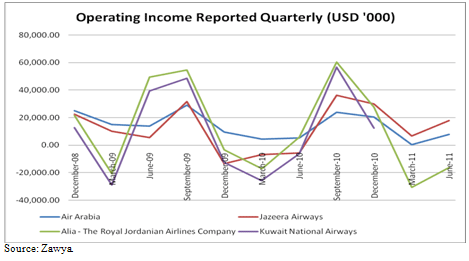
The graph illustrates the airline industry cycle throughout the year with its high and low seasons. The MENA region results are in line with IATA numbers. Operating profit increased in June 2010, peaked in September 2010 and started decreasing afterwards.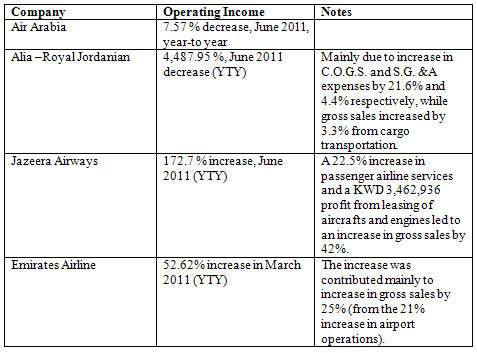
2012 Outlook
IATA has a cautious outlook for the international aviation industry in 2012 with total net profit scoring USD 4.9 billion compared to USD 6.9 billion in 2011 and USD 16 billion in 2010. In 2012, the Asia-Pacific region is expected to lead the industry with USD 2.3 billion in profits, followed by the MENA region with USD 0.7 billion.
IATA's expectations are linked to the forecast that world economic growth will remain weak at 2.4% in 2012.
Looking at the airline industry's benchmarks, Zawya data shows that MENA PLF (passenger load factor) value increased by 2.85% in 2010 and scored 75.4% in July 2011, compared to 77.7% worldwide. Freight load factor (FLF) reached 44.1% for MENA airlines compared to 46.2% worldwide. Passenger traffic value has increased by 8.2% in 2010.
IATA announced in September 2011 that MENA carriers grew their passenger traffic by 8.3% compared to a capacity increase of 9% in the first seven months of 2011, indicating expansion in fleets and flight schedules and establishing further government-protected networks, infrastructure, FDI and tourism regulations.
The above figures are valuable proof that the sector is on the right track to increase its efficiency. It also puts it on track to achieve the expectations of the Boston Consulting Group that passenger traffic in and out of the Middle East will reach 140 million in 2015. But 2012 expectations are still hesitant for some MENA airline companies, as forecast performance and profits show variations.
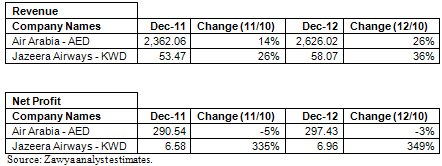
SICO said in September 2011 that Air Arabia has hedged (at USD 75 per barrel) 20%, 15%, and 5% of its 2011, 2012 and 2013 fuel requirements, respectively, but continues to be vulnerable to high fuel costs.
On the other hand, Jazeera Airways's main strength was highlighted in its ability to pass on a major portion of fuel price increases to passengers in the form of fuel surcharges instead of using fuel hedging instruments, according to the National Bank of Kuwait.
Opportunities
Major opportunities are lying ahead for the MENA airline industry and will help in the process of growth and expansion. The industry will be competing aggressively in the long-haul segment and expanding agreement networks (current and future alliances with global airline companies as oneworld, Star Alliance and SkyTeam).
Regional aviation is expected to grow on the back of increasing hub capacity, which will reach about 200 million by 2018, thus exceeding the combined capacity of London Heathrow, Paris Charles de Gaulle and Frankfurt, according to Ayusha Tyagi, General Manager of Aviation Outlook MENA 2011.
With the Arab countries holding around 60% of the world oil reserves, it presents a cost advantage in managing the jet fuel for the airline industry and their consequent futures and hedging accounts.
Although jet fuel prices were 44% higher in August 2011 on-year, they have experienced a downward effect after peaking in April 2011. As Japan's nuclear disaster, China's floods and the absence of Libyan and Syrian oil on the market will probably add more pressure to prices, forecasts are still optimistic for oil prices to remain above USD 100 per barrel in 2012.
MENA airlines will have to step up the game in terms of improved infrastructure, well-equipped fleets, managed rules and regulations on open skies (securing air traffic rights) and shifting to new sources of fuel. For example, Qatar Airways is considered the leader in the use of gas-to-liquid (GTL) renewable fuel in it flights.
Challenges
The MENA airline industry, along with other industries, is faced with the region's fragile economic environment and political instabilities, with the next five years seen extremely critical to maintaining profits and facing aggressive competition from the West, Turkey, and the rising Asian hubs.
Giovanni Bisignani, director general and chief executive of IATA, said the most important four challenges are: infrastructure, technology, government involvement and environment.
Infrastructure for the MENA airline industry should be heavily correlated with the open sky limits and regulations, especially considering that military airspace covers 60% of the region, limiting capacity and routings. Infrastructure has to walk hand in hand with safety regulations as well. Currently, 35 MENA carriers are on the IOSA registry (the IATA Operational Safety Audit).
Technology is needed in the region to simplify the airline business, stretching from bar-coded boarding passes to e-freight techniques.
Government intervention and regulatory frameworks are needed in this industry, especially to balance the rapidly increasing long-haul opportunities with short-haul regional liberalization of tax laws and charges. Morocco, Jordan and Tunisia are setting examples of liberalization in building open-sky agreements with Europe.
Environmental challenges are facing all business sectors in the whole and the airline business is no exception. The 37th Assembly of the International Civil Aviation Organization placed aviation ahead of all other industries in dealing with climate change, with an inspiring goal to improve fuel efficiency by 2% to 2050, while limiting emissions from 2020 with carbon-neutral growth.
For now, however, all eyes are on 2012, the year of slow-moving growth and weak profits for the international airline business. The MENA aviation industry faces the daunting task of preserving its pool of customers and markets in the face of competition while tackling issues related to human resources, capital, and new hubs.
© Zawya 2011