TNS examines the Kingdom's largest non-food category.
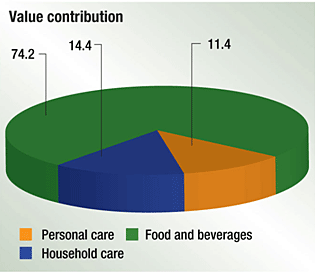
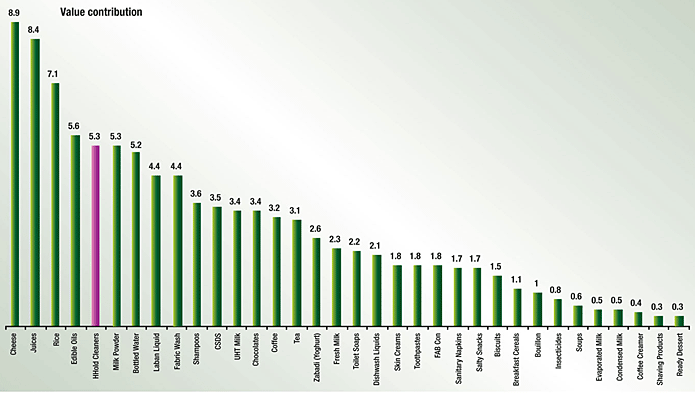
The bulk of household spend in Saudi Arabia among fmcgs are on F&B. The household care categories viz. Household Cleaners, Fabric Care, Dishwash and Insecticides contribute 14.4% of the total household spends in fmcg.
Cheese is the largest category in terms of spend followed by other F&B categories such as Juices, Rice and Edible Oils.
Household cleaners contribute to 5.3% of the household spends and is the largest non-food category followed by Fabric Wash.
Household Cleaners comprises of three main segments:
Specialist cleaners such as toilet cleaners, floor cleaners, glass cleaners, carpet cleaners, bathroom cleaners, kitchen cleaners, etc.
Disinfectants
Bleach
Disinfectants and bleaches are general purpose cleaners. Bleaches are generally used for household cleaning as well as for fabric wash.
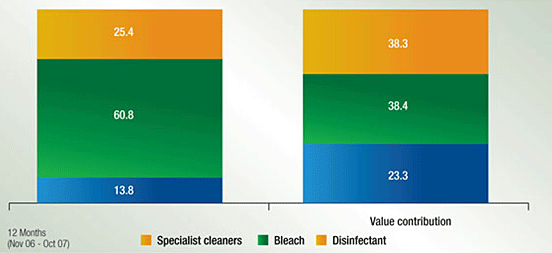
Bleach is the largest segment. It accounts for two third of the volumes. In value terms the Specialist Cleaners segment is also important since it is more expensive than disinfectants and bleaches. The following Measure Tree (right) gives the key household purchase indices for Household Cleaners category. An average household purchases 73.9 litres of Households Cleaners in a year which translates into $82. The purchase frequency is once in three weeks. In a single occasion, an average of 4.4 Liters of cleaners is purchased.
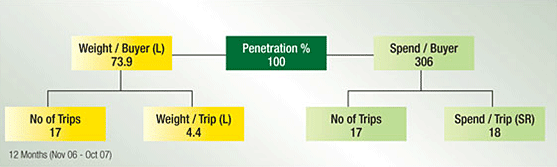
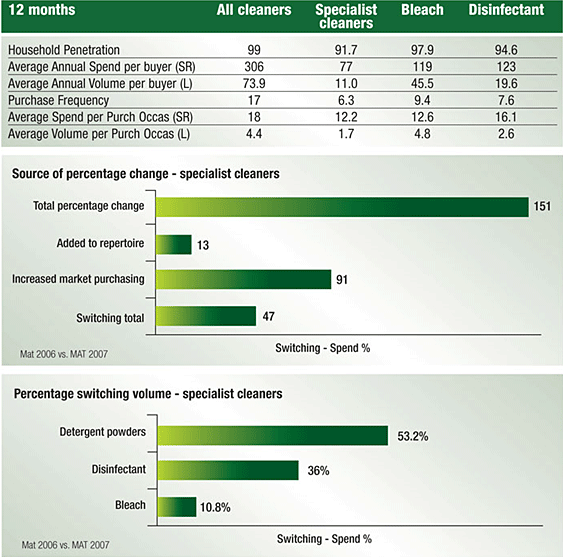
But a break up by the three segments indicates that a large quantity of cleaners is purchased in a single occasion only if it is Bleaches. When a Specialist Cleaner is purchased, the quantity is around one and a half liters.
The purchase frequency of Bleach is once in five weeks while that for Specialist cleaners is once in two months.
All the three segments have penetration of more than 90%. However, there is potential to increase penetration for sub segments within specialty cleaners such as toilet cleaners, glass cleaners, kitchen cleaners, etc.
Growth of specialist cleaners
The Saudi market used to be more of general cleaners market with almost all households using Bleach and Disinfectants. Even detergents were used for household cleaning purposes. This phenomenon termed 'cocktailing' was one where a housewife mixes bleaches, disinfectants and detergent powders for household cleaning purposes. But more recently, there has been lot of activity in this category with marketers launching cleaners for a particular surface like floor, glass, carpet, toilet, etc.
The Specialist Cleaners grew at 151% in 2007 over 2006. This growth is mainly due to increased purchasing which indicate that the household have actually purchased more of Specialty cleaners without replacing any other format. But there is also a large amount of switching.
In switching, Specialty Cleaners have gained mainly from Detergent Powders followed by Disinfectants. This confirms that 'cocktailing' is on a decrease in Saudi households. This also indicates that the Household Cleaners market is evolving.
Channel contribution
More than half of the household cleaner volumes are purchased from upper trade (Hypermarkets and Supermarkets).
A quarter of the cleaners are purchased from Mini markets and hypermarkets. This indicates that the modern trade is very important for household cleaners' category and provides opportunity for marketers to do marketing activities which are store specific.
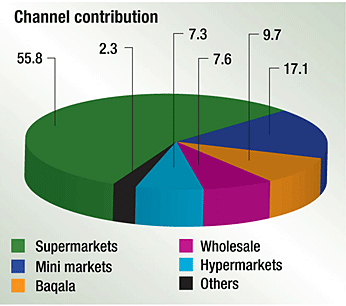
Some of the stores have started their own private label brands which would provide more choice for consumers. Panda store has launched the Panda brand primarily in the disinfectants segment. It year 2007, it had a penetration of 23% which is remarkable considering that Panda label is considerably recent.
The impressive growth of specialist cleaners is good news for marketers since this would result in increased spend on Household Cleaning category. Marketers are increasing the level of activity and it would be interesting to wait and watch how the household cleaning category grows over time.
A clean sweep: highlighting the latest initiatives in brand development and media planning
Clorox:
Clorox, which has been in the region for more than 50 years, has enjoyed continued success with its flagship Liquid Bleach - overall bleach household penetration is at 92% in the GCC says the company. Clorox is the dominant bleach in the region with 84% market share and TOM awareness of 95%.
In the middle of last year, however, introduced an entire range of new distinfecting products including surface cleaners, disinfecting bathroom and toilet bowl cleaners, disinfecting wipes and antiseptic disinfecting liquid. What made the launch particularly notable was that it diluted the umbrella brand's laundry credentials and moved the entire positioning - globally - onto the more emotionally engaging, health and wellness platform: the entire range was designed to make everyday life better, everyday.
Following a region-wide 360 campaign, Clorox reports that its home care volumes almost doubled in the UAE and more than doubled in other markets including Qatar and Kuwait. In fact, Liquid Bleach's volumes scored record sales in the region.
Building on the wellness positioning Clorox plans to roll out its range of natural products in the region later this year.
Unilever Group
Chief Executive Patrick Cescau paid his first visit to Saudi Arabia late last year to commemorate the 75-year partnership between his company and local distributor, Binzagr Company, to and meet with government officials.
One of the world's largest consumer products companies, Unilever has deep roots in the Kingdom. Currently, the Binazgr factory has 350 permanent employees and a 45% Saudi workforce, many of whom have been trained to lead in senior management positions. Global brands like Lux, Dove, Sunsilk, Comfort, Signal and Close Up are common household names in the region but not many people are aware that they are produced in Saudi Arabia by this factory.
The American manufacturer says a strong local market base combined with its ability to leverage Unilever technology and access to global R&D resources drives the factory's competitiveness.
SMG MENA
A study last year, conducted jointly by SMG MENA, Procter & Gamble, and in-store media supplier Hypermedia, showed that Arab shoppers are more influenced by in-store advertising media than their Asian or Western counterparts.
Philip Jabbour, SMG MENA group director for marketing and business development, said that the study was particularly important given the growing share of marketing budgets being spent on in-store advertising.
"We recognise the need to connect with shoppers, not just consumers. A simple call-to-action will no longer suffice for today's savvy shoppers. Rather, we need to communicate brand messages, and there's no more powerful way of doing this than reaching them on the ground where they make their purchases," Jabbour said.
Eyad Zarea, household goods giant P&G's regional media group manager, said, "We developed the idea for this research in discussions with SMG because we believe in-store advertising is pivotal but there had not been any independent data or findings to back up our investment in it. Arab consumers are rapidly changing, and this increased sophistication is affecting their shopping habits. We need to identify the key measurable contact points to ensure successful communication."
The three partners chose the UAE for the first study because of the significant investment in in-store marketing and rapid evolution of supermarkets and hypermarkets in the country. In Saudi Arabia, volumes still derive from self-service outlets and groceries, although the trend there also is toward large retailers.
Commenting on the rise in shopper marketing, Habib Wehbe, Hypermedia CEO, said: "The feedback we have had from consumers as well as clients has been overwhelming in the last three years.
On target
Targetism, specialists in the "design of tailor-made business simulations for efficient human resource development" announced the launch of a new business simulation for suppliers of consumer packaged goods in November last year.
The product, called Targetism CPG, is a modular board modular board simulation that illustrates the structures and processes of a typical CPG business. It covers the entire value chain from product innovation over 0.manufacturing, marketing and sales to logistics and deli.00.ve ry. The simulation includes business in emerging and developed markets and five distribution channels: convenience, supermarkets, mass merchandisers, discounters and 'Mom and Pop' stores.
The board simulation provides the framework for 3-day interactive courses. Teams of 4-6 participants lead competing simulated CPG companies throughout three business cycles representing business years. As a team, they cope with tough competition and deadline pressure while striving to optimize their business.
Participants experience the CPG business and its challenges, understand business and cost drivers and obtain 'big picture' knowledge on interdependencies between performance and profitability. The course includes simulation cycles, facilitator's inputs, decision-making rounds, team presentations of results and benchmarking.
According to Targetsim CEO Dr. Gudrun G. Vogt, who devised the training method, "The simulation methodology has proven to be much more effective than traditional classroom training or case studies."
Key Trends in the Global Household Cleaning Market
Convenience - Disposable, compact, timesaving and efficient products are on the rise. As lifestyle trends become increasingly hectic and fast-paced, the convenience factor is a key driver. Purchasing decisions are heavily determined by the necessity of products that do the job quickly and efficiently. This has been particularly evident in the floor-wiping segment, where a number of product launches have made 'bucket-less' floor cleaning possible and more desirable.
Fragrance - A prominent trend in household care, with consumers looking not only for higher performance and convenience but also for pleasantly-scented products. Introducing novel fragrances has been integral to most sectors, bringing an additional appeal to products and making cleaning tasks seem a more agreeable experience to consumers.
Technology - A number of manufacturers have recently introduced products with "active oxygen" such as oxygen bleach, "Oxi" stain removal products claiming strong efficiency and more environmentally friendly features.
Innovation - To boost value and fight increasingly sophisticated private label products, continual innovation activity and diversification of products is taking place.
Task-specific devices - A key development is the introduction of devices aimed to make the performance of household chores significantly more convenient and less time consuming. Such products have been launched across the board, from dishwashing to toilet care.
Decor - An increased interest in improving the living environment is leading to greater awareness of appearance; products need to look good, as well as perform. This has been particularly evident in air care via the success of products such as Air Wick Crystal'Air.
The decorative factor is extending to categories such as toilet care with Henkel's Fresh Surfer, an in-the-bowl rim liquid developed in collaboration with the Italian design factory Alessi.
Gulf Marketing Review 2008