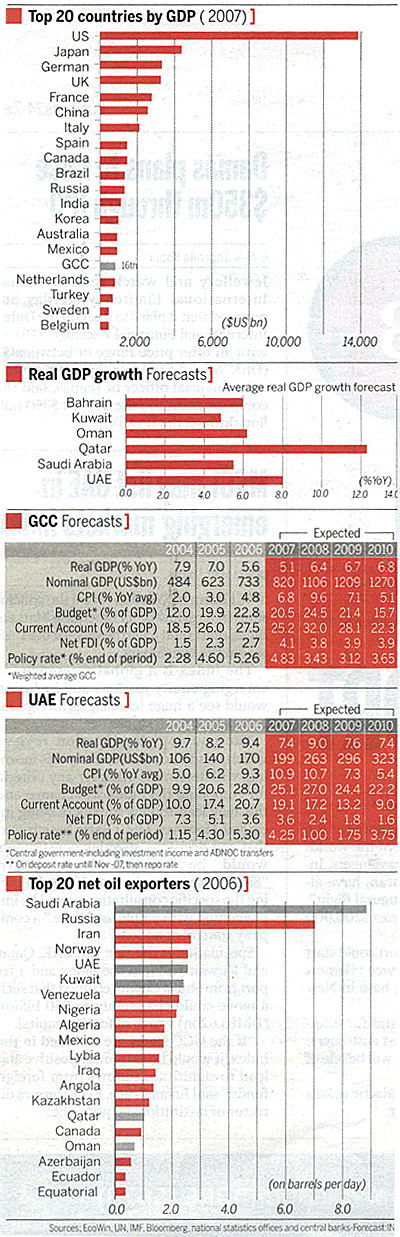
Gulf nations will see nominal gross domestic product rise by a compounded annual growth rate of 16.4 per cent over the three years to 2010 if the price of crude averages at $120 per barrel in 2008, $131 in 2009 and $133 in 2010, new research has forecast.
This is a decrease on the average nominal GDP growth of 19.4 per cent year-on-year in the previous three years, the London-based research arm of ING investment bank said.
In real terms, growth should pick up from 5.9 per cent average over 2005-2007 to 6.6 per cent over 2008-2010. "However, we also expect the differentiation in dynamics to strengthen across the region," ING's Senior Economist Dorothe Gasser-Chteauvieux said in the report. "UAE and Qatar should perform the best - Qatar boosted by new LNG production plants kicking off and the UAE better protected from the softening oil cycle due to a more diversified economy."
ING sees a possible oil price reversal as the largest threat, followed by military conflict in the region to the growth scenario.
In spite of a softening outlook for oil prices beyond 2008, the GCC should still record hefty budget surpluses and continue injecting liquidity in their economies, ING said. Official public capital expenditure stands at about seven per cent of GDP in the region.
Project momentum will remain strong in the GCC, up 28 per cent between November 2007 and March 2008 alone. And ING estimates that $2 trillion (Dh7.34trn) worth of projects are currently in the pipeline and the construction boom will last another three to five years.
"On the assumption of a five to eight year completion framework, this equates to 20 to 30 per cent of GDP per annum," Gasser-Chteauvieux wrote. "In our GCC GDP growth profile for 2008-2010, we continue to see investment as a critical driver to growth, fuelled by the authorities' traction and high oil prices."
Gross fixed capital formation is thus expected to grow by 19 per cent year-on-year in the next three years, only modestly softer than the 23 per cent recorded in 2005-2007.
Inflation constraint
ING sees inflation as a moderate constraint to consumption growth in the short term - "but there are differences across the region".
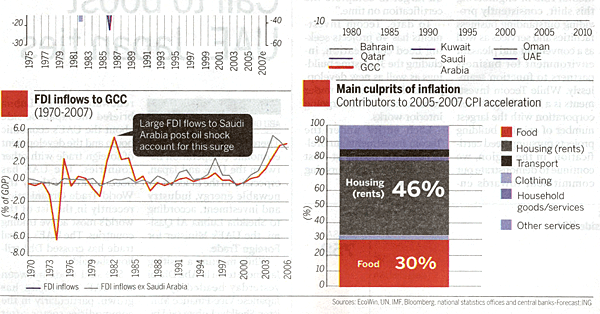
Inflation has picked up from 0.8 per cent in 2002 to 6.8 per cent in 2007. In the first wave, from 2003 to 2006, UAE and Qatar led the way, with CPI boosted mostly by rents. Both countries now have the highest inflation in the region.
In the second wave from 2007 onwards, there has been what ING calls "catch-up" from Saudi Arabia and Oman, with CPI mostly boosted by food prices.
"We do not see inflation coming off noticeably in the next three years. This year should be a peak for most of the 'catch-up'. In fact, CPI should still land at around five per cent in the region by 2010, back only at 2006 levels. Food price pressures should remain vivid in the short term, while anti-inflation measures remain unorthodox," Gasser-Chteauvieux wrote.
Budget surplus
The favourable oil cycle backdrop has allowed GCC countries to achieve massive "official" budget surpluses
of 11 per cent of GDP on average over 2003-2006, but this does not include investment income receipts (for Kuwait, Qatar, UAE), Oman's SPRF, and part of hydrocarbon revenues (UAE, Qatar), ING said.
"We estimate an actual figure closer to 16-18 per cent of GDP," Gasser-Chteauvieux said.
ING also forecasts a substantial reduction in public debt, and an additional fiscal cushion built up with SWFs (around $2-3tr for the region) with a focus to boost regional growth.
The region's nations have based their budget estimates on a very conservative assumption of the oil price for the past five years. If this continues, surpluses are likely to increase over the next three years.
"Investment accounts for a larger share of GDP growth going forward than during the past two oil shocks: from virtually nil on average over 1973-74 to 22 per cent over 2003-06," ING said.
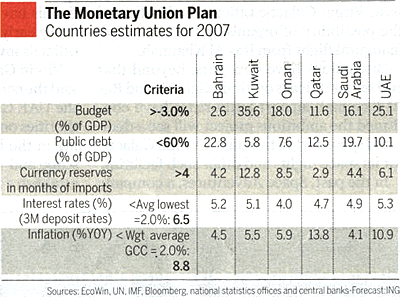
Most of the criteria prescribed for GCC monetary union are met by the six Gulf nations in terms of budget, public debt, interest rates and currency reserves. The interest rates are almost uniform due to the countries' peg to the US dollar, and Qatar's non-fulfilment of the currency reserves criterion is a "limited challenge" given the country's current account surplus and the assets of the Qatar Investment Authority, ING said.
"Inflation remains the key challenge, with Qatar and the UAE unlikely to meet the criteria by 2010. However, both countries' CPI underperformance is due to the high housing component weight in the index. Should housing prices slow back below 10 per cent annual growth, the inflation criterion could be met."
Dollar peg to stay
Except for Kuwait, the GCC countries have pegs against the US dollar. Their interest rate policy is thus not independent. With the US Fed set to ease rates further, de-synchronising with the GCC economic backdrop, pressures have mounted on the local authorities to change the exchange rate regime, ING said.
"We do not expect the other GCC states to abandon the peg, because the dollar is still the prominent currency in GCC trade flows and scrapping it would damage the credibility of the monetary union project," Gasser-Chteauvieux said.
"Logistically, it would be difficult to implement in the short term, given the need for basket weight computation and money supply management." However, in spite of the peg, some countries are not fully using the "tightening leeway", ING said.
Besides, dropping the peg would not solve the inflation problem, for example in Kuwait. Revaluing would reduce competitiveness and thereby hamper export diversification efforts.
"Revaluing would undermine fiscal and export revenue flows, which are also set to face softening oil prices. Revaluing would weaken the banking sector, which is historically long on the US dollar. The weak dollar scenario should recede from H2-2008 onwards," ING said.
By Staff Writer
Emirates Business 24/7 2008