Even as Ukraine looks to move further away from the European Union, its former Soviet Union comrade Azerbaijan took another confident step forward with the final investment decision earlier this year on the USD 28 billion Shah Deniz II gas project.
The giant gas project would supply 20% of European gas demand till at least 2048. It will also "change the energy map of our region and help the historical development of our country," according to Azeri president Ilham Aliyev.
The project also allows the Eurozone to diversify away from uncertain Russian natural gas supply via Ukraine - a country that is currently caught in a political storm.
Ukrainians have spilled on to the streets, enraged by Ukraine's president Viktor Yanukovich's decision to side with Russia and spurn an economic deal with the European Union.
Even as Ukraine dithers, the Western European countries have found a willing partner in Azerbaijan.
Oil giant BP, which is leading the Shah Deniz project, notes that the final investment decision triggers plans to expand the South Caucasus Pipeline through Azerbaijan and Georgia, to construct the Trans Anatolian Gas Pipeline (TANAP) across Turkey and to construct the Trans Adriatic Pipeline (TAP) across Greece, Albania and into Italy.
"Together these projects, as well as gas transmission infrastructure to Bulgaria, will create a new Southern Gas Corridor to Europe," the company said in a statement.
CHANGING EUROPE'S ENERGY MAP
Apart from BP's 28.8% stake in the project, Azeri state-owned SOCAR (16.7%), Norwegian company Statoil (15.5%), French company Total (10%), Russian Lukoil (10%), Iranian NICO (10%) and Turkish company TPAO (9%) are stakeholders in the project. Some of these companies are also partners in TANAP and TAP pipeline projects.
"Very few projects have the ability to change the energy map of an entire region. Shah Deniz 2 and the Southern Corridor pipelines will not only change the energy map, but will give customers in Europe direct access to the gas resources of Azerbaijan for the first time," said Bob Dudley, group chief executive of BP.
And in a nod to the regional - and political -- support for the project, Dudley added: "The final investment decision today would not have been possible without years of cooperation between many companies and many countries. I am proud that BP can be part of this historic moment, and grateful for the efforts of so many people in making this possible. As well as creating tens of thousands of jobs along the route of the pipelines in Azerbaijan, Georgia, Turkey and Europe, this project represents the largest ever foreign investment to Azerbaijan."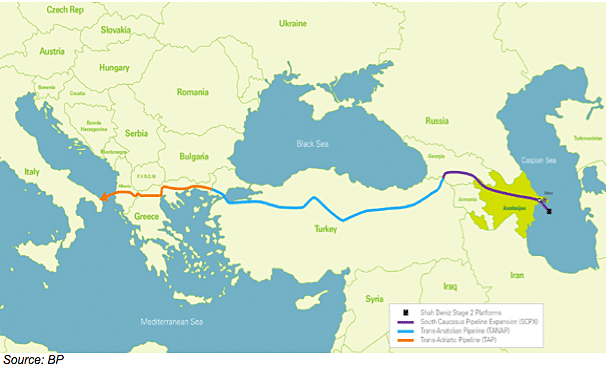
POLITICAL OVERTONES
The political overtones of the project cannot be understated. The EU sees the Azeri deal as a win for Western powers in a former Russian territory.
The win comes at a time when an increasingly belligerent Russian president Vladimir Putin has been reinforcing his country's geopolitical reach and is looking to create an EU rival - the Eurasian Customs Union that would include Kazakhstan, Belarus apart from Ukraine and other former Soviet Union states, recreating the communist bloc.
The battle between Russia and Europe over influence over the Central Asian states will play out over a number of years. Many Central Asian governments such as Azerbaijan are aware of the great game being played, but instead of being mere pawns, they are taking advantage of the predicament.
While Azerbaijan is a regional powerhouse, it has fallen short of democratic principles. But it is also aware that a natural gas dependent EU would be less likely to criticize the authoritarian rule of president Aliyev, whose family has ruled the country for 20 of the 22 years of its history as an independent state.
QUESTIONABLE HUMAN RIGHTS RECORDS
"Azerbaijan has an appalling human rights record and the country is currently embarked on a particularly aggressive crack down on freedom of expression," said Allan Hogarth, Amnesty UK's head of Policy & Government Affairs, noting that the UK's foreign secretary William Hague should have raised the issue of human rights during his visit to Azeri capital Baku on December 17 to attend the signing ceremony of the Shah Deniz project.
However, the British secretary' statement merely focused on the economic aspects.
"The announcement of the Shah Deniz 2 development is welcome news for Azerbaijan, for the UK and for Europe. This adds to Europe's energy security and competitiveness by opening up a new source of gas for southern Europe," Hague said in a statement that also noted that the official will discuss "a range of issues" with the Azeri president and foreign minister.
While Hague may have brought up the recent issue of arrest of a well-known democracy advocate Anar Mamadli and other violations in private with Azeri authorities, human rights groups have criticized the EU for not taking a more public stand with the Baku government.
The softly-softly approach towards Azerbaijan is in contrast to the EU's stated goals of pursuing human rights, NGO group says.
In a report last year titled 'The EU and Azerbaijan: Beyond Oil', the European Council on Foreign Relations noted that the EU should revisit its policy and follow a "hug and hold" strategy - that is, hug Azerbaijan but also hold it to its commitments to reform.
"The EU should support transfer of know-how, exchange programs and capacity-building in the public sector while re-directing more political and financial support to grassroots groups, SMEs and independent media who can put more pressure on the regime. Unless the EU takes this bolder approach towards Azerbaijan, it risks finding itself in the same position it was in the southern neighborhood before the Arab Awakening: that of a quiet supporter of autocrats."
© alifarabia.com 2013