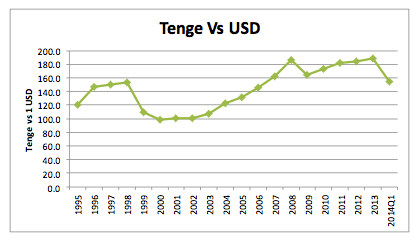
Kazakhstan's economy received a major jolt when the country's central bank devalued the currency by 20% against the US dollar.
The central bank was responding to a dramatic decline in the currencies of Turkey, Ukraine, Russia and Argentina in recent weeks as the emerging market currency rout continues to spill over across the world.
"This is a purely financial measure, aimed at only improving the economic state of our enterprises, each of which employs 10,000-40,000 people," said Kazakh president Nursultan Nazarbayev. "Our economy will receive additional income and in general, it will positively impact the economy's further growth."
Ivan Tchakarov, an economist at Citigroup said in a note to clients that the Kazakh central bank moved aggressively as it was "concerned about losing competitiveness vis-à-vis their main trading partner, Russia. The central bank thinks devaluation is a way to restore lost competitiveness."
While many emerging markets have raised interest rates to stop capital from fleeing the country, the Kazakh bank's dramatic devaluation was a bold move, and it's too early to say whether it was the right move.
Kazakh deputy executive director of the Association of Mining and Metallurgical Enterprises Tulegen Muhano told the local media that the devaluation would help the country's resource and metals industry, which sells its products in US dollars.
The currency crunch comes at a time when growth prospects in the country are uncertain. While the International Monetary Fund expected Kazakh's GDP this year to clock a robust 7.5%, much of it is predicated on the production surge from the Kashagan oil field.
The much-hyped USD 47 billion project was expected to start firing on all cylinders last year, but has failed to live up to its expectation. Kashagan is the largest oil field discovered in the past four decades but continues to face technical challenges as a consortium of major oil companies struggle to get it up and running.
The US Department of Energy forecasts that Kashagan will restart production in the second half of 2014 and ramp up in 2015 but remain below the field's phase one target of 370,000 bpd as technical challenges and high development costs may limit its expansion.
"However, if commercial production from Kashagan is delayed beyond 2015, this would result in a downward revision of Kazakhstan's total projected supply growth over the next two years because the country's supply growth is mainly dependent on Kashagan," the department warned.
Kazakh officials have threatened to fine the consortium of companies, which includes Italian company Eni SpA, The Hague-based Royal Dutch Shell and US's Exxon Mobil Corp.
EXPANDING TRADE
Currency volatility and poor growth prospects are pushing the Kazakh authorities to take urgent action to expand and deepen the country's trade dimensions.
President Nazarbayev held numerous meetings with the European Union, the European Bank for Reconstruction and Development and the World Trade Organization at the recently concluded Davos, in an effort to revive Kazakh's plans to apply for WTO and forge closer ties with the EU.
Kazakhstan is keen to sign a partnership and cooperation agreement (PCA) with the EU.
"As Brussels is preparing to unveil a new version of its region-wide policies to extend as far as 2020, Astana has been actively pushing for a more ambitious PCA with Europe in order to account for their constantly expanding ties," said Georgiy Voloshin, an analyst at Jamestown Foundation.
The EU is currently Kazakhstan's leading trade partner responsible for more than USD 50 billion worth of annual trade. That partnership could bear more fruits as the economic bloc is keen to export more Kazakh oil resources and wean itself away from Russian supplies.
Kazakhstan is also looking to speed up its WTO membership which has been pending since 1996.
But a key stumbling block is Kazakhstan's trilateral Customs Union (with Russia and Belarus), which violates WTO trade practices.
"As the promised benefits of Kazakhstan's participation in the Customs Union look more as outright losses and Russia's efforts to impose political integration intensify, Astana is increasingly turning westward," Voloshin said. "WTO membership and closer ties with the EU are thus construed by the Kazakhstani leadership as a means to limit Russia's geostrategic influence without compromising the ongoing integration projects with Moscow."
Earlier this year, president Nazarbayev also signed off a new foreign policy document for the country, which is focused on deepening political and trade ties not just with Eurasian countries, but also the West, China and the Muslim world, apart from far-off Africa and South American states, as the country looks to move out of Russia's orbit.
The feature was produced by alifarabia.com exclusively for zawya.com.
© Zawya 2014