PHOTO
(The opinions expressed here are those of the author, a columnist for Reuters.)
By Andy Home
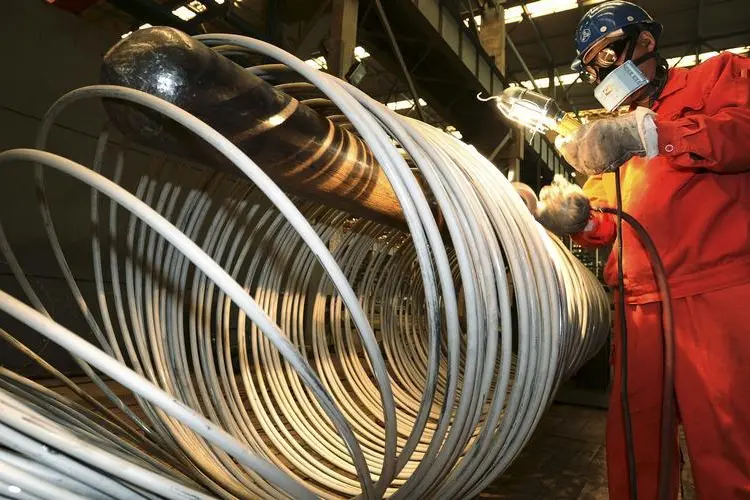
LONDON, Nov 15 (Reuters) - China has already met its target of cutting 45 million tonnes of steel production capacity this year, according to the country's top economic planning body, the National Development and Reform Commission.
urn:newsml:reuters.com:*:nL4N1DC1KN
It may even eliminate a bit more over the last couple of months of 2016.
The country is ahead of schedule in terms of its originally stated goal of reducing its bloated steel sector by 100-150 million tonnes over a five-year period.
This shouldn't come as a big surprise.
Beijing's planners do targets well, particularly when they have something to prove. In this case, staving off international pressure to do something about the flood of steel product exports roiling other producing nations.
The only problem is that Chinese steel production is rising, not falling.
So too are exports. True, their growth has slowed sharply from last year's supercharged 20 percent to "just" 2.4 percent in the first nine months of this year.
But that may yet prove to be only a temporary respite in the slide to full-out trade war in the global steel sector.
CAPACITY DOWN, PRODUCTION UP
The combination of capacity cuts and higher production seems, at first glance, a counterintuitive outcome.
But it's not.
Firstly, while there is no doubting Beijing's determination to slim its huge steel sector, there is a serious question mark as to whether it's doing enough.
China's own steel body, the China Iron and Steel Association, has previously estimated excess capacity to be 300 million tonnes, twice the targeted closure rate.
Secondly, it has never been clear what exactly is being closed.
If it is long-disused mills in China's rust belt, clearly it won't have any impact on actual run rates.
If it is "zombie" capacity, mills that flit in and out of activity largely to keep servicing distressed debt, it won't have much more effect.
That's not to say closing such capacity isn't a good thing. It's just that it's a good thing first and foremost for China itself rather than the rest of the world's steel producers.
The capacity closure programme ticks two policy-goal boxes for Beijing beyond easing the international furore about China's steel exports.
It's a chance both to clean up the morass of bad debts surrounding "zombie" steel mills and the environmental impact of older-technology production lines.
The steel city of Tangshan, for example, will relocate millions of tonnes of capacity to a new, purpose-built, high-technology site on the coast.
The steel reform programme will leave China's steel sector leaner and meaner and capable of running faster.
Which it is currently doing. After contracting by 2 percent last year, national production is now up year-on-year to the tune of 4 percent in October and 0.7 percent over the first 10 months of the year.
PRICE UP, DEMAND UP
And it's rising because China's steel mills are making money.
Steel rebar prices on the Shanghai Futures Exchange
SRBcv1
hit a two-year high of 3,220 yuan per tonne on Monday.
This is all part of the frenzied trading that has once again caused turmoil across China's commodity exchanges over the last few weeks.
The trigger, ironically, was Beijing's over-enthusiastic closure of coal capacity. The resulting price rises have drawn the same crowd of retail investors that wreaked similar price havoc earlier this year.
The authorities have responded with a barrage of margin hikes and trading curbs that have damped but not extinguished the crowd's animal spirits.
But these wild price swings are also a manifestation of China's renewed stimulus package, flowing as ever down the twin channels of construction and infrastructure.
This has boosted the country's steel demand, which is why the export pace has slowed sharply so far this year.
But part of the credit splurge seems to have found its way into exchange trading, particularly of commodities such as iron ore and steel that are directly linked to the real-world beneficiaries of government largesse.
THE COMING SLOWDOWN
The tail winds of the early-year stimulus package are still blowing hard.
Fixed-asset investment from the state sector increased by 20.5 percent in the January-October period, with real estate investment rising by 6.6 percent.
But the authorities are already trying to deflate renewed property price bubbles in what are termed Tier 1 cities, even as prices stagnate in lower-tier cities.
The stimulus package comes with a limited shelf life and the general consensus is that it will have largely run its course by around the second quarter of next year.
To what extent promises of further targeted spend on infrastructure will pick up the slack is a moot point, given a proposed shift of financing to untested public-private partnership structures.
The danger is that demand fades even while steel mills are still pumping out ever-greater quantities of the stuff.
LOOMING SHOWDOWN
The obvious escape mechanism for such a supply-demand mismatch is exports.
Even with the current stimulus-fuelled demand boost, China's steel exports are still increasing, just at a slower pace than before. A potential re-acceleration is looking increasingly likely over the course of 2017.
The rest of the world is simply incapable of absorbing such a huge flow.
Whatever the enthusiastic reaction to President-elect Donald Trump's promised infrastructure programme in the United States, it will not compensate for a slowdown in the Chinese leviathan.
Analysts at Goldman Sachs estimate that, even if delivered in full, the U.S. package will translate into a boost to steel demand in the order of 6 million tonnes per year. ("Metals' pricing of potential U.S. infrastructure spending: too much too fast", Nov. 11, 2016)
To put that into context, consider that China is exporting close to 10 million tonnes of steel products every month.
Not that much of that tonnage will make it to the United States anyway thanks to an increasingly high wall of anti-dumping duties on Chinese steel.
The European Union looks set on following the same protectionist path.
China can be expected to react badly. It has, after all, delivered its promised capacity cuts. Just a shame that its steel mills are increasing production again.
But that was always going to be the problem with the tortuous political compromise on steel overcapacity at the last G20 meeting in September.
(Editing by Dale Hudson) ((andy.home@thomsonreuters.com, 44-207-542-4412 and on Twitter))
By Andy Home
LONDON, Nov 15 (Reuters) - China has already met its target of cutting 45 million tonnes of steel production capacity this year, according to the country's top economic planning body, the National Development and Reform Commission.
It may even eliminate a bit more over the last couple of months of 2016.
The country is ahead of schedule in terms of its originally stated goal of reducing its bloated steel sector by 100-150 million tonnes over a five-year period.
This shouldn't come as a big surprise.
Beijing's planners do targets well, particularly when they have something to prove. In this case, staving off international pressure to do something about the flood of steel product exports roiling other producing nations.
The only problem is that Chinese steel production is rising, not falling.
So too are exports. True, their growth has slowed sharply from last year's supercharged 20 percent to "just" 2.4 percent in the first nine months of this year.
But that may yet prove to be only a temporary respite in the slide to full-out trade war in the global steel sector.
CAPACITY DOWN, PRODUCTION UP
The combination of capacity cuts and higher production seems, at first glance, a counterintuitive outcome.
But it's not.
Firstly, while there is no doubting Beijing's determination to slim its huge steel sector, there is a serious question mark as to whether it's doing enough.
China's own steel body, the China Iron and Steel Association, has previously estimated excess capacity to be 300 million tonnes, twice the targeted closure rate.
Secondly, it has never been clear what exactly is being closed.
If it is long-disused mills in China's rust belt, clearly it won't have any impact on actual run rates.
If it is "zombie" capacity, mills that flit in and out of activity largely to keep servicing distressed debt, it won't have much more effect.
That's not to say closing such capacity isn't a good thing. It's just that it's a good thing first and foremost for China itself rather than the rest of the world's steel producers.
The capacity closure programme ticks two policy-goal boxes for Beijing beyond easing the international furore about China's steel exports.
It's a chance both to clean up the morass of bad debts surrounding "zombie" steel mills and the environmental impact of older-technology production lines.
The steel city of Tangshan, for example, will relocate millions of tonnes of capacity to a new, purpose-built, high-technology site on the coast.
The steel reform programme will leave China's steel sector leaner and meaner and capable of running faster.
Which it is currently doing. After contracting by 2 percent last year, national production is now up year-on-year to the tune of 4 percent in October and 0.7 percent over the first 10 months of the year.
PRICE UP, DEMAND UP
And it's rising because China's steel mills are making money.
Steel rebar prices on the Shanghai Futures Exchange
This is all part of the frenzied trading that has once again caused turmoil across China's commodity exchanges over the last few weeks.
The trigger, ironically, was Beijing's over-enthusiastic closure of coal capacity. The resulting price rises have drawn the same crowd of retail investors that wreaked similar price havoc earlier this year.
The authorities have responded with a barrage of margin hikes and trading curbs that have damped but not extinguished the crowd's animal spirits.
But these wild price swings are also a manifestation of China's renewed stimulus package, flowing as ever down the twin channels of construction and infrastructure.
This has boosted the country's steel demand, which is why the export pace has slowed sharply so far this year.
But part of the credit splurge seems to have found its way into exchange trading, particularly of commodities such as iron ore and steel that are directly linked to the real-world beneficiaries of government largesse.
THE COMING SLOWDOWN
The tail winds of the early-year stimulus package are still blowing hard.
Fixed-asset investment from the state sector increased by 20.5 percent in the January-October period, with real estate investment rising by 6.6 percent.
But the authorities are already trying to deflate renewed property price bubbles in what are termed Tier 1 cities, even as prices stagnate in lower-tier cities.
The stimulus package comes with a limited shelf life and the general consensus is that it will have largely run its course by around the second quarter of next year.
To what extent promises of further targeted spend on infrastructure will pick up the slack is a moot point, given a proposed shift of financing to untested public-private partnership structures.
The danger is that demand fades even while steel mills are still pumping out ever-greater quantities of the stuff.
LOOMING SHOWDOWN
The obvious escape mechanism for such a supply-demand mismatch is exports.
Even with the current stimulus-fuelled demand boost, China's steel exports are still increasing, just at a slower pace than before. A potential re-acceleration is looking increasingly likely over the course of 2017.
The rest of the world is simply incapable of absorbing such a huge flow.
Whatever the enthusiastic reaction to President-elect Donald Trump's promised infrastructure programme in the United States, it will not compensate for a slowdown in the Chinese leviathan.
Analysts at Goldman Sachs estimate that, even if delivered in full, the U.S. package will translate into a boost to steel demand in the order of 6 million tonnes per year. ("Metals' pricing of potential U.S. infrastructure spending: too much too fast", Nov. 11, 2016)
To put that into context, consider that China is exporting close to 10 million tonnes of steel products every month.
Not that much of that tonnage will make it to the United States anyway thanks to an increasingly high wall of anti-dumping duties on Chinese steel.
The European Union looks set on following the same protectionist path.
China can be expected to react badly. It has, after all, delivered its promised capacity cuts. Just a shame that its steel mills are increasing production again.
But that was always going to be the problem with the tortuous political compromise on steel overcapacity at the last G20 meeting in September.
(Editing by Dale Hudson) ((andy.home@thomsonreuters.com, 44-207-542-4412 and on Twitter))