Central Asia and wider Eurasian countries have benefited from the natural resource over the past few decades, and it is time the region leverages its natural strength to build a deeper and wider economic base without deviating from its core strengths, according to a new report.
Eurasian states have utilized its resource base to build their economies, compared to East Asia, which used labor to catapult itself in the 1970s and 1980s. However, with only 280 million people across the massive Eurasian region, human skills alone will not be enough to push regional growth.
Six of the Eurasian countries are rich in resources: Azerbaijan, Kazakhstan, the Russian Federation, Turkmenistan, Ukraine and Uzbekistan; while the other six are not: Armenia, Belarus, Georgia, the Kyrgyz Republic, Moldova, and Tajikistan.
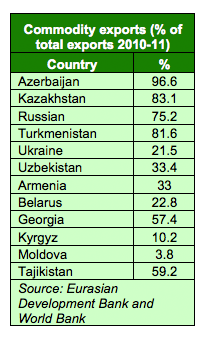
About 85% of the economic output of Eurasia is in its six resource-rich economies, and minerals and metals are about 85% of the exports of the region.
The resources have served the region well with Azerbaijan, Kazakhstan, and Russia on the verge of becoming high-income economies. And their prosperity has spilled over to their less fortunate neighbors, with the result that 85% of Eurasia's citizens are no longer considered poor.
There is considerable argument by analysts whether Eurasian states should diversify away from natural resources for its next phase of developments.
"Academics who study resource-based economies debate whether these countries should consider themselves cursed or blessed," Indermit S. Gill, Ivailo Izvorski, Willem van Eeghen and Donato De Rosa, analysts at Eurasian Development Bank and World Bank said in a report.
"And Eurasian countries seem uneasy with living off the land. Their policy makers long for the day when their economies no longer depend so heavily on natural resources. They try to put away some of the earnings from oil and gas for future generations. And they have spent significant amounts of public money trying to foster activities believed to be less extractive and more innovative."
DOWNSIDES OF RESOURCE RELIANCE
The "chafing dependency" on natural resources has its disadvantages, as most of the Central Asian states have come to the limits of much of their large-scale resource developments and any growth from here on would be incremental. Almost 90% of Azerbaijan's exports are resource-driven, compared to nearly 80% in both Kazakhstan and Turkmenistan.
But the region should not be hasty in abandoning its core strengths.
"The experience of resource-rich countries around the world shows that diversification of exports or production may be neither necessary nor sufficient for development," said Laura Tuck, World Bank vice president for Europe and Central Asia.
"Eurasia region need to worry less about diversifying their exports or production, and think more about building diversified national asset portfolios - to ensure better balance between natural resources, built capital, and economic institutions."
A key area of focus should be infrastructure developments. When the Eurasian countries were under Soviet rule in the past century, there was an emphasis on infrastructure and electricity supply, which made the entire region formidable.
"It is not so formidable now," said the bank in the report. "Kazakhstan covers 10 times the land area of Malaysia, but its roads are barely as long as Malaysia's. Eurasia, a region of almost 22 million square kilometers, has a road network only as big as Brazil's, with just a third of the area and two-thirds of the population. A quarter of Eurasia's rural population lives more than 2 kilometers from an all-weather road, lower than in Indonesia."
Resource-rich nations in Central Asia can also take a leaf out of Saudi Arabia's books which has leveraged its massive oil and gas production base to develop a world-class petrochemicals sector and manufacturing sector that produces steel, fertilizer, refined oil products and plastics.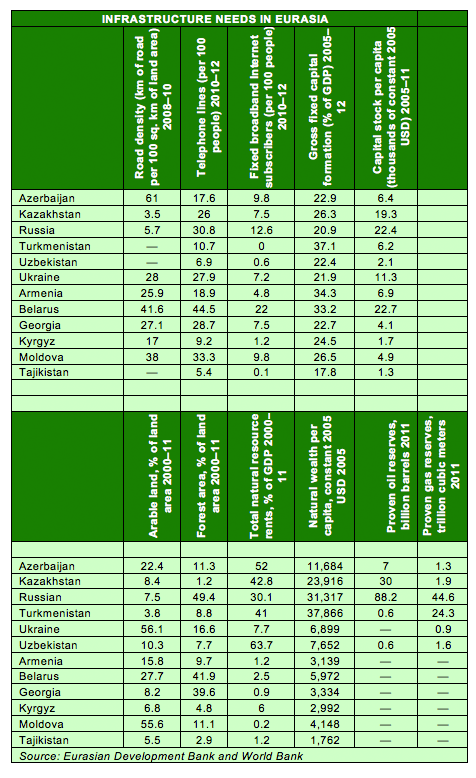
INTANGIBLE CAPITAL
The most successful resource-rich economies such as Saudi Arabia, Norway, UAE and Chile have strong institutions that manage their resources, a reserve fund to manage resource revenues and strong governance and corporate ethics among its key enterprises.
At the other end of the spectrum, state-owned institutions such as Mexico's Petroleos Mexicanos (Pemex) and Venezuela's Petroleos de Venezuela SA (PVDSA) - have presided over falling resource development, as they have suffered from poor governance.
The Eurasian states must resist the temptation to use state enterprises for short-term political gains, and build them into strong enterprises that can symbolize their strength and have world-class corporate governance.
"The quality of institutions in Eurasia today resembles neither that in Chile nor that in Venezuela," the report noted. "Azerbaijan, Kazakhstan, and Russia have improved the arrangements for managing resource revenues, providing social services and regulating enterprises. But they have not yet attained the institutional standards of Chile. The other resource-rich economies--Turkmenistan, Ukraine and Uzbekistan--are even further behind."
Indeed, while some of the Eurasian states have strong infrastructure, schools, roads and medical facilities, they lack in "softer assets" such as quality of teaching, medical care and public services that are customer-oriented.
While countries such as Azerbaijan and Turkmenistan have been investing heavily, their efforts are not efficient and projects have suffered from poor planning.
"In Kazakhstan, significant expenditures are carried out through public-private partnerships and extra-budgetary institutions, notably the giant state investment holding company Samruk Kazyna," said Mark Horton, assistant director, and Jonathan Dunn, deputy division chief, in the IMF's Middle East and Central Asia Department. "This raises questions about the coordination of fiscal policy with the budget, as well as about transparency and potential contingent liabilities. Finally, the transparency of Turkmenistan's oil- and gas-related funds--and, indeed, of Turkmenistan's economy more generally--is quite limited."
All Eurasian countries needs to invest in sounder economic institutions to be able to manage their public finances, improve education and infrastructure to make workers more productive, and develop stronger competition regimes to encourage private enterprise and entrepreneurship, the World Bank concluded.
"Stabilization, education, and competition--these are the priorities for the next decade."
The feature was produced by alifarabia.com exclusively for zawya.com.
© Zawya 2014




















