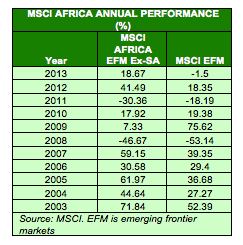
The MSCI Africa Index has risen 60% over the past two years, but the continent's capital markets need further reform to fulfill their potential as financing engines for the continent.
By late October, Ghana had emerged as the continent's best-performing market, up 65.68%, with Malawi (up 53.08%) and Rwanda (up 37.50%), comprehensively beating their other emerging counterparts.
"African economies have so far built up their growth as suppliers of new materials and low value-added goods to western countries," said Sunil Benimadhu,
chief executive of The Stock Exchange of Mauritius Ltd and president of the African Securities Exchanges Association (ASEA), in a presentation.
"There is, now, a substantial need for African economies to power themselves up to move-up the value-chain of products to become over time the supplier of high-value added products to the rest of the world."
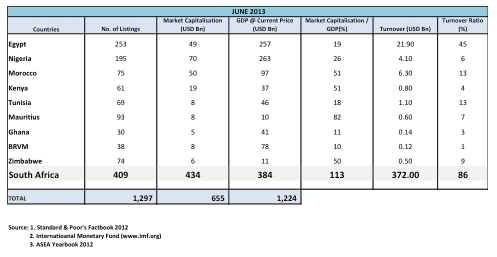
By June 2013, the combined African capital markets had a market capitalization of USD 655 billion, with nearly 1,300 companies - but the entire continent's combined market capitalization is lower than that of Indian or Brazil stock markets.
Most African exchanges (with the notable exception of South Africa) have significantly lower market capitalization to GDP and turnover ratios compared to exchanges in the US, Europe, Japan and the BRIC countries.
"This emphasizes the extent to which the African stock exchanges are undersized with respect to the economies in which they operate," said the African Development Bank. "More importantly, it underscores the growth potential of African stock exchanges."
MAJOR CONCERNS
The ASEA president identified key issues holding the markets back:
- Fragmented nature of financial services sector
- Restricted market depth and breadth
- Equity-centric exchanges
- Liquidity issues
- Unusually high transaction costs
- Absence of an active and well developed domestic investor base (low institutional participation & less than 1% retail participation)
- Manual trading and settlement infrastructure
- Issues of efficiency and real-time availability of market information
- Corporate governance practices of listed companies
- Protection of minority shareholders' rights
- Accounting and disclosure standards
- Transmission mechanism
African capital markets need to secure products, players, participants and partnership to stimulate them, the president noted.
"Increase the number of local investors from the current 1% to at least 10% of the population," Benimadhu said in his presentation.
"Diversify product base (corporate and government bonds, short-selling on liquid counters, single-stock futures on liquid stocks, introduce index-futures), slash transaction fees and innovate by introducing turnaround trades."
Reaching out to the rest of the world and improving the availability of updated market statistics was also crucial in putting African stock markets on the radar screen of international investors.
An AfDB report in 2012 noted that a 156% turnover ratio (average ratio of the US, Japan and the BRIC countries) and based on current market capitalization, turnover of African stock exchanges (excluding South Africa), would increase to USD 330 billion, representing an increase of USD 286 billion.
"This would represent more than a seven-fold increase from the current levels" the bank estimated.
GROWTH MOMENTUM
The AfDB president recently noted that Africa must maintain a 7% annual growth. "We are all pleased and satisfied with the [5%] GDP growth rate for the continent recorded in the past few years," AfDB president Donald Kaberuka said.
"But this rate is insufficient for our needs in Africa. Given strong demographic growth, the required growth rate should stand at [7%]. The gap between [5% and 7%] is due to poor infrastructure hindering the continent's development. With solid and efficient infrastructure, we can without doubt reach a [7%] growth rate per annum - a good starting point for Africa."
Much of that growth can be driven with sectoral investment, which should bring capital market as a key vehicle for financing.
"Stock Exchanges in Africa can provide centralized and organized platforms for these private and public sector entities to raise capital to fund their future growth," said AfDB.
Benimadhu argues the capital market authorities should encourage good companies to list on African exchanges.
"Successful African companies should contribute to the growth of local capital markets and local economies, instead of systematically supporting the growth of the larger well-established markets. In addition, linking up stock markets through technology so as to increase the intra-regional investment flows and broaden the availability of tradable scrips on our exchanges."
GLOBAL INVESTORS DIVERSIFYING
In addition, international investors are also looking to diversify from emerging markets and dip their toes in frontier markets.
"Asset allocation at the international level is growingly shifting towards emerging and frontier markets. African Stock Exchanges are expected to benefit from this asset allocation shift and witness increased portfolio flows from international institutional and retail investors," AfDB said.
Even as many more countries go to the market, there is a general lack of capital market expertise in many African countries.
International capital market access is still relatively new to most sub-Saharan African countries, says Vera Songwe, nonresident senior fellow, Africa Growth Initiative.
"Local financial markets are underdeveloped and consequently the in-country knowledge and expertise needed to make informed decisions are often weak and lacking. Global investment banks have a role to play. As part of their market penetration strategy, they will need to do more capacity building and client education. In addition to playing the role of solicitor, firms must be more transparent and provide active development training to countries."
© alifarabia.com 2014