Around 11 million SMEs remain unserved or underserved in the Middle East, presenting a massive USD15-billion opportunity for the banking industry.
There is a massive USD15-billion opportunity for banks in the Middle East's small-to medium-enterprises (SME) sector over the next five years, according to McKinsey & Co.
The global research consultancy says the time is right for global banks to home in on the SME sector in emerging markets which are on the verge of explosive growth.
The opportunity is clear for banks seeking new prospects: McKinsey data shows that up to 9-11 million SMEs in the Middle East, or roughly 41-50%, are unserved or underserved by banks.
The regional SME space is part of a greater opportunity in emerging markets led by East Asia, which is expected to grow at 20% per annum from USD62 billion in 2010 to USD167-billion by 2015.
Overall, the emerging market's SME sector is set to expand from USD150-billion in 2010 to USD366-billion.
Middle East will slightly underperform global markets, growing at 14% per annum, but will still more than double from USD6-billion in 2010 to USD15-billion.
McKinsey notes there are three clear reasons for banks to pay attention to SMEs now:
1 First, close to 60% of global banking revenue growth over the next decade will be in emerging markets.
2 Second, banks are increasingly focused on emerging markets and finding ways to overcome the challenges of serving SMEs.
3 Third, technological breakthroughs, risk assessment and business models are facilitating growth and making such projects viable..
"It is not just banks in emerging markets that should grab the opportunity," says McKinsey in a report.
"Western banks will find innovative practices that they can use to refresh and adapt their traditional banking models back home."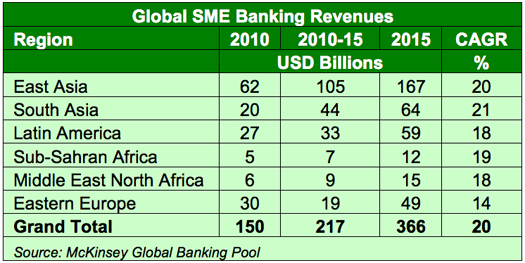
McKinsey believes that the challenges that obstructed growth - such as low revenue per client, high risk of credit losses and the need for a physical presence to lend to MSMEs - are no longer the obstacles they used to be.
"Revenue growth should therefore be profitable. Our research revealed that a few leading emerging market banks are making returns on equity (ROE) of over 30% in the MSME segment, and many others are earning 20-30%," McKinsey estimates.
'CREATIVE CREDITS'
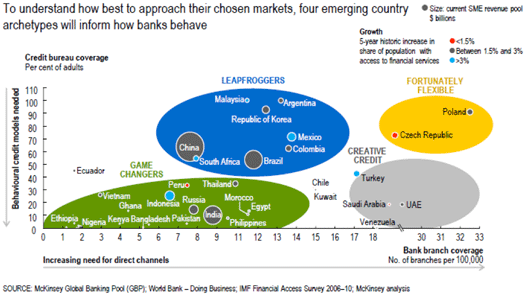
To understand how best to approach their chosen markets, four emerging country archetypes will inform how banks behave: 'game changers', 'creative credits', 'fortunately flexible' and 'leapfroggers'.
The UAE and Saudi Arabia are part of the 'creative credit' group of countries that have good distribution but low credit bureau coverage.
"Creative credit" countries typically have good distribution but sparse credit bureau coverage. This group has relatively few countries and includes Turkey, the UAE, Chile and Saudi Arabia. Banks operating in these countries must pay extra attention to risk management because of the lack of information, McKinsey notes.
Egypt, Morocco, meanwhile fall under the 'game changers' group of countries that present distribution and risk management challenges.
Kuwait falls somewhere in between both the two categories.
However, further dissecting the emerging markets, the UAE, Saudi Arabia, Qatar and Morocco were in the 'cool zone', suggesting sluggish growth.
"Markets in the "cool" zone... are increasing financial penetration at less than 1.0 per cent per annum... Domestic banks can pursue profitable MSME niches within "cool" countries, and multinational banks can approach these markets opportunistically as part of a broader portfolio of markets weighted towards red hot and warm countries," says McKinsey.
Egypt is the sole Mideast country in the 'warm zone', suggesting it is achieving a moderate growth in financial penetration of 1.0-2.0% per annum but still represent an exciting opportunity.
Not surprisingly, Brazil, Russia, India, China - the BRICs - apart from Turkey, South Africa and Indonesia, were in the 'red hot' zone.
However, Middle East states do well in mobile phone and retail coverage which may give them an advantage especially as banks are considering partnering with telcos and retail operators to access SMEs.
"Many forward-thinking [banks] are forging such partnerships to: share physical infrastructure, for example retail outlets for correspondent banking, as in Latin America; use mobile as a distribution channel for financial services; and use account data from telecom companies to assist with credit scoring," notes McKinsey.
NO PHILANTHROPHY - WE ARE BANKS, PLEASE!
While SMEs are seen as the 'backbone' of most economies and inspire many rags-to-riches stories, banks have traditionally been wary that these feel-good stories don't necessarily translate into bottomline growth.
No more. There are clear compelling business reasons for banks to get into the SME space. McKinsey research shows that SMEs accounted for USD150 billion, or a sixth of overall banking revenues in all emerging markets in 2010.
"Our interviews with 29 leading banks in emerging markets were consistent with this: almost two-thirds believe that MSME lending will increase by over 20% per annum or more over the next five years, and another 10% believe it will increase by at least 15% per annum," says McKinsey.
"Strikingly, this projected USD217 billion revenue growth by 2015 is larger than the combined growth of USD140-billion in global sales and trading (USD64 billion), global asset management (USD63 billion) and global investment banking (USD13 billion)."
HOW TO PLAY IT
It will not be easy though. McKinsey believes the banks will have to focus on five areas to take advantage of the opportunities that will present themselves:
1 Develop a granular understanding of their markets
Identifying clear geographical areas will be crucial as emerging markets are less concentrated than in advanced markets. It will be equally crucial to identify the sectors to focus on.
In emerging markets, five sectors comprise around 75% of the SME banking revenue pool: retail (approximately 20%), manufacturing (30%), hospitality (9%), general services (9%) and agriculture (8%).
2 Radically lower operating costs
Low-cost branches and correspondent banking will be crucial to operating profitably in emerging markets. This is where contact centres, mobile phones and point-of-sales agents will be crucial for success.
3 Manage risk innovatively
"A people- and judgement-intensive approach to risk is likely to be too costly," notes McKinsey. "Banks must develop new and creative ways to assess credit, such as psychometric testing, cash flow estimates, or qualitative credit assessment. All associated credit processes (e.g., loan origination, monitoring and collections) must be streamlined."
4 Empower MSME clients
Financial literacy is a challenge in emerging markets.
"About three-quarters of the banks interviewed told us that poorly presented business cases, a consequence of poor financial literacy, is the number one reason why banks decline credit applications for SMEs," notes McKinsey. "Such businesses, they added, often have limited knowledge of supply chain management, sourcing, marketing, pricing and other quite fundamental practices."
5 Engage with government
Governments can be useful allies in overcoming challenging business environments - so banks must work with them by, say, establishing risk-sharing facilities and credit bureaus, or seeking out information that identifies under-served and unserved clients.
The UAE recently launched Federal Credit Bureau focused on collecting and documenting data from different financial institutions and individuals in the UAE, conducting studies and analysis, in addition to presenting comprehensive reports specifying debt levels and financial commitments.
In Saudi Arabia, the Saudi Credit Bureau was launched in 2002 but remains a work in progress.
Other markets in the region are slowly looking to build credit bureaus, but the regional unrest has set many of these plans back by a few years.
Also Read: Zawya joins forces with Arabia 500 to help fast-growing regional small-and-medium businesses
© alifarabia.com 2012