Highlights
Total assets of banks listed in the Arab stock markets totaled $1.394 trillion in 2011
QNB takes the top spot with total assets of $82.995 billion
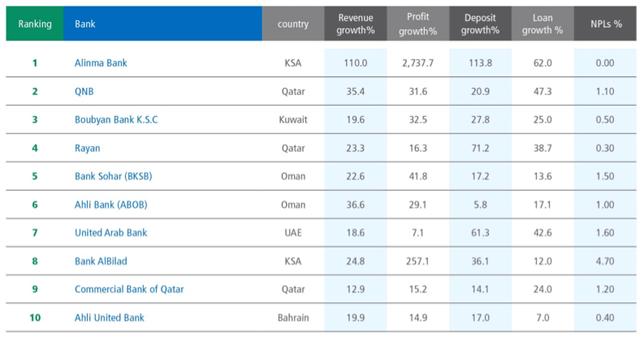
Alinma Bank tops the list of fastest growing banks with net profit growth of an incredible 2,737.7%
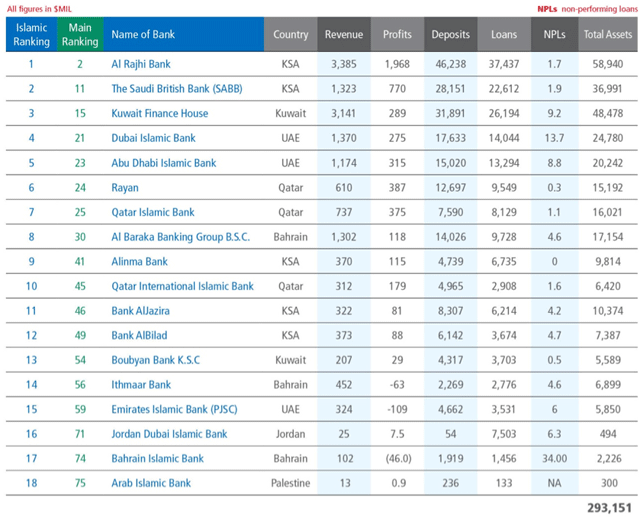
Total Islamic banking assets reached $293 billion across 18 banks
Al-Rajhi Bank tops the Islamic banking list with total assets of $58.9 billion
Total loans of the largest and fastest growing banks in Arab stock markets reached $855.7 billion in 2011
The UAE's Emirates NBD leads the way on the ranking of largest banks by loans, with total loans reaching $55.30 billion
The MENA region amassed a grand total of $979.7 billion in deposits for 2011 from across 75 banks
The GCC was the dominant player where deposits are concerned, contributing $780.3 billion amounting to 80% of the total
Total assets of banks listed in the Arab stock markets totaled $1.394 trillion in 2011
QNB takes the top spot with total assets of $82.995 billion.
Dubai- 18 June, 2012
The 75 Largest Banks in Arab Stock Markets
Forbes Middle East has conducted an in-depth study into the largest banks in the Arab stock markets. This study included detailed research into 19 countries within the MENA region; 12 of which made it on to our final lists. Due to political instabilities or non-disclosure of annual financial reports for the full year ending 31 December 2011, a number of countries were excluded from the rankings on this occasion. These countries include: Syria, Libya, Iraq, Mauritania, Yemen, Algeria, Sudan and Tunisia. As a result, out of a total of 110 banks, 75 were included in our ranking of 'The 75 Largest Banks in Arab Stock Markets,' with combined total assets reaching an impressive $1.394 trillion.
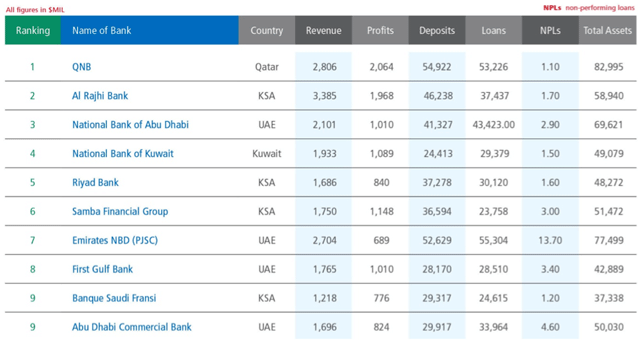
Assets were afforded the highest weighting amongst other criteria, as they provide the most accurate indication of bank size. With total assets of $82.995 billion, QNB secured the top spot on this ranking, followed by Al Rajhi Bank with total assets of $58.940 billion. The 75 banks involved also recorded combined operational income of $60.6 billion and combined net profits of $22.7 billion, thanks in part to the creation of new credit portfolios (loans) totaling $855.7 billion. Our research concluded that Emirates NBD is the highest lending bank with total loans of $55.3 billion.
The GCC dominated this ranking with 57 banks, accounting for 76% of the total and representing combined total assets of $1.158 trillion. Furthermore, in the GCC alone, deposits which are regarded as the lifeblood of banks and the backbone of credit portfolios, reached $780.3 billion from a total of $979.7 billion.
The top ten leading the way on the Forbes Middle East ranking of 'The 75 Largest Banks in Arab Stock Markets' include:
The 75 Fastest Growing Banks in Arab Stock Markets
The GCC demonstrates its dominance amongst the region's fastest growing banks
Tracking banks' annual growth using key indicators such as growth in profits, revenues, loans and deposits throughout the year is vital to analyzing performance, both of individual banks and the sector as a whole. As part of this extensive study, and in light of increased profits achieved across the MENA region in 2011, the Forbes Middle East team conducted further research based on the disclosed annual financial reports of 75 banks for 2011 and 2010. This research resulted in our second featured ranking: 'The 75 Fastest Growing Banks in Arab Stock Markets'.
As one of the main indicators, profit growth was afforded the highest weighting amongst all the criteria used to develop the ranking. Profits are crucial in measuring the activity of a bank, as well as its ability to create a balance between assets and liabilities. They are also indicative of how well a bank is handling, and building upon, its shareholders' investments.
Alinma Bank tops the list of fastest growing banks with net profit growth of an incredible 2,737.7%, translating to a figure of $115 million up from just $4 million the year before. QNB followed in second place with net profits of $2.06 billion, representing growth of 31.6%.
Growth in deposits is one of the most important factors in increasing a bank's profits, followed by loan growth. As a result, the Forbes Middle East team paid close attention to both of these factors. While taking a modest position of 67th in the ranking of the fastest growing banks, Palestine's Arab Islamic Bank came out on top where deposit growth is concerned with an increase of 232.0%, followed by Alinma Bank which achieved deposit growth of 113.8%.
Again, the GCC proved its centrality to the MENA region's banking sector, with just two entries from Lebanon in twelfth and twentieth place disrupting the GCC's dominance of the top 20 spots. As for the top ten, Qatar boasts three banks, Oman and KSA enter the list with two banks each, and Kuwait, UAE and Bahrain each claim one.
The top ten leading the way on the Forbes Middle East ranking of 'The Fastest Growing Banks in Arab Stock Markets' include:
Islamic Banking
Synonymous with Islamic Banking: Saudi Arabia
Al Rajhi Reigns Champion
The global financial crisis has demonstrated the growing popularity of Islamic banking, which is increasingly regarded as more trustworthy and stable than its conventional banking counterparts. With figures to support this, a recent report by Ernst & Young expects MENA's Islamic banking industry to reach $990 billion by 2015. In light of its increasing significance, Forbes Middle East has created a sub-ranking of Islamic banking in the MENA region. Detailed research led by our-house team revealed total Islamic banking assets exceeding $293 billion across 18 banks.
KSA led the way in 2011 entering with five banks boasting combined total assets of $123.4 billion. Presiding over the list is Al-Rajhi Bank with total assets of $58.940 billion followed by the Saudi British Bank with $36.991 billion. Joint second in terms of banks per country entering this ranking are Qatar, UAE and Bahrain recording three banks each.
The top 18 banks on the Forbes Middle East ranking of Islamic banking include:
Largest Banks by Deposits
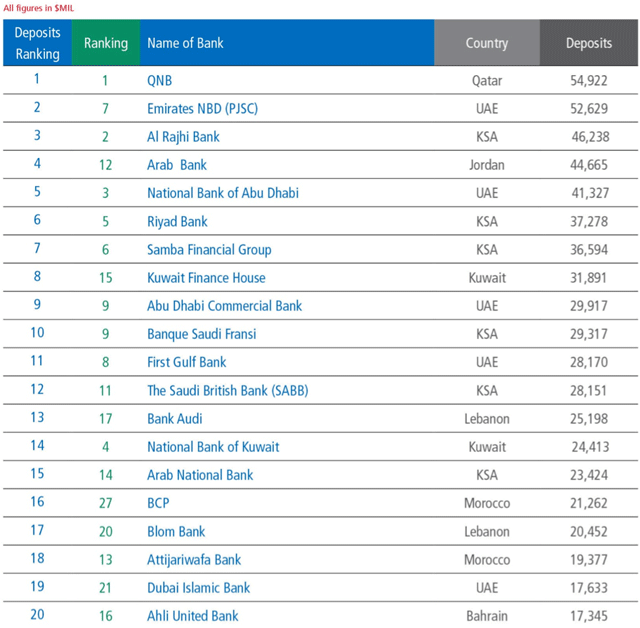
The top twenty largest banks by deposits record a total of $54.922 billion
The MENA region amassed a grand total of $979.7 billion in deposits for 2011 from across the 75 banks involved in this study. The GCC was the dominant player in this regard, contributing $780.3 billion which amounts to 80% of the total. Qatar's QNB topped our list, with deposits of $54.922 billion for the year. Emirates NBD came in second recording deposits of $52.629 billion, followed in third place by KSA's Al Rajhi Bank with total deposits of $46.238 billion. Out of the twenty banks on the list, KSA dominated in terms of number of entries, with a total of six banks.
The top 20 largest banks by deposits include:
Largest Banks by Loans
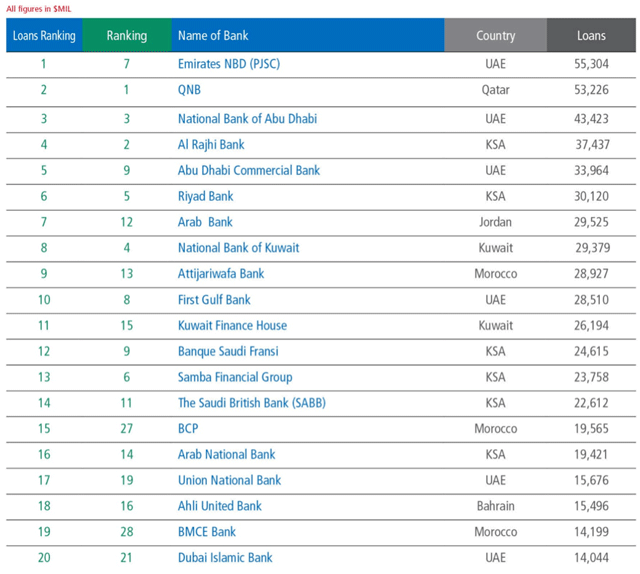
Total loans across the 75 largest banks reached a combined total of $855.7 billion
Across the 75 banks analyzed as part of the Forbes Middle East study of the largest and fastest growing banks in Arab stock markets, total loans reached an impressive figure of $855.7 billion. Our ranking of the largest banks by loans was composed of twenty banks, with the UAE and KSA entering the list with six each. Taking the number one spot was the UAE's Emirates NBD with loans reaching $55.304 billion, followed by Qatar's QNB with a total of $53.226 billion. Third spot was also taken by the UAE with the National Bank of Abu Dhabi recording loans of $43.423 billion.
The top 20 largest banks by loans include:
Geographical Distribution
UAE has the highest number of banks present throughout the MENA region
A comprehensive investigation conducted by Forbes Middle East has broken down the geographical distribution of banks in the MENA region. Findings revealed that the UAE has a total of sixteen banks throughout the region accounting for 21% of the total and securing it the top spot on this list. The UAE is followed by KSA with eleven banks, representing 15% of the total. Rounding out the top three is Bahrain bringing nine banks to the table that make up 12%.
The ranking continued to break down as follows: Kuwait has a total of eight banks taking 11% of the total, Jordan and Qatar each have seven banks constituting 9.5% each, and Oman presents six banks with 8%. Morocco and Lebanon each claim 5% of the total, both entering the list with four banks, followed by Egypt with two banks, capturing 2.5% of the geographical distribution. Finally, Palestine features in this geographical distribution list with a single bank.
Geographical distribution of banks across the MENA region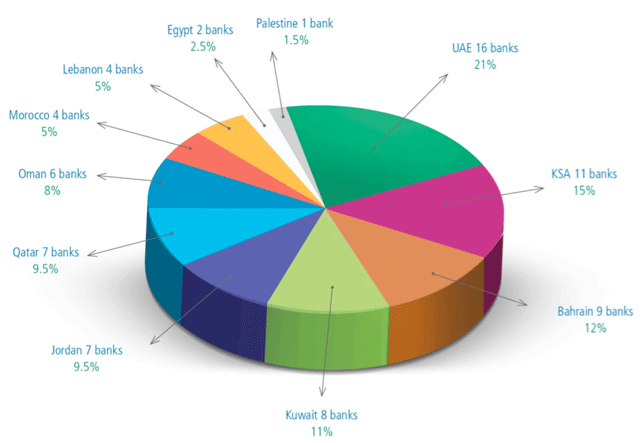
Commenting on the study findings, Khuloud Al Omian, editor-in-chief at Forbes Middle East, explains:
"Standing out from our rankings is the fact that both lists are dominated by banks from the GCC. In the largest banks ranking, the GCC enters the list with 57 banks with combined total assets of $1.158 trillion from a total of $1.394 trillion. Making its mark on our rankings is Qatar's QNB, securing the top spot amongst 'The 75 Largest Banks in Arab Stock Markets' with impressive total assets of $82.995 billion. Meanwhile, in our ranking of the fastest growing banks, Alinma Bank tops the list with an almost unbelievable net profit growth of 2737%."
Regarding the banking sector as a whole, Al Omian, continues:
"Banks have a pivotal position in the financial system contributing to the overall economy. The role of banks is vital to society and future national development agendas--whether for economic growth or general welfare of the state."
According to the editor-in-chief, Islamic banking in particular has prevailed:
"Banking has been, and always will be, a lucrative business. This is evident in our research over the past months through which we discovered that not only has Islamic banking weathered the ill-effects of economic recession, and survived the impact of the Arab Spring uprisings--it has flourished."
-Ends-
Forbes Middle East
Forbes Middle East is the licensed Middle Eastern version to the world renowned Forbes magazine and extends the Forbes brand of journalism across the MENA region. Forbes Middle East's distinctive editorial style attracts a readership community of Billionaires, Powerful Arab Men and Women, Entrepreneurs, C-Level executives, government officials and investors united by a belief in the spirit of free enterprise and entrepreneurial values.
Across the region, Forbes Middle East is setting the pace for preemptive business journalism. By uncovering trends and anticipating opportunities in the regional marketplace, each monthly issue, brings top executives the information critical to their success - in both Arabic & English language editions. Forbes Middle East is the guiding compass for investments and best practices in the Arab region.
The magazine researches and publishes original and relevant Lists/Rankings, based on the criteria of neutrality, authenticity, commitment to the methodology of scientific research and the quality of standards set globally by Forbes Media, US.
For Media inquiries, please contact:
Tarteeb Media Company
Tamara Karram
Mobile: +971-50-1004982
Email: tamara@tarteeb.com
info@tarteeb.com
© Press Release 2012