Africa accounts for two-thirds of the world's mineral reserves, but recent regulatory changes in the continent could have an adverse effect on the mining industry, which is already reeling from major price pressures.
The Democratic Republic of Congo recently raised taxes on copper and cobalt beneficiation from USD 60 to USD 100 per metric ton, while Gabon has also introduced mandated beneficiation - a process that separates the mineral from the commercially worthless gangue material.
Meanwhile, Ghana introduced the National Fiscal Stabilisation Levy Bill that will impose a 5% tax on profits of mining companies; Mozambique is set to introduce a 32% capital gains tax on the sale of local assets by foreign countries from January 2014, and Tanzania is expected to introduce mandatory procurement of at least 80% of goods and services from local businesses by 2015.
Africa produces more than 60 minerals and is a major producer of gold, platinum group metals, diamonds, uranium, manganese, nickel, bauxite, cobalt and chromium. Its changes in the regulatory environment come at a time when metal prices across the world are falling.
The S&P GSCI composite industrial metals index is 30% lower than its peak in 2011 and prices of most industrial metals have fallen.
"Some clear trends emerged in 2012-13," wrote Julian Jessop, Tom Pugh and Caroline Bain, analysts at Capital Economics, in a recent report. "The link between industrial metals and equity price movements collapsed as investors lost confidence in commodities as an asset class. However, the more intuitive inverse relationship between commodity prices and the US dollar broadly held, although it started to show some variance in 2013."
While the metals market received a boost as China tried to boost the economy, 2014 is expected to see a slowdown in industrial activity in the country.
"Whilst we continue to expect China to avoid a 'hard landing', GDP growth will slow further and become less commodity-intensive in the coming years," said the Capital Economics analysts. The government's aim to curb credit growth will act as a further constraint on commodity imports."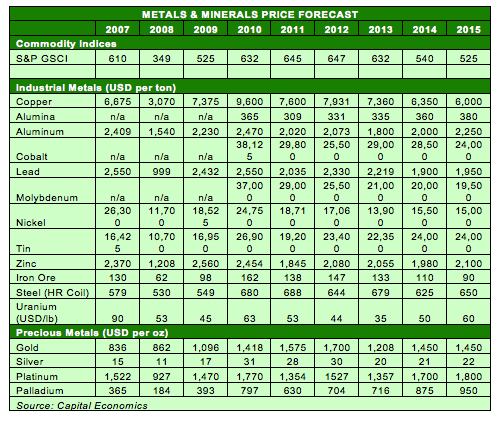
MINING IN AFRICA
"A combination of demand from the east, dwindling mineral resources and rising costs is reshaping the mining sector, as mining companies attempt to manage their asset life cycle in this new landscape, their three main strategic priorities are growth, performance and compliance," said management consultant KPMG in a report.
The continued depression in metal and mineral prices could impact growth in many African countries, which have enjoyed a good run over the past decade.
Management consultant EY notes that Africa's share of global exploration spending has risen to 17%, making it the second-most preferred destination for exploration in 2012, up from its third position in 2011 - according to latest data available. The region saw the second largest increase in exploration spending in both percentage and dollar terms.
"The Democratic Republic of Congo (DRC) was the most preferred destination for exploration spending in Africa for the second time in the last three years," EY said.
Africa also accounted for 19% of mining and metal M&A deals in 2012, with Chinese state-owned companies investing heavily in DRC, Sierra Leone, Namibia and South Africa.
However, that flow of investment may dry up as the mining industry faces a number of challenges in the continent.
CORRUPTION: Transparency International ranks Democratic Republic of Congo as the 154th most corrupt country in the world out of 177, with Nigeria (144th) not far behind.
"Regions with less stringent laws can see heightened exposure of miners to government patronage of third-party agents, vendors or job applicants," said EY.
RESOURCE NATIONALISM: Miners now face rising taxes and royalties, increasing government ownership while restrictions on exports are spreading. Last year, Kenya revoked mining licenses issued and raised royalties on a range of metals and mineral resources.
"These unexpected policy shifts signal that mining firms investing in Kenya face an elevated degree of regulatory uncertainty," management consultant Maplecroft said, noting that Kenya has risen from 'medium' to 'high risk' on the back of increased regulatory volatility.
Risk consultancy Maplecroft believes resource nationalism in Africa is on the rise.
INFRASTRUCTURE BOTTLENECKS: With mining and metals companies turning to new deposits especially in frontier African countries, the lack of infrastructure is a substantial hurdle," notes EY. "High costs and capital constraints are creating an infrastructure funding gap where neither governments nor miners are able to fund all of infrastructure needs."
SOCIAL LICENSE: Frustrated at their government's ability to translate economic growth into jobs and benefits, local activists are retaliating. They are demanding greater share and benefits as their communities are often uprooted to allow metal and mining companies to develop their projects.
"Stakeholders are increasing their call for a bigger piece of the pie despite lower margins," EY said. "This risk is characterized by a push and pull: more vocal stakeholders with increased demands versus falling commodity prices and higher costs."
African states will need to change their strategy if they are to help revive the global mining sector and ensure their own commodity-dependent economies do not falter either.
But while some states such as Mozambique are looking to find ways to become more investor-friendly, other countries are seeing less flexibility.
On January 20, South Africa's Association of Mineworkers and Construction Union that boasts of 90,000 laborers who work in the world's top three mining companies and some of the largest gold mines in the country, said they are poised to strike over a wage dispute.
With growth already slowing and global mining companies in a major retreat mode, the latest South African move could further push the sector into deeper troubles, with severe consequences for commodity-driven African economies.
© alifarabia.com 2014