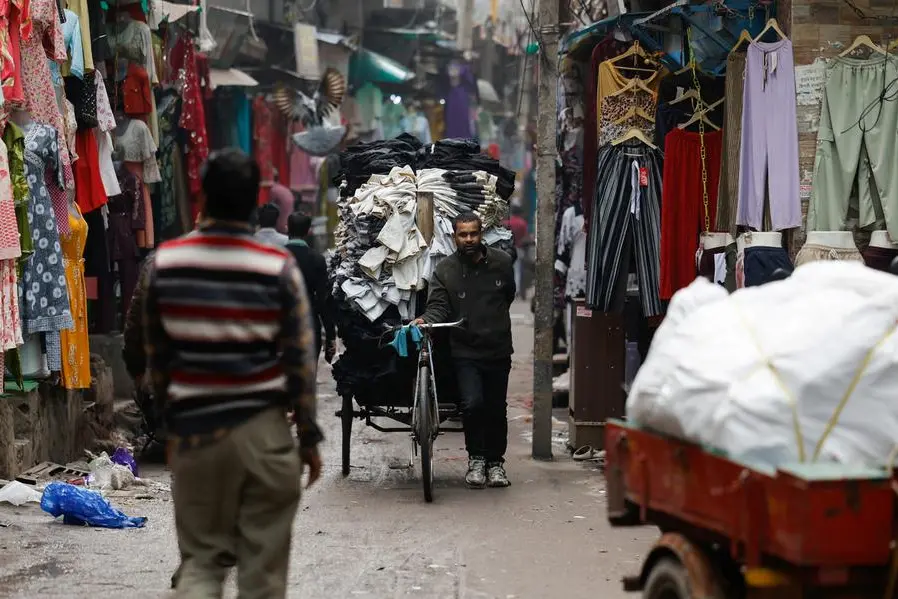
PHOTO
NEW DELHI/MUMBAI: India’s textile and apparel exporters, hit by 50% U.S. tariffs imposed late in August, are banking on this week's trade agreement with the European Union to offset part of the damage, while urging New Delhi to secure a quick deal with Washington.
Under the pact, which will be implemented in about a year, the EU will immediately remove duties on 90% of Indian goods, including the roughly 12% tariff on textiles and apparel.
"At a time when the sector is weighed down by high U.S. tariffs, the India–EU agreement opens the door to greater market access," said Ashwin Chandran, chairman of the Confederation of Indian Textile Industry (CITI), adding that jobs in the sector are currently at risk.
U.S. shipments fell more than 50% in October-December from July-September for nearly one-quarter of textile exporters, a CITI survey showed, while businesses warned losses could reach $5 billion–$6 billion this year without a U.S. deal.
In a letter to the government, the Apparel Export Promotion Council (AEPC) said higher U.S. tariffs have hurt firms that earn up to 70% of their sales from the U.S., risking order cancellations and factory shutdowns, and urged swift action to avoid lasting damage.
India's textile and apparel exports held steady at $37.5 billion in 2025 despite the drop in U.S. orders, as exporters diverted shipments to markets such as the EU, UAE, Japan and Africa, government estimates showed.
Nevertheless, the U.S. remains India's top market, taking 28% of its textile and apparel exports - about $11 billion out of $38 billion in the financial year ending March, 2025. The EU was the second-largest market with around one fifth of total shipments.
"Zero-duty access to the EU market will enhance Indian garments' competitiveness," said AEPC Chairman A. Shakthivel, projecting EU exports could grow 20-25% annually and double in three to four years.
Currently, India's share of the EU's $250 billion apparel market is just 3%, with shipments dominated by China, Bangladesh and Vietnam due to lower duties.
NEAR-TERM RISKS
However, analysts warned of near-term risks for Indian exporters, as the EU has suspended preferential tariffs on Indian apparel for 2026–2028, and it will be at least one year before the new deal comes into force. The gap before full implementation could temporarily raise costs and squeeze margins, they said.
Exporters will still need to meet strict EU technical and safety norms, including detailed labelling, chemical limits, and health-and-environment certifications, analysts added.
Of the EU's top 20 high-demand ready-made garment products, India exports only eight cotton and two man-made fibre items -showing a gap in matching demand.
Some major EU fashion brands, including H&M and Zara, have visited factories in Tiruppur, the southern textile hub, to plan new orders, said Kumar Duraiswamy, joint secretary of the Tiruppur Exporters Association. He expects exporters to add capacity, win new customers and expand into synthetic garments.
"Opening up the European market will be hugely beneficial for India's textile industry, particularly at a time when exporters are facing serious challenges in the U.S. market,” said Rajinder Gupta, CEO of Trident Group, who expects the group's exports to double in two to three years.
"However, the amount of U.S. business cannot be replaced by any other market," he added. (Reporting by Manoj Kumar and Dhwani Pandya; Additional reporting by Shivangi Acharya; Editing by Raju Gopalakrishnan)