PHOTO
- Out of 2.1 million people, Zakat funds nearly reached 1.6 million beneficiaries in the form of cash assistance and goods distribution, the remaining 0.5 million are Sadaqah beneficiaries
- In 2020, Zakat donations increased by 12.5% in comparison to 2019, triggering a 59% increase in the number of Zakat beneficiaries
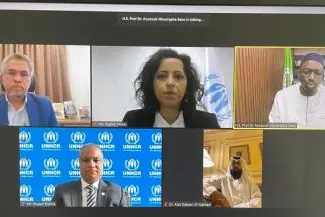
Jeddah, KSA: Under the title ‘Islamic Philanthropy - Transforming the Lives of the World's Displaced’, UNHCR, The UN Refugee Agency, launched its Annual Islamic Philanthropy Report today, highlighting the impact of Zakat, Sadaqah, and Sadaqah Jariyah donations received through its Refugee Zakat Fund.
In 2020, UNHCR supported 2.1 million vulnerable refugees and internally displaced people through Zakat and Sadaqah funds, thanks to institutional partners and philanthropists across the region and globally. In comparison to 2019, Zakat donations witnessed in 2020 an increase of 12.5%, triggering a significant growth in Zakat beneficiaries at 59%.
Contributions received helped UNHCR in providing lifesaving support through the distribution of cash assistance and goods, allowing refugees and internally displaced people (IDPs) to address immediate needs including shelter, food, education, healthcare, and debt repayment. Furthermore, the support provided helped refugees and IDPs to effectively address economic hardships that were further exacerbated by the ongoing COVID-19 pandemic.
Commenting on the impact of Islamic philanthropy on marginalized communities, H.E Prof. Dr. Koutoub Moustafa Sano, Secretary General of the International Islamic Fiqh Academy stated: “It is heart-warming to see that UNHCR, in its humanitarian response efforts, has succeeded to rely on the foundations of Islamic economics, which entails a complete way of life, realizes comprehensive social development, and is based on noble values, good morals and social justice.”
“With more than 50% of the refugees and IDPs coming from OIC countries, the Muslim community responded with generosity to UNHCR’s Refugee Zakat Fund, in particular in the context of the consequences of the pandemic. But the needs are still high, and there is much space left to cover for the expenditures of Zakat-compliant activities,” added Sano.
Of the 2.1 million beneficiaries of UNHCR’s Refugee Zakat Fund, nearly 1.6 million persons have directly benefitted from Zakat funds in 10 countries: Yemen, Lebanon, Bangladesh, Jordan, Egypt, Iraq, Mauritania, India, Niger and Pakistan. The remaining 0.5 million beneficiaries have benefitted from Sadaqah, Sadaqah Jariyah and purification funds across multiple locations including Chad, Sudan, and Ethiopia.
UNHCR’s Senior Advisor on Islamic Philanthropy and Representative to the Gulf Cooperation Council Countries, Khaled Khalifa said: “We are immensely grateful for the unwavering support and trust of our donors and institutional partners, which allowed us to support over 2 million refugees and IDPs. This growing impact is testament to the pivotal role and potential of Islamic Philanthropy in addressing pressing humanitarian crises. We look forward to further expanding our programmes in offering safe, effective and innovative solutions in responding to the needs of those who have been forcibly displaced.”
Despite the growth that the Refugee Zakat Fund has witnessed due to generous contributions by individuals and institutional partners, the ongoing COVID-19 pandemic has widened the gap between the needs of displaced families and funds received. To address the unmet needs of these vulnerable populations in 2021, UNHCR has projected global budget needs at $9.1 billion, of which $2.7 billion are needed in countries where it will be distributing Zakat, to provide lifesaving support to 24.2 million people in Jordan, Lebanon, Yemen, Iraq, Mauritania, Egypt, Bangladesh, India, Pakistan, Thailand, Iran, Nigeria, Burkina Faso, and Somalia.
“With the Holy month of Ramadan upon us, we urge everyone to continue supporting refugees and displaced families who will welcome Ramadan in incredibly difficult circumstances, either through prayers, kindness, or Sadaqah and Zakat, added Khalifa.”
Zakat and Sadqah donations to refugees in urgent need can be given now via zakat.unhcr.org and UNHCR’s newly launched Zakat mobile application “GiveZakat”
© Press Release 2021
Disclaimer: The contents of this press release was provided from an external third party provider. This website is not responsible for, and does not control, such external content. This content is provided on an “as is” and “as available” basis and has not been edited in any way. Neither this website nor our affiliates guarantee the accuracy of or endorse the views or opinions expressed in this press release.
The press release is provided for informational purposes only. The content does not provide tax, legal or investment advice or opinion regarding the suitability, value or profitability of any particular security, portfolio or investment strategy. Neither this website nor our affiliates shall be liable for any errors or inaccuracies in the content, or for any actions taken by you in reliance thereon. You expressly agree that your use of the information within this article is at your sole risk.
To the fullest extent permitted by applicable law, this website, its parent company, its subsidiaries, its affiliates and the respective shareholders, directors, officers, employees, agents, advertisers, content providers and licensors will not be liable (jointly or severally) to you for any direct, indirect, consequential, special, incidental, punitive or exemplary damages, including without limitation, lost profits, lost savings and lost revenues, whether in negligence, tort, contract or any other theory of liability, even if the parties have been advised of the possibility or could have foreseen any such damages.