PHOTO
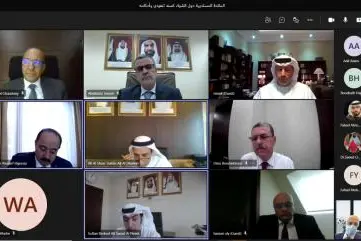
The Abu Dhabi Judicial Department (ADJD) organised a round table discussion on the provisions of the law dealing with the cheque as an executive instrument, as introduced by the recent legislation and conferring on the cheque the status of an executive instrument as a payment tool, in accordance with Federal Decree Law No. 14 of 2020 amending certain provisions of the Commercial Transactions Law, the Executive Regulations of the Civil Procedures Law and the Instructions of the Central Bank of the United Arab Emirates.
Counsellor Ali Al Shaer Al Dhaheri, Director of the Judicial Inspection Division at the Judicial Department, affirmed that the legislative amendments introduced in the provisions related to the handling of the cheque as an executive instrument are in line with international best practices that ensure promptness in taking legal steps to safeguard the rights of the claimants in record time, thereby enhancing the UAE's leading position as an investment incubator in the region and an attractive destination for investors and talents from around the world.
The organisation of the round table on these developments, M. Ali Al Shaer said, aims to discuss the purposes of the recent amendments in the provisions dealing with the cheque and to unify the approaches and concepts according to the principles of proper legal and judicial interpretation, in line with the vision of His Highness Sheikh Mansour bin Zayed Al Nahyan, Deputy Prime Minister, Minister of Presidential Affairs, and Chairman of Abu Dhabi Judicial Department, to establish a pioneering and advanced judicial system that supports the efforts made to improve the economic environment, consistent with the UAE's vision for the next fifty years.
The event, which was attended by judges, prosecutors and government cases counsels, discussed the legal concept of the executive formula given to the cheque and its impact on jurisdiction, in light of the new amendments that established the principle of " the bearer of the cheque holds the medium for payment", and made it possible to enforce directly through the enforcement judge in case the cheque is returned for full or partial balance default, without resorting to lengthy court proceedings.
The round table also dealt with procedural and material provisions relating to the cheque as an executive instrument and with the exceptional cases that must be brought before the competent court in the context of payment orders and in summary proceedings, as well as with the cases of criminalisation related to the cheque, which includes the fraudulent issuing of cheques, the offences of forgery and use of forged cheques, the closure of the account or withdrawal of the entire balance deposited in it before the cheque is issued or presented to the bank, or the case of freezing the account, and the deliberate drawing up or signing of a cheque in such a way as to prevent its encashment.
-Ends-
© Press Release 2022
Disclaimer: The contents of this press release was provided from an external third party provider. This website is not responsible for, and does not control, such external content. This content is provided on an “as is” and “as available” basis and has not been edited in any way. Neither this website nor our affiliates guarantee the accuracy of or endorse the views or opinions expressed in this press release.
The press release is provided for informational purposes only. The content does not provide tax, legal or investment advice or opinion regarding the suitability, value or profitability of any particular security, portfolio or investment strategy. Neither this website nor our affiliates shall be liable for any errors or inaccuracies in the content, or for any actions taken by you in reliance thereon. You expressly agree that your use of the information within this article is at your sole risk.
To the fullest extent permitted by applicable law, this website, its parent company, its subsidiaries, its affiliates and the respective shareholders, directors, officers, employees, agents, advertisers, content providers and licensors will not be liable (jointly or severally) to you for any direct, indirect, consequential, special, incidental, punitive or exemplary damages, including without limitation, lost profits, lost savings and lost revenues, whether in negligence, tort, contract or any other theory of liability, even if the parties have been advised of the possibility or could have foreseen any such damages.