PHOTO
- By studying how these waves travel, researchers can probe regions of the Sun’s interior that cannot be observed directly, revealing the structure and strength of its magnetic fields.
- This discovery opens a new way to study the Sun’s internal magnetic system, improving understanding of solar activity and offering potential insights for predicting space weather that can affect satellites, communications, and power systems on Earth.
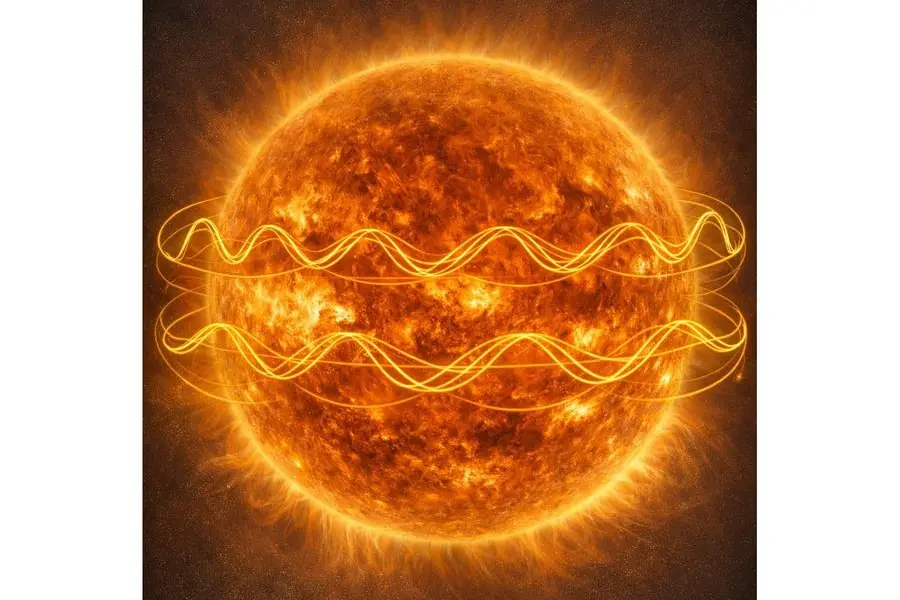
Abu Dhabi, UAE: Researchers at NYU Abu Dhabi have discovered new large-scale waves moving deep inside the Sun, driven by magnetic fields far below the surface. These waves provide a window into parts of the Sun that are otherwise inaccessible, giving scientists a new tool to study how its magnetic field is formed and evolves over time.
The Sun’s interior is a dynamic ocean of hot, electrically charged gas shaped by rotation and magnetic forces. These magnetic fields drive the solar cycle, sunspots, and powerful eruptions that can disrupt satellites, communications, and power grids on Earth. Until now, the magnetic behavior deep inside the Sun was largely hidden from observation.
In the new study, published in Nature Astronomy, researchers at NYU Abu Dhabi’s Center for Astrophysics and Space Science analyzed more than a decade of the Sun’s natural vibrations. Their work revealed evidence for previously undetected, global-scale waves influenced by the Sun’s internal magnetism. By measuring how these waves move, the team can infer the strength and structure of magnetic fields far below the Sun’s surface.
“These waves give us a unique look at the Sun’s hidden magnetic system,” said Shravan Hanasoge, co-PI at the Center for Astrophysics and Space Science at NYU Abu Dhabi and lead author of the study. “Understanding these internal processes is crucial for predicting solar activity, which can impact satellites, communications, and power systems on Earth.”
The findings provide a new approach to studying the Sun’s interior and its magnetic evolution over time, with implications for improving space-weather forecasting and for understanding magnetic activity in other stars throughout the universe.
This work was supported by the NYU Abu Dhabi Research Institute.
About NYU Abu Dhabi
www.nyuad.nyu.edu
NYU Abu Dhabi is the first comprehensive liberal arts and research campus in the Middle East to be operated abroad by a major American research university. Times Higher Education ranks NYU among the top 31 universities in the world, making NYU Abu Dhabi the highest globally ranked university in the UAE. NYU Abu Dhabi has integrated a highly selective undergraduate curriculum across the disciplines with a world center for advanced research and scholarship. The university enables its students in the sciences, engineering, social sciences, humanities, and arts to succeed in an increasingly interdependent world and advance cooperation and progress on humanity’s shared challenges. NYU Abu Dhabi’s high-achieving students have come from over 120 countries and speak over 100 languages. Together, NYU's campuses in New York, Abu Dhabi, and Shanghai form the backbone of a unique global university, giving faculty and students opportunities to experience varied learning environments and immersion in other cultures at one or more of the numerous study-abroad sites NYU maintains on six continents.