PHOTO
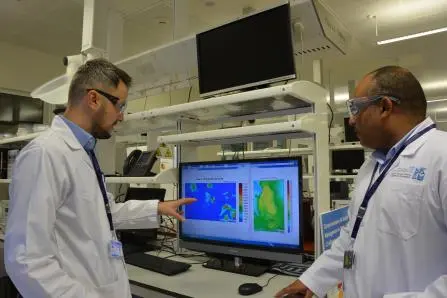
Doha – Following its research mission to help tackle Qatar’s grand challenges in the fields of energy, water security and environment, the Qatar Environment and Energy Research Institute (QEERI), one of Hamad Bin Khalifa University’s three national research institutes, recently commissioned its fourth permanent Air Quality Monitoring Station (AQMS) at the American School of Doha. The stations continuously measure the concentration of pollutants in the air, including gases (e.g. ozone, nitrogen oxides, methane, etc.), particulate matter as well as meteorological parameters (e.g. temperature, wind speed, direction, etc.) in high time resolution.
In effect, the AQM stations forge cooperative bonds between QEERI’s researchers and national stakeholders by collecting reliable data that help quantify the impact of poor air quality on environment, energy and health systems in the country. QEERI’s Executive Director, Dr. Marc Vermeersch, said: “We are committed towards providing a better understanding of Qatar’s air quality, including its primary causes and impact. This information can help provide valuable information to the local community and guide best-practice development in the health and safety sectors. Consequently, we have established a close working relationship with a number of private and governmental stakeholders from across various industries to join forces on this nationally significant initiative.”
QEERI’s growing Air Quality and Climate Change Research activities are designed to support the systematic development and evaluation of national policies, strategies and technologies aimed at mitigating the negative impacts of poor air quality as well as adapting to climate change.
Commenting on the AQMS’ role in positioning Qatari technology at the forefront of regional climate studies, Air Quality and Climate Change Research Portfolio Lead at QEERI Mohammed Ayoub said: “The monitoring network gives us a clearer understanding of the underlying causes of Qatar’s air quality, including the sources and types of pollutants, the mechanisms that induce episodic days and the contribution of long-range transport of polluted air masses into Qatar. As such, it forms the basis for the development of sustainable methodologies for future adaptations to climate change.”
“The first AQMS was commissioned in 2014 and by the end of the year, we plan to establish a total of six stations across the greater Doha area. Currently, four AQM stations are operational in Ash-Shahaniyah, Qatar Foundation, Al-Soudan, and Al-Wakrah. The AQM stations at Hamad Medical City and Al-Thumama are under commissioning,” he added.
The location of each station was carefully selected based on siting studies that account for population distribution, prevalent wind direction, land use (residential, commercial, traffic, other) and future infrastructure development plans. The Qatar Foundation “super site” was established on the roof of the HBKU Research Complex; it will house the upcoming Aerosol Chemical Speciation Monitor along with other high fidelity measurements.
QEERI’s set up of its fourth air quality monitoring station comes as the latest in a series of initiatives launched by the institute to compile critical information that assists high-impact, research-based solutions for Qatar. Earlier this year, its scientists including Ayoub participated in the National Air Quality Conference organized by the United States Environmental Protection Agency, where they shared expert knowledge and information with colleagues from across the world involved in the same field.
-Ends-
About Hamad Bin Khalifa University
Innovating Today, Shaping Tomorrow
Hamad Bin Khalifa University (HBKU), a member of Qatar Foundation for Education, Science, and Community Development (QF), was founded in 2010 as a research-intensive university that acts as a catalyst for transformative change in Qatar and the region while having global impact. Located in Education City, HBKU is committed to building and cultivating human capacity through an enriching academic experience, innovative ecosystem, and unique partnerships. HBKU delivers multidisciplinary undergraduate and graduate programs through its colleges, and provides opportunities for research and scholarship through its institutes and centers. For more information about HBKU, visit www.hbku.edu.qa.
© Press Release 2018Disclaimer: The contents of this press release was provided from an external third party provider. This website is not responsible for, and does not control, such external content. This content is provided on an “as is” and “as available” basis and has not been edited in any way. Neither this website nor our affiliates guarantee the accuracy of or endorse the views or opinions expressed in this press release.
The press release is provided for informational purposes only. The content does not provide tax, legal or investment advice or opinion regarding the suitability, value or profitability of any particular security, portfolio or investment strategy. Neither this website nor our affiliates shall be liable for any errors or inaccuracies in the content, or for any actions taken by you in reliance thereon. You expressly agree that your use of the information within this article is at your sole risk.
To the fullest extent permitted by applicable law, this website, its parent company, its subsidiaries, its affiliates and the respective shareholders, directors, officers, employees, agents, advertisers, content providers and licensors will not be liable (jointly or severally) to you for any direct, indirect, consequential, special, incidental, punitive or exemplary damages, including without limitation, lost profits, lost savings and lost revenues, whether in negligence, tort, contract or any other theory of liability, even if the parties have been advised of the possibility or could have foreseen any such damages.