PHOTO
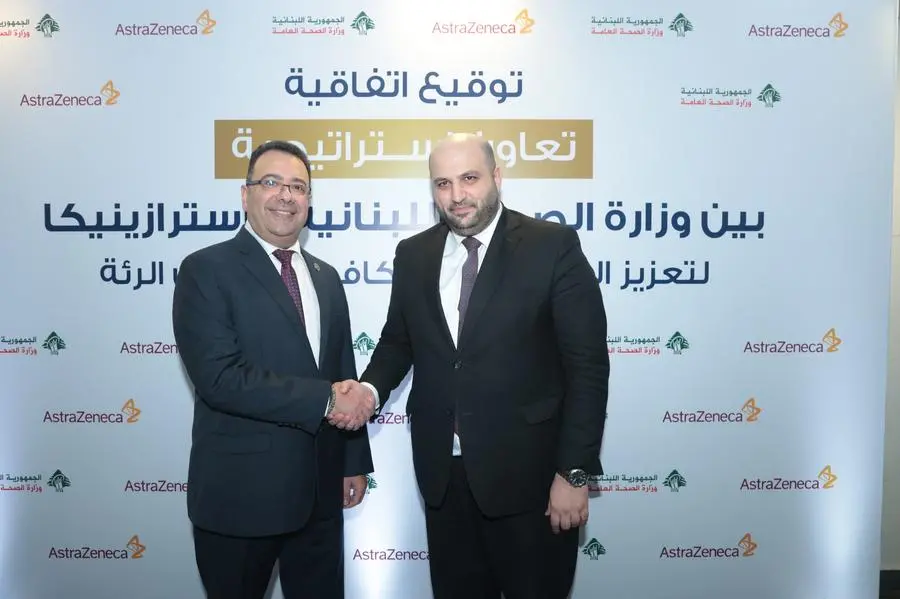
Beirut: The Lebanese Ministry of Public Health and AstraZeneca have signed a Memorandum of Understanding to launch a comprehensive national initiative aimed at enhancing prevention, raising public awareness, building capacity, and enabling evidence-based early diagnosis of lung cancer in Lebanon. This comes in alignment with the Ministry of Public Health’s National Cancer Plan 2023–2028 and seeks to improve health outcomes through prevention, awareness, early diagnosis, and reducing the burden of the disease and its associated mortality.
Under the agreement, the two entities will closely collaborate to ensure equitable access to testing, diagnosis, treatment, and information for patients across Lebanon. The memorandum focuses on strengthening scientific and technological cooperation, including supporting national awareness campaigns, capacity building for healthcare professionals, support for evidence-based early detection programs, and promoting data gathering to better inform planning and decision-making.
“AstraZeneca shines as a scientific and technical partner in supporting national lung cancer programs, as it leverages its expertise in prevention, early detection, and data management,” said His Excellency Dr. Rakan Nasreddine, Lebanon’s Minister of Public Health. “This collaboration strengthens our healthcare system's capacity to battle this disease, within a transparent framework aligned with the Ministry of Public Health's priorities and national policies.”
“We are honored to be collaborating with the Lebanese Ministry of Public Health in supporting national initiatives to establish a comprehensive lung cancer care system through public awareness, capacity building, and evidence-based early detection,” said Rami Scandar, AstraZeneca Country President for the Near East and Maghreb region. “Our collaboration is based on scientific innovation and a commitment to health equity, enabling equitable access to early diagnosis, building capabilities, and modern treatments for patients across Lebanon. This helps improve outcomes and reduces disparities in access to care.”
“Lebanon has the highest lung cancer incidence in females and second highest in males in the Middle East and North Africa, with rates increasing significantly over time. It’s a leading cancer in the country, accounting for over 9% of new cancer cases, second only to breast cancer,” said Dr. Arafat Tfayli, president of the committee in charge of implementing the national cancer prevention plan. “Rates rise with age, peaking in older adults over 70 years old, but increasing trends are seen across all ages.
“This is largely driven by high rates of smoking of cigarettes, water pipes, and e-cigarettes, air pollution from sources that include diesel generators, and exposure to secondhand smoke especially among children.”
Scope of Cooperation as per the Memorandum of Understanding:
- Contribute to and support national lung cancer awareness campaigns initiated by the Ministry of Health (MOH).
- Contribute to the development of awareness campaigns assets for lung cancer to be launched across channels as per agreement with MOH.
- Support the territory’s regional Center of Excellence vision through knowledge exchange and building capabilities locally to align with regional expertise.
- Strengthen lung cancer diagnostic capacity by contribution to education and awareness in underserved areas in addition to participation in facilitating Molecular testing to ensure equitable access to Lebanese patients.
- Collaborate with MOH in defining designated accounts to initiate a pilot LCS program with the aim of including LCS on Lung Cancer control plan.
- Collaborate with MOH in Evidence generation to inform healthcare planning, and strategic decision-making in lung cancer screening & management.
Implementation mechanisms, work schedules, and performance indicators are subject to detailed agreements between the two parties, ensuring full compliance with applicable laws and regulations and the highest standards of integrity and adherence to best practices.
For more information, please contact:
AstraZeneca Media contact: NEMAG.Communications@astrazeneca.com
&/or
Jean Akouri, Akouri Communications: jean@akouricom.com