PHOTO
Abu Dhabi: Sheikh Ahmed bin Hamdan bin Mohammed Al Nahyan, Chairman of the Abu Dhabi Agricultural Club, affirmed that agriculture in the United Arab Emirates represents a fundamental pillar of food security and sustainability. He stressed that the Sheikh Mansour bin Zayed Agricultural Excellence Award has directly contributed to a qualitative shift in farmers’ awareness and has encouraged young people to enter the agricultural sector with an entrepreneurial spirit grounded in innovation and modern technologies.
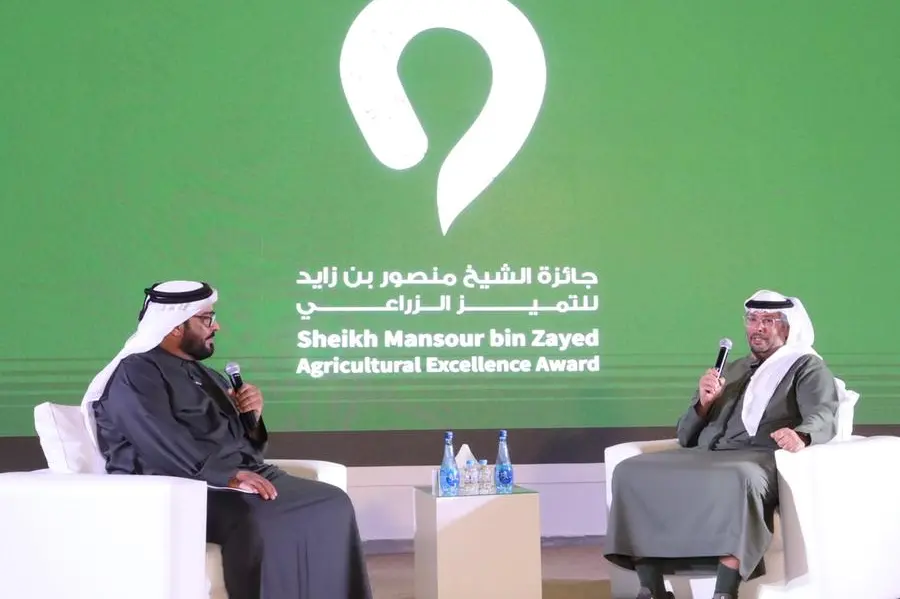
This came during a panel session held at the pavilion of the Sheikh Mansour bin Zayed Agricultural Excellence Award at the Sheikh Zayed Festival in Al Wathba, Abu Dhabi, during which Sheikh Ahmed bin Hamdan bin Mohammed Al Nahyan spoke about his experience in the agricultural sector and the importance of enhancing innovation within it.
The session was attended by Sheikh Eng. Salem bin Sultan bin Saqr Al Qasimi, Chairman of the Department of Civil Aviation and Chairman of Ras Al Khaimah International Airport and Chairman of One Hive for honey production; H.E. Moza Suhail Al Muhairi, Deputy Director-General for Regulatory and Administrative Affairs at the Abu Dhabi Agriculture and Food Safety Authority and Chair of the Higher Organising Committee of the Sheikh Mansour bin Zayed Agricultural Excellence Award; H.E. Ahmed Khaled Othman, Acting Deputy Director-General for Operational Affairs at the Abu Dhabi Agriculture and Food Safety Authority; along with a number of officials, experts, farmers and young entrepreneurs. The session addressed several key themes, including the future of agriculture in the UAE, the importance of sustainability, the role of national awards in stimulating agricultural innovation, and practical case studies from Emirati farmers.
During the session, moderated by H.E. Mubarak Al Qusaili Al Mansouri, Chairman of the Festivals and Accompanying Competitions Committee of the Sheikh Mansour bin Zayed Agricultural Excellence Award, Sheikh Ahmed bin Hamdan Al Nahyan said that the idea of establishing the Abu Dhabi Agricultural Club was not an individual initiative, but rather the result of a collective passion among farmers to exchange knowledge and expertise. He explained that his early beginnings in agriculture were full of challenges, and that experience, inquiry and engagement with farmers were the keys to progress and success. These experiences, he noted, inspired the creation of a platform that brings farmers together under one umbrella to share knowledge and unify efforts.
He added that the club has now become a fully integrated agricultural community comprising hundreds of members from various agricultural disciplines. This diversity, he said, has helped create a rich environment for learning and development and has contributed to spreading best agricultural practices across the UAE.
Sheikh Ahmed also addressed the concept of sustainability, emphasising that sustainable agriculture is not a new concept but a deeply rooted practice in Emirati culture, where resources were historically utilised fully and without waste. He highlighted the importance of employing modern technologies to preserve natural resources, particularly water and soil.
Speaking about agricultural transformation and the adoption of modern farming systems, he affirmed that the UAE has successfully overcome environmental and climatic challenges by adopting advanced agricultural technologies such as hydroponics and solar-powered greenhouses, which reduce water consumption by up to 90%. He noted that these achievements are an extension of the vision of the late founding father, Sheikh Zayed bin Sultan Al Nahyan, who believed in the potential of both land and people despite the challenges.
He expressed his gratitude to the UAE’s wise leadership for its unlimited support to the agricultural sector, noting that the Sheikh Mansour bin Zayed Agricultural Excellence Award has played a pivotal role in driving this transformation by honouring farmers and innovators and highlighting outstanding national models.
He explained that the award has not only recognised excellence but has also created a renewed agricultural momentum, increased the number of young farmers, and encouraged positive competition in adopting smart and sustainable solutions.
Sheikh Ahmed noted that many young people told him that their entry into the agricultural field was inspired by their engagement with the award’s programmes and initiatives, and by witnessing the genuine governmental interest in supporting farmers. This moral support, he said, is as important as technical and financial support.
He also discussed the role of public–private partnerships, stressing that they are essential to developing the agricultural ecosystem. Government entities provide policies and support, while private companies contribute to production, marketing and the adoption of modern technologies — creating an integrated system that includes both large and small farms.
He reviewed the challenges facing the agricultural sector, emphasising that the solution lies in adopting modern technologies and digital innovations to enhance efficiency and production quality. He also pointed to the significant shift in farmers’ mindsets towards smart agriculture and the UAE’s direction over the next decade to increase reliance on artificial intelligence and automated systems to ensure the sustainability of agricultural resources.
Following the panel session, Sheikh Ahmed bin Hamdan bin Mohammed Al Nahyan, accompanied by Sheikh Eng. Salem bin Sultan bin Saqr Al Qasimi, H.E. Moza Suhail Al Muhairi, H.E. Ahmed Khaled Othman and several officials, toured the pavilion of the Sheikh Mansour bin Zayed Agricultural Excellence Award. They were briefed on the pavilion’s content, the festival’s accompanying activities, and the interactive displays documenting the award’s journey, categories and success stories of winning farmers and innovators.
He affirmed that the Sheikh Mansour bin Zayed Agricultural Excellence Award reflects the extensive efforts made to support farmers and embodies the national vision that innovation and sustainability are the true foundations of the future of agriculture in the UAE.
He added that the pavilion delivers a clear message, particularly to young people: agriculture is no longer a traditional occupation but a dynamic, entrepreneurial sector capable of embracing innovative ideas and modern technologies. He stressed that the award serves as a distinguished platform for showcasing these exemplary national models.
Sheikh Ahmed also praised the Sheikh Zayed Festival, describing it as a unifying national space that brings together heritage and authenticity on one hand, and innovation on the other. He reaffirmed the commitment of the Abu Dhabi Agricultural Club to continue supporting farmers, promoting agricultural culture and enhancing sustainability in a way that contributes to achieving the UAE’s vision for food security and sustainable development.