PHOTO
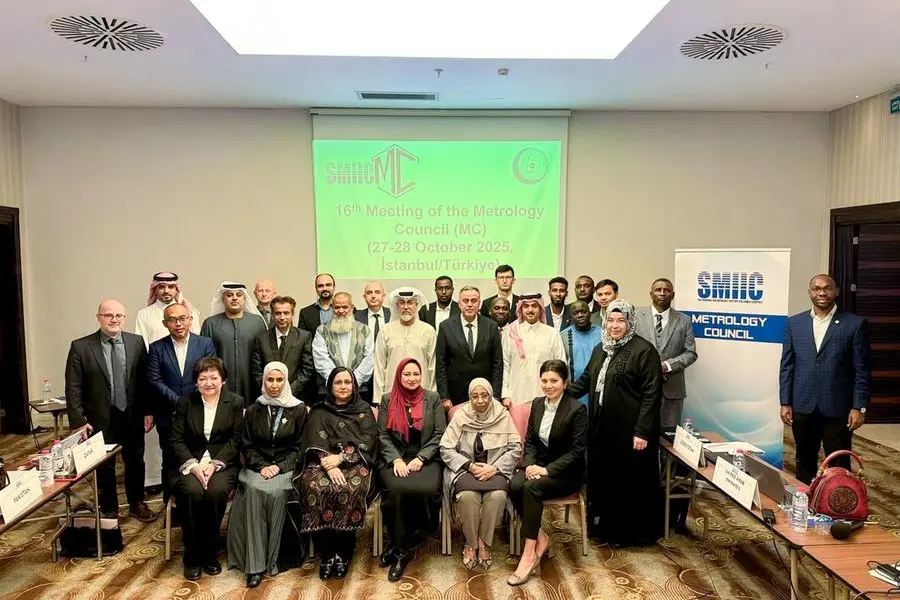
Istanbul – The 16th Meeting of the Metrology Council for the Organization of Islamic Cooperation (OIC) Member States was held in Istanbul, chaired by H.E. Saeed Al Mehairi, Executive Director of the Emirates Metrology Institute (EMI) at the Abu Dhabi Council for Quality and Conformity, and Chair of the Metrology Council under the Standards and Metrology Institute for Islamic Countries (SMIIC MC).
In his opening remarks, H.E. Al Mehairi welcomed the participants and emphasized the importance of presenting practical proposals to enhance cooperation among Member States, build national metrology capabilities, and strengthen the overall quality infrastructure in support of sustainable development across Islamic economies.
The meeting addressed several strategic and technical topics, most notably the new Metrology Council Strategy for 2026–2028, presented by the Emirates Metrology Institute. The strategy sets a clear roadmap for elevating the Council’s role and influence globally, with a special focus on Islamic Metrology (Halal Metrology) as a vital contributor to the credibility and growth of the halal economy.
Among the key initiatives included in the strategy are:
• The Halal Index, an innovative benchmarking tool developed specifically for OIC Member States to assess their progress in metrology, particularly in the field of Islamic (Halal) Metrology. The index aims to provide an accurate and transparent overview of each country’s advancement and readiness in this domain.
• The Metrology Hub of Knowledge, a digital platform designed to connect metrology institutes, industry experts, and research entities, fostering scientific and
technical cooperation and supporting knowledge sharing across the Member States.
The proposed strategy received broad support from Council Members. A Working Group chaired by the United Arab Emirates, with the participation of Indonesia, Iran,
Iraq, Malaysia, Pakistan, Sudan, Türkiye, and Uzbekistan, was established to finalize and officially adopt the strategy.
The meeting also reviewed Member States’ reports, working group outputs, and the GULFMET report, as well as mechanisms for applying for membership in the International Bureau of Weights and Measures (BIPM). Technical presentations highlighted several successful national experiences, including Saudi Arabia’s advancements in legal metrology, the UAE’s digital transformation journey in metrology, and Uzbekistan’s expertise in vibration measurement and uncertainty evaluation. A comprehensive overview of Halal Metrology in the Gulf region was also presented, addressing strengths, challenges, and opportunities for international recognition and trust.
In his closing remarks, H.E. Saeed Al Mehairi stated:“We are proud to witness the consensus among Member States on a forward-looking strategy that reinforces leadership and supports developing countries in Islamic Metrology. The initiatives we have launched — particularly the Halal Index and the Metrology Hub of Knowledge — mark a significant step toward deepening cooperation between metrology institutes and industry, ultimately enhancing the quality and reliability of products and measurement services across our Member States.”
The meeting concluded with the announcement that the 17th Metrology Council Meeting will be hosted by the United Arab Emirates in Abu Dhabi, reaffirming the shared commitment to advancing innovation, excellence, and collaboration in metrology at both regional and international levels.
About QCC:
Abu Dhabi Quality and Conformity Council (QCC) is an Abu Dhabi government entity established in accordance with Local Law No. (3) of 2009 to raise the quality of Abu Dhabi’s exports and products traded locally. QCC consists of a council of regulators and industry with a mandate to ensure provision of quality infrastructure in line with global standards.