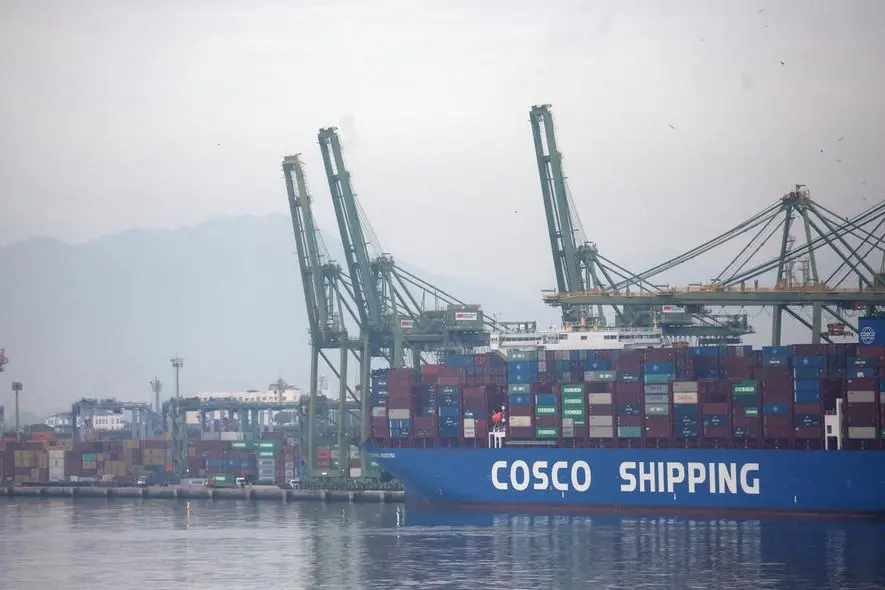
PHOTO
(The opinions expressed here are those of the author, a columnist for Reuters.)
ORLANDO, Florida - U.S. President Donald Trump has tempered his most belligerent trade threats and begun striking deals with major partners, meaning most countries won't face the punishing tariffs announced on 'Liberation Day'. Not so Brazil.
In fact, Brazil's trajectory has gone in the opposite direction. On April 2, Brazil faced the minimum 10% tariff rate, but if a deal is not reached by the end of this week, South America's largest economy is staring at a whopping 50% levy.
That's significantly higher than the 15% rates negotiated in both the U.S.-Japan and U.S.-European Union deals. Setting aside China, the 50% charge would match the highest levy applied to any country in the Liberation Day 'reciprocal' tariff program.
And, importantly, the impasse is rooted in politics, not economics. Brazil is one of the few major economies with which the United States runs a trade surplus. Indeed, it has done so every year since 2007, with last year's goods surplus clocking in at $6.8 billion on a total trade volume of $91.5 billion, U.S. Census Bureau figures show.
Trump has tied the 50% tariffs to judicial moves in Brazil against former president and ideological ally Jair Bolsonaro, who has been accused of plotting a coup following the election of leftist President Luiz Inacio Lula da Silva. "LEAVE BOLSONARO ALONE!" Trump wrote on social media earlier this month.
Diplomatic relations are frosty right now, and between Trump and Lula they are downright icy. The prospect of them thawing by the end of this week is negligible.
"Trade deals are a result of negotiations, but there is no dialogue if the U.S. doesn't respond to our letters. I'm worried," said one Brazilian government official.
THE TARIFF TOLL
Brazilian industry lobby, the CNI, estimates that the imposition of 50% U.S. import tariffs could result in the loss of over 100,000 jobs and knock off 0.2 percentage points from Brazil's annual economic growth. Brazil's agribusiness lobby, CNA, warns exports to the U.S. – the country's second-largest trading partner - could fall by half.
And this is an especially delicate juncture for Brazil.
Foreign exchange flows have turned negative in June and July, and this year's rally of Brazil's currency, the real, has stalled. On top of this, foreign direct investment has slowed in recent months.
That is a dangerous development because Brazil's current account deficit of 3.4% of GDP in the 12 months through June was more than double the deficit a year earlier. At current rates, FDI inflows will no longer cover that gap.
REAL RATES
Given this backdrop, Brazil's central bank now finds itself in a bind.
Inflation has risen over the last year to eclipse 5%, putting it above the central bank's upper-band limit of 4.5% for six consecutive months. In response, the central bank has hiked the benchmark Selic interest rate to a two-decade high of 15%.
The central bank is expected to leave the Selic at 15% on Wednesday, and is unlikely to have the wiggle room to cut for several months. High interest rates are needed to get inflation back in its box, attract deficit-plugging inflows from abroad, and support the real.
But the domestic economic price is high. Inflation-adjusted interest rates in Brazil are now around 10%, the highest in the G20 – topping even those of Russia and Turkey – and among the most restrictive real policy rates in the world.
High borrowing costs are, unsurprisingly, slowing credit growth in Brazil, and in June a broad measure of default rates on consumer and business loans rose to its highest level since February 2018.
What's more, sizeable interest payments are the primary factor behind the ballooning public debt, because nearly half the country's debt is linked to the Selic rate. Federal public debt expanded by 567 billion reais ($101.53 billion) in the first half of this year, of which 393 billion reais was interest payments.
Brazil's primary budget, excluding interest payments, is close to balance. But the government's interest bill is fast approaching 1 trillion reais a year, some 7% to 8% of GDP. This is set to help drive the country's gross debt-to-GDP ratio above 82% next year from 76% currently.
For policymakers in Brasilia, detente with Washington can't come quickly enough.
(The opinions expressed here are those of the author, a columnist for Reuters) ($1 = 5.5843 reais)
(By Jamie McGeever; Editing by Joe Bavier)