PHOTO
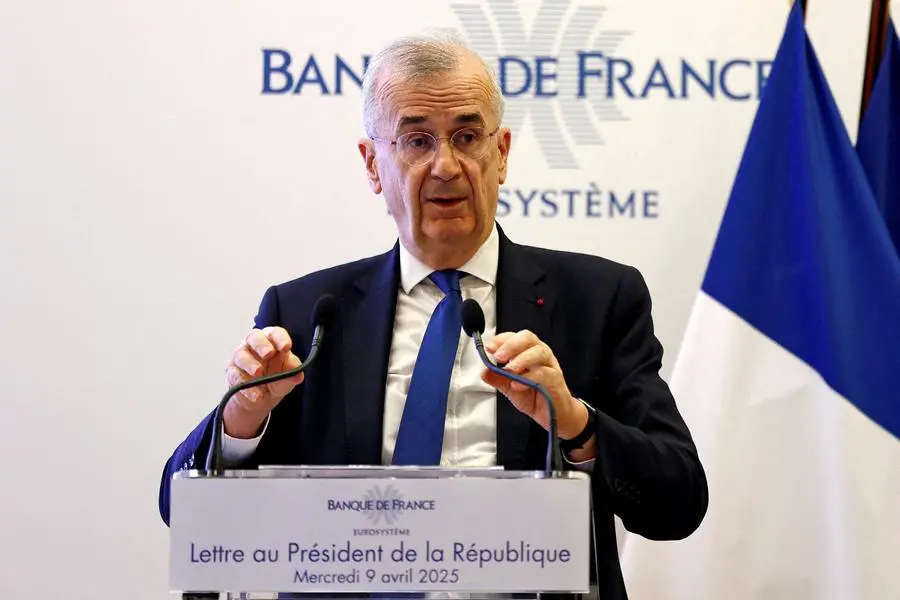
FRANKFURT - The surprise resignation of Francois Villeroy de Galhau as French central bank governor is unlikely to change the European Central Bank's steady policy course at a time of rare unity among the euro zone's top rate setters.
Villeroy's announcement on Monday that he will step down in June, over a year before his term ends, also means that French President Emmanuel Macron will get to appoint a new central bank chief ahead of a 2027 presidential election, which polls show could be won by the eurosceptic far-right.
Villeroy has been one of the ECB Governing Council's most outspoken policy doves as he consistently warned for months about the downside risks to inflation, including from a stronger euro.
But his departure was not seen as having an immediate impact on the ECB, which unanimously decided to keep interest rates on hold last week and is expected to stay put through this year barring major shocks from the geopolitical or trade environment.
"The resignation won't have any immediate implications for the market," said Marco Brancolini, head of euro rates strategy at Nomura, who praised Villeroy's communication with investors.
Two sources told Reuters that current Banque de France director Bertrand Dumont or past head Emmanuel Moulin would be good candidates, as well as deputy governor Agnes Benassy-Quere or former ECB policymaker Benoit Coeure, both of whom have had positions in the Treasury.
Former OECD Chief Economist Laurence Boone, currently at Spanish bank Santander, was also seen as a possible candidate to replace Villeroy, both sources said.
RARE HARMONY
Eric Dor, director of economic studies at the IESEG School of Management, said whoever replaces Villeroy was likely to be a centrist with dovish inclinations - referring to a preference for lower interest rates - given France's problems with high public debt.
"Governors at the end of the day are hawkish or dovish depending on the state of their national economy," Dor said.
"If you are the governor of the central bank of a very indebted country - so if you are French, if you are Italian - necessarily, you have to take account that too high an interest rate is a very big problem for the public finance of your country."
But whoever France chooses to replace Villeroy was unlikely to shift the balance atop the euro zone's central bank, where a rare harmony has been reigning for a few months.
This was likely the result of recent personnel changes as well as ECB President Christine Lagarde's more collegial management style compared to her predecessor, Mario Draghi.
In Austria, Robert Holzmann, an outspoken hawk who was often a lone dissenter when the ECB cut rates in 2024-25, was succeeded by the more moderate Martin Kocher at the helm of the Austrian central bank.
Dovish Portuguese central banker Mario Centeno was replaced by a centrist in Álvaro Santos Pereira.
The Netherlands' new central bank chief Olaf Sleijpen has also toed the official line in ways his predecessor Klaas Knot sometimes didn't, particularly during the ECB's era of ultra-loose policy.
The broad consensus means that the change of any one single governor could not tip the scales.
"The variance of opinions has decreased, it is easier to reach a consensus," Dor said. "So, I don't think that the change of another governor is a big challenge now."
(Reporting by Francesco Canepa; editing by Mark John and Susan Fenton)