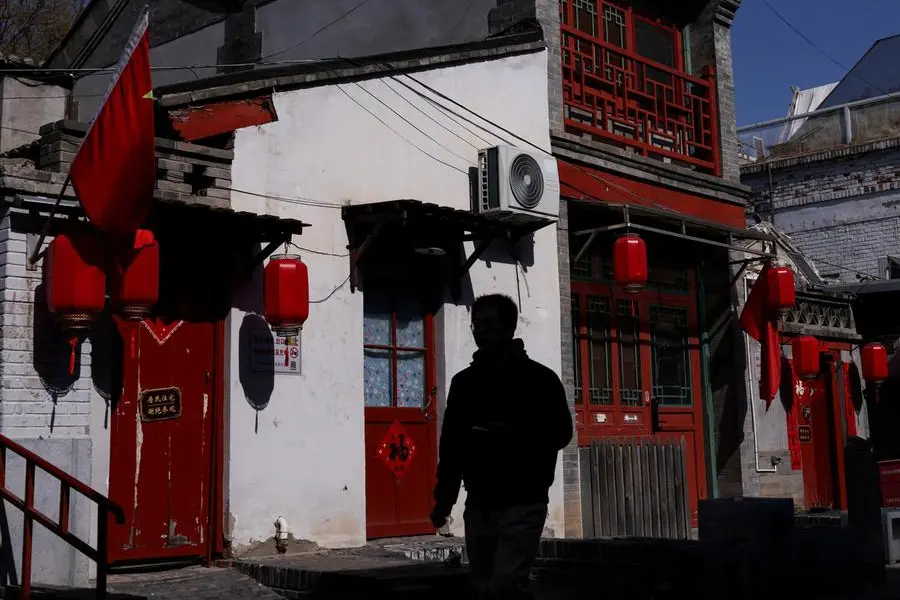
PHOTO
DONGGUAN, China - John Zhao and Charlie Wei are both unhappy with how their factory in southern China has responded to a landmark top court ruling in one of Beijing's biggest reform steps in recent years. But their objections couldn't be more different.
From September 2025, the court made it illegal for workers and employers to avoid social insurance payments, setting the stage for a long-term redistribution of resources from producers to consumers via the welfare system.
To minimise costs, the Dongguan-based auto parts supplier restructured salaries to pay contributions only on a base wage of around a third of their 12,000 yuan ($1,747) monthly income, said the workers, who now have to pay their share as well. They declined to name their employer.
Wei, 23, prefers "more money now", rather than the better longer-term deal when the firm's contributions into his social insurance account are factored in. Zhao, 37, wants the payments to reflect his full income.
"No one thinks they need a safety net until something goes wrong," said Zhao as the two shared a "drunken goose" meal, a southern Chinese cousin of coq au vin. "Younger people don't understand that."
COMPLIANCE WITH COURT RULING REMAINS PATCHY
Economists see the Supreme People's Court ruling as a pivotal test of Beijing's efforts to improve household finances and rebalance an export-reliant growth model that causes trade tensions and fuels disinflationary pressures.
Six months on, workers, employers and economists say compliance remains partial, raising questions over China's ability to pursue structural economic shifts as parliament is due for its annual meeting - the most-watched gauge of Beijing's reform momentum.
The human resources ministry and the cabinet did not respond to requests for comment. In January, ministry spokesperson Cui Pengcheng said social insurance reform has been "steadily promoted."
Reuters interviews with over a dozen workers and factory owners show firms responded to the ruling mostly in ways that minimise their own payments, in some cases even by lowering wages.
Most make payments based on a lower base wage rather than the full salary, having restructured the balance as bonuses or other benefits. Some workers and one factory owner said they still don't pay at all because they cannot afford the contributions.
Such examples "encapsulate the policy dilemma facing China's leaders: can you accept short-term pain for long-term gain? The answer, in this instance, seems to be no," said Nick Marro, an Asia analyst at the Economist Intelligence Unit.
"This could be instructive when thinking about other difficult market-based reforms."
By making the contributions mandatory - roughly 25% of income for employers and about a tenth for employees - the ruling aims to bolster the social safety net, a key step towards encouraging workers to spend more now, rather than save on their own for rainy days.
But it also raises labour costs.
Avoiding such contributions historically has strengthened China's competitiveness, turning exports into a major growth driver.
Richard Yarrow, fellow at Harvard Kennedy School’s Mossavar-Rahmani Center for Business and Government, says firms struggle to comply because low domestic demand, tariffs, high debts and price wars triggered by endemic industrial overcapacity hurt their revenues.
"If your competitors avoid paying for social insurance, then you have even more reason to avoid complying," Yarrow said.
The owner of an industrial valves manufacturer, asking not to be named to speak frankly about the ruling's impact, said he did not expect pressure from authorities to comply because that would "crush" factories like his.
A furniture factory owner said he was paying higher contributions, but below the legal requirement.
"The burden on our company is already quite heavy," he said.
EIU's Marro says authorities have "to some extent tacitly allowed companies to cut corners," because of thin margins.
"This reflects the difficult trade-off authorities face."
'CHINA IS TOO BIG'
Many workers feel they earn too little to contribute.
With debt to repay, Daniel Zhang, 27, works 10-hour shifts for 5,000 yuan monthly at a Shenzhen-based LED screen factory, then delivers food nightly for an extra 3,000 yuan.
"I'm in a bad state now, I feel very tired," he said over beers, peanuts and oysters with his manager at a hawker stall. "Paying 300-500 yuan every month would add a lot of pressure."
His boss, who owns shares in the factory and only gave his surname Zou, "turns a blind eye" as 30% of workers insist, like Zhang, on informal contracts to avoid payments. He said the factory might close if it loses money "again" this year.
"It's hard to fully enforce" payments, Zou added. "China is too big."
Some employers try their best.
Maria Wang, 28, says her boss at an engineering firm in the southern city of Guangzhou sold some of his apartments and cars to cover social insurance for 50 staff.
But the firm now struggles to pay suppliers, said Wang.
'A PROBABILITY PROBLEM'
A survey of 6,689 firms last August by human resources firm Zhonghe Group found only 34.1% were "fully compliant."
Reuters could not find more recent surveys. But revenues into the biggest social insurance scheme, urban pensions, increased 5.77% to 7.8 trillion yuan last year, an insignificant change over 2024's 5.61% rise.
One labour lawyer says firms tend to underpay using lower base wages, which could still be illegal.
"They know there's a risk, but they treat it like a probability problem," said the lawyer, asking for anonymity.
Some workers bear costs greater than their mandated contributions.
Finance worker Yu, 26, took a 27% net-income cut under threat of being laid off. To meet payments, her employer reduced her wage by 800 yuan to 4,000 yuan. Yu now also contributes 500 yuan.
Garment worker Xia, 39, is resisting a similar demand, together with her colleagues.
"We're all from rural areas, our wages are already low. If they deduct 600 yuan, what's left doesn't even cover living costs."
($1 = 6.8692 Chinese yuan renminbi)
(Reporting by David Kirton in Dongguan and Liangping Gao and Ellen Zhang in Beijing; Writing by Marius Zaharia Editing by Shri Navaratnam)