PHOTO
Monday, Oct 31, 2016
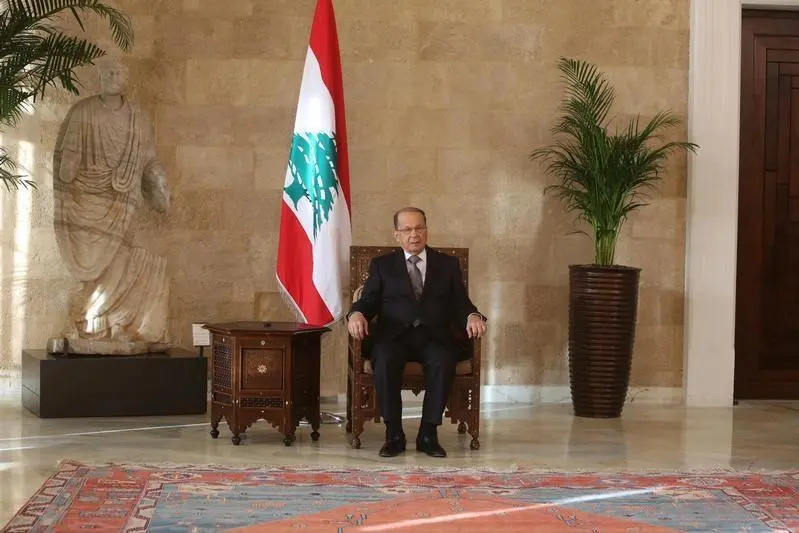
Washington, DC: Michel Aoun was born in 1935 to a Maronite Catholic Christian family from Jezzine (South Lebanon) in Harat Hreik, now a mixed Christian-Shiite suburb of south Beirut. A graduate of the College Des Freres Furn Al Chibak in 1955, Aoun enrolled in the Military Academy as a cadet officer that same year, and graduated three years later as an artillery officer in the Lebanese Armed Forces (LAF).
Like most of his counterparts, Aoun embarked on a military career by accepting various training stints abroad, starting with a 1966 appointment at the US Army Training Centre at Fort Still in Oklahoma, a 1978 course at the Ecole Superieure de Guerre in France. He returned to Lebanon in 1980, and was appointed head of the Defence Brigade stationed along the infamous “Green Line” that separates West and East Beirut at the height of the civil war, a conflict that consumed him.
In 1982, Aoun was promoted to brigadier general and received command over the new 8th Brigade, a multi-confessional army unit, which was ostensibly empowered to protect the Palestinian refugee camp of Burj Al Barajneh, though various atrocities were committed under his watchful eye, including the sinister Sabra and Shatila massacres.
His struggle against the Syrian army, which occupied Lebanon from 1976, started in 1983 when Aoun’s 8th Brigade fended off an attack by Syrian aligned militias in Suq Al Garb, which earned him a promotion in 1984 to Lieutenant-General (three-star General), and military chief-of-staff.
On September 22, 1988, outgoing President Ameen Gemayel appointed him head of a military government, which set-up the violent clashes that followed, culminating with military confrontations with the Lebanese Forces in February 1989, and the Syrian army that destroyed the presidential palace at Baabda over his head.
Aoun declared a “War of Liberation” against Syria, which he lost, in October 1990, escaped to the French Embassy where he surrendered to the Syrians via a radio address. While he arranged asylum for himself in Paris, several hundred of his men perished, some hastily buried in unmarked mass graves.
Aoun returned to Lebanon on May 7, 2005, eleven days after the withdrawal of Syrian troops from the country, which was imposed by the international community after the February 2005 assassination of Prime Minister Rafik Hariri.
In 2006, and in his capacity as the leader of the Free Patriotic Movement, Aoun signed a memorandum of understanding with Hezbollah, an alliance that endured and formed the cornerstone of the March 8 coalition. Despite the bloody history with the Syrian regime, Aoun visited Syria twice since then and seems to have turned the page with his former foes.
He was elected Member of Parliament in 2005 and 2009, and though he did not vote to renew the legislative body’s terms, which he deemed unconstitutional, he determined that parliament was legitimate after a deal was reached to select him as head-of-state.
Michel Aoun is married to Nadia Al Shami, who gave him three daughters, Mireille (married to businessman Robert Hashem), Claudine (married to retired Brigadier general Shamel Roukoz), and Chantal (married to Minister of Foreign Affairs Jibran Bassil).
By Joseph A. KechichiaN Senior Writer
Gulf News 2016. All rights reserved.