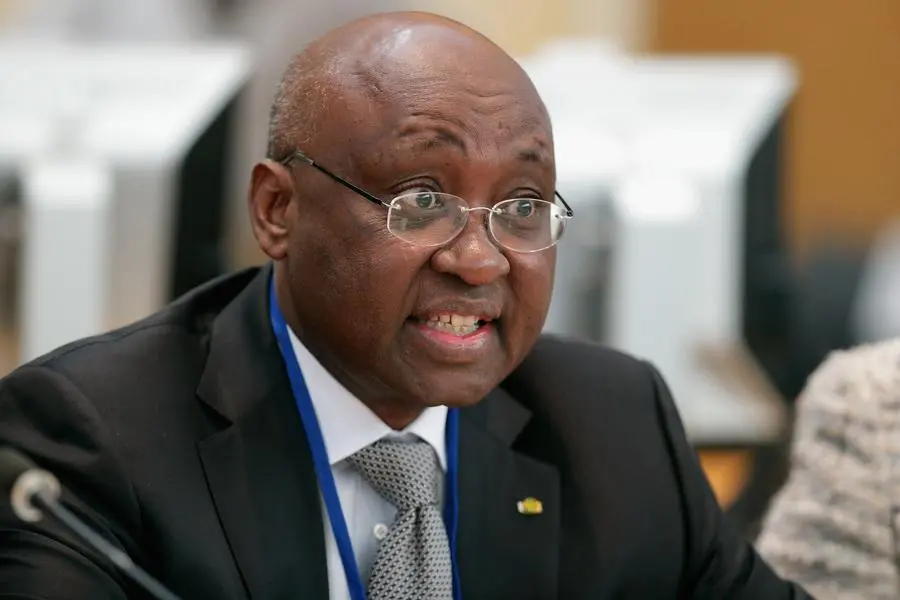
PHOTO
Former president of the African Development Bank, Donald Ka- beruka, has called for Africa to strengthen and integrate its fi- nancial and governance institu- tions to safeguard the continent’s future in a rapidly fragmenting global order.
Delivering this year’s Babacar Ndiaye Lecture, Kaberuka warned that “the world is not waiting for Africa; therefore, Africa must not wait for the world”, and urged African nations to take ownership of their development agenda through resilient, homegrown institutions.
Reflecting on global power shifts, Ka- beruka (opposite), pointed to the return of mercantilism; rising narrow national interests; the end of the aid era; weak- ened global institutions; and the erosion of multilateralism as the five trends that are reshaping the global economy. For Africa, that means turning inward, while leading the charge for a renewed global architecture. “We can no longer rely on post-war institutions that were never de- signed to address Africa’s challenges,” he said. “Strong nations are built on strong, homegrown institutions; not on borrowed ideas or conditional generosity.”
Kaberuka emphasised that Africa’s development requires an ecosystem ap- proach, where institutions across sectors – finance, trade, peace and security, health, and governance - operate in coordinated harmony rather than isolation.
“Like an orchestra, African financial institutions on their own will not get to the end point. They have to be part of an ecosystem of African financial institutions and not simply financial institutions. They have to operate together in a sym-phony,” he urged.
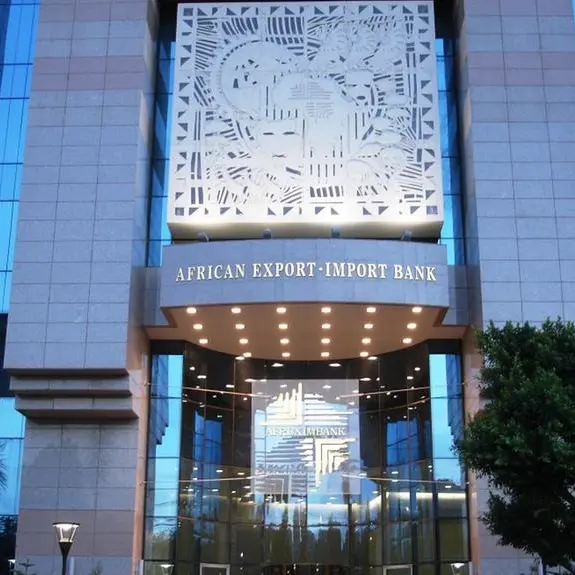
The African Export-Import Bank, Ka- beruka said, must be commended for exemplifying this model through its support for the African Continental Free Trade Area, the Africa Centres for Dis- ease Control and Prevention (Africa CDC), the regional economic communities, and other initiatives and institutions of the continent.
Kaberuka, who is also the Chairman and Managing Partner of SouthBridge, a financial advisory and investment firm, further argued that Africa must lead in reshaping global governance to reflect 21st-century realities and replace the post-World War II institutions such as the Bretton Woods system which were primarily designed for the reconstruction of Europe and Japan and not for the needs of emerging African economies.
“We can no longer outsource our future to institutions that were never meant to serve us,” he said, calling for the con- tinent to take a more assertive role in creating new multilateral frameworks that champion African priorities.
Kaberuka stressed that as the world moves from globalisation to fragmenta- tion, Africa’s ability to define and defend its interests will depend on the strength, coordination, and legitimacy of its own institutions.
Pointing to over $1.1trn held by African pension and sovereign wealth funds, he called for new models to mobilise and connect this capital with global invest- ment flows. “It is not only about mobilis- ing African capital,” he said. “It is about defining how that capital is deployed for Africa, by Africa.”
Establishing financial sovereignty
Earlier, in his welcome remarks, Dr George Elombi, who was at the time President Designate of the Afreximbank, called for urgent action to strengthen Africa’s financial sovereignty through the completion of the continent’s finan- cial architecture. Elombi said the time has come to move decisively toward the establishment of the African Monetary Fund and the African Central Bank as “full operational pillars of our sover- eignty”.
He outlined three non-negotiable pri- orities for African financial institutions going forward: “First, we must reaffirm the credibility and performance of our institutions. Their success stories must be told and documented. Second, we must protect the special treatment we receive from our member states, not as a privi- lege, but as the bedrock of Africa’s finan- cial independence. And third, we must accelerate the integration of our financial ecosystem so that Africa can speak and act with one voice in global finance.”
Elombi, who has now taken over as the 4th president of the bank following his selection by the board at the general shareholders meeting in June, reaffirmed Afreximbank’s Preferred Creditor Status as an essential safeguard for Africa’s abil- ity to finance its own development.
Cautioning against narratives that question the credibility of African in- stitutions, he noted that such criticism often arises “not because we have failed, but because we have succeeded.” Afrex- imbank, he noted, has disbursed over $155bn in the past decade, including $18.7bn in 2024 alone. “These are not just numbers,” he said. “They represent jobs, freedom, and hope. They are living proof of what Africa can accomplish when trust is matched by capacity.”
Elombi argued that the real challenge facing the continent is not risk, but per- ception. “Africa is not too risky; Africa is dependable,” he said.
Elombi also paid tribute to Dr Babacar Ndiaye, the fifth president of the AfDB, describing him as a man “whose vision turned words into action”. Ndiaye, he said, believed that Africa’s progress de- pended on institutions built, financed, and led by Africans, a conviction that gave rise to Afreximbank, Shelter Afrique, and the African Business Roundtable.
“Dr Ndiaye understood that true in- dependence meant having the capacity to stand on our own and shape our own future, no matter how the world around us changes,” he said. Elombi reaffirmed Afreximbank’s commitment to Ndiaye’s legacy, pledging that “we will not aban- don this ambition. Our task is to carry forward the vision of financial self-reli- ance until the job of Africa’s development is significantly achieved.”
This year’s Babacar Ndiaye Lecture was the 9th in the series held in honour of the late Ndiaye, who was the driving spirit behind the establishment of Afreximbank and other key pan-African institutions. It was held under the theme “Leverag- ing Global Africa’s Capital for Develop- ment: The Imperative for Stronger African Financial Institutions amid Geo-eco- nomic Shifts”, and attended by policy makers and business leaders from the continent and the United States where it was held. n
The Babacar Ndiaye Lecture
The annual Babacar Ndiaye Lecture, organised by Afreximbank, has become a signature event in Africa’s international events calendar. This year’s Lecture, held at the Willard Washington Hotel, Washington DC, was the 9th in the series. The Lectures, given by a variety of Africa’s outstanding thinkers, largely on the subject of finance, have gained a reputation for being not only exceptionally robust in their research and quality of argument, but being widely influential in global financial and development circles.
© Copyright IC Publications 2022 Provided by SyndiGate Media Inc. (Syndigate.info).