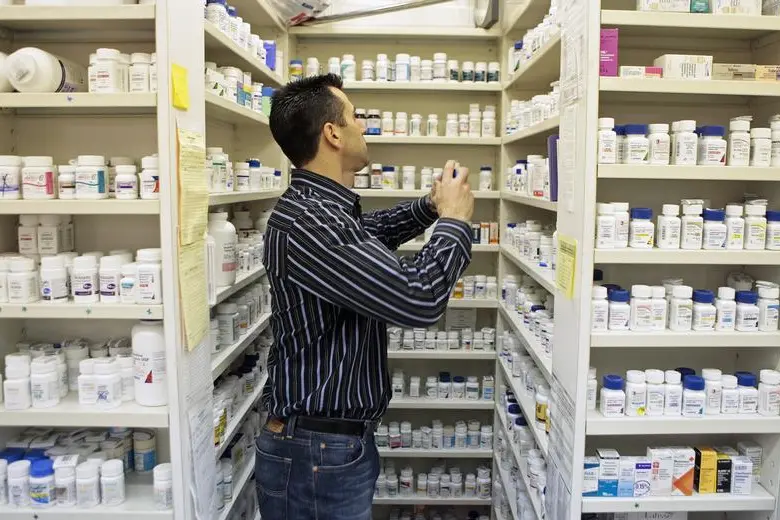
PHOTO
01 July 2015
BEIRUT: The unified prescription form, which makes it easier for Lebanese patients to access inexpensive medicine, was launched Tuesday in what Prime Minister Tammam Salam called a great national achievement.
This national achievement seeks to ease the burden on citizens, be it through the cost of medication or the manufacturing of drugs, the premier said during a ceremony at the Grand Serail.
Previously, doctors often prescribed costly brand-name drugs while patients were unable to request generic versions, often chemically identical to the proprietary-name medication.
According to Health Minister Wael Abu Faour, generic drugs comprise just 13 percent of the pharmaceutical market in Lebanon. In Europe and the West, however, inexpensive generic drugs make up more than 80 percent of all drugs sold.
The new unified prescription form, which will become fully operational in mid-July, will allow patients, with their doctors permission, to purchase generic medication for their maladies.
Head of Parliaments Public Health Committee MP Atef Majdalani, who has lobbied for the unified prescription form, said that in Lebanon generic drugs are 30 to 40 percent cheaper than brand-name drugs. As the majority of citizens pay for medication out of pocket, Majdalani said the new unified prescription form would help patients save money.
Moreover, the National Social Security Fund, which covers over a million working Lebanese, stands to benefit from the unified prescription form. As the NSSF typically reimburses patients for 80 percent of the cost of prescription drugs, the broader adoption of inexpensive generic drugs will limit the costs incurred by the fund.
While the law approving a unified prescription form, which gives patients more leeway to opt for generic medication, was approved in 2011, it stalled before it could be implemented. The Order of Physicians, which was charged with printing the forms, refused to do so until the NSSF amended its bylaws which forbade pharmacists from selling patients generic medicine if the prescription called for a brand-name drug.
Abu Faour, however, has suggested that the physicians had other motives for blocking the new policy.
Abu Faour previously told The Daily Star that some doctors are only prescribing drugs that are produced or marketed by certain companies.
Antoine Boustany, the head of the Order of Physicians refused to comment for this article and told The Daily Star he had forbade other members of the Order from making statements to the press.
But Abu Faour struck a conciliatory tone at the Grand Serail Tuesday. No one interferes in the right of the doctor to prescribe the drug that they deem necessary for a patient, he told gathered reporters.
The new form allows doctors to check a box indicating that generic medication cannot be dispensed for a particular patients malady.
But we are urging doctors to allow patients to choose a generic drug because its less costly for the patient, for the state and for the insurance companies, Abu Faour said at the Serail Tuesday.
Elie Habib, the head of the North Lebanon Order of Physicians, said that while the group have their reservations, we will comply with the new regulations.
The law remains contentious. A pharmacist in Beirut, who asked not to be named, said he was opposed to the law because generic drugs were less expensive and he would therefore make less profit. Were already struggling, he said.
Moreover, he expressed concern that special interest groups would control the importation and distribution of generic brands.
But proponents of the new policy say that there are clear advantages.
Abu Faour said that wider accessibility to cheaper drugs would help ensure that more than 1.2 million Syrian refugees in the country are able to buy medication.
Moreover, prescription fraud and forgery will be limited with the new unified prescription form. The forms themselves have a watermark and are printed on a special paper manufactured in European factories that conforms to international standards, Abu Faour said.
But Abu Faour acknowledged the need for more steps to ensure the full functionality and effectiveness of the unified prescription form.
An information bank, he said, should be established as soon as possible ... to evaluate the impact of the new policy.
Copyright The Daily Star 2015.



















