It's early days yet, but several international companies are sniffing around Morocco's offshore basins in the hunt for oil and gas.
The United States Geological Survey (USGS) estimates more than 19 billion barrels of technically recoverable undiscovered conventional oil and 370 trillion cubic feet of undiscovered natural gas is spread across eight geological basins in North Africa.
Of the undiscovered conventional oil resource of 19 billion barrels of oil, about 41%, or 7.5 billion barrels, is estimated to be in the offshore salt structures near Morocco.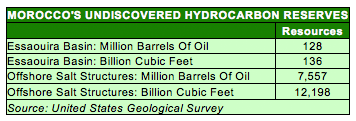
As a result, the North African country oil importer, has recently been on the radar screens of oil and gas companies due to its promising offshore riches. Earlier this year, Chevron signed petroleum agreements with Morocco's Office National Des Hydrocarbures Et Des Mines (ONYHM) for three offshore areas.
The US energy giant plans to acquire seismic data and conduct studies in the deepwater areas of Cap Rhir Deep, Cap Cantin Deep and Cap Walidia Deep, located west and northwest of Agadir, Morocco.
The areas comprise around 29,200 square kilometers with average water depths ranging from between 330 feet to 14,700 feet.
Chevron Morocco Exploration has a 75% working interest in the three areas, with the Office National Des Hydrocarbures Et Des Mines holding the remaining 25%.
While the arrival of Big Oil in Morocco was a big fillip for the country's energy potential, other intrepid explorers have also joined the fray.
Bermuda-based Kosmos Energy, Scotland-based Cairns Energy and Angol-Turk company Genel Energy have swooped in to pick up promising offshore plays.
Kosmos Energy has acquired 14 million areas of pre-salt plays offshore Morocco.
The company says it has secured a key position in the Agadir Basin, operating three large blocks: Essaouira; Foum Assaka; and Tarhazoute.
"In addition, the Agadir Basin is a salt basin that provides significant hydrocarbon trapping opportunities," according to Kosmos. "We are processing and interpreting 3D seismic data from our 2012 data acquisition as we mature the substantial prospectivity on the blocks. The company is planning for initial exploration drilling as early as late 2013."
The company recently told investors that signed a new-build drillship on a three-year contract, starting in mid-2014 offshore Morocco,
"Management is looking to secure a second rig to drill in the region in H1 2014. The company has stakes in three sizeable licenses offshore Morocco and, having closed its data rooms recently, Kosmos expects to announce farm-out deals in the coming months," said Victoria McCulloch, analyst at RBC Capital Markets.
The company's Moroccan portfolio encompasses a number of pre-salt, post-salt and stratigraphic plays and shareholders may be hoping to obtain insights from third-party drilling in the fourth quarter of 2013 or first half of 2014.
Last year, Cairn bought acreage of 8,900 square kilometers, comprising a 50% operated interest in the Foum Draa blocks 1-3 and a 37.5% operated interest in the Cap Juby Maritime blocks I-III license.
"Preparations are underway for the planned first well in the sequence on the Foum Draa permit which is due to commence later in 2013 subject to necessary approvals," the company noted on its website.
"These preparations include sea-bed site surveys and environmental surveys. The Environmental Impact Assessment (EIA) for the planned drilling program is underway."
Cairn has a 50% interest, along with Office National des Hydrocarbures et des Mines (ONHYM) 25%, San Leon Energy 14.2%, Serica Energy 8.3% and Longreach Oil & Gas 2.5%, in the Foum Draa acreage.
Cairn is also looking to drill an exploration well in 2013/early 2014 in the Juby Maritime area, along with partners Genel Energy and ONHYM.
Genel Energy, headed by Tony Hayward - the former chief executive officer of BP, has also taken a major interest in Morocco's offshore basin.
The company said, in an investor presentation, that it plans to spud its first well in the fourth quarter of the year.
"Cairn is likely to be targeting the most analogous, post-salt play on Foum Draa, but Cairn/Genel's well on Juby Maritime and a Q3 2013 CPR from Genel could help increase the profile of the wider region," said RBC's McCulloch.
Morocco is the latest African country to see a surge of interest from oil and gas companies. The country is also benefiting from the early success of oil companies in neighboring Mauritania's offshore reserves as well.
The country's proximity to energy-starved European markets also make it an attractive target for oil and gas companies.
As an energy importer, Morocco remains vulnerable to oil price volatility. The International Monetary Fund estimates that an increase in the Brent price of 5% a year starting in 2013 would lead to a depreciation of 10% of the Moroccan currency.
The presence of some of the world's most resourceful companies such as Cairns and Genel suggests that Morocco could soon join its neighbor Mauritania and Algeria as an oil producer.
© alifarabia.com 2013