Enhancement of public participation in decision-making is the current international political trend, and the developing countries are now heavily influenced to inculcate this drift into their governance system. In these countries, public participation is part of the priority political agenda. In these countries, however, there has not been sufficient research on the actual condition concerning the effective measures and processes for advancing public-private participation or the priorities that should be adopted in this course.
The wave for more involvement of public in the government affairs, throughout the world since the end of the Cold War, has given a boost to the process for decentralization. It has become a theme of political importance in many developing countries, which are presently progressing toward a worldwide movement for democratization, liberalization and marketization.
Further, this situation is an indispensable framework for ensuring the long term stability of the State and the advancement of development.
The international community has decided to actively increase the opportunities for supporting democratization, especially in the developing world. This movement has the power to dramatically change the relationships between the central and local institutions. These relationships are a fundamental aspect of a state's institutional framework, along with an independent legislature, executive branch and judiciary.
Along with economic development, the demand for the proper delivery of administrative services to the public has been growing so that it now requires broad based decision sharing.
Improving the livability and competitiveness of cities places big demands on urban governance and management. Good governance implies inclusion and representation of all groups in the urban society - and accountability, integrity, and transparency of local government actions - in defining and pursuing shared goals.
Capable urban management requires a capacity to fulfill public responsibilities, with knowledge, skills, resources, and procedures that draw on partnerships. The focal point for local government institutional capacity includes assigning revenues and expenditures to ensure that local governments have the revenues with which it is expected to finance local expenditures; improving the transfer system; and introducing transparent and reliable reporting systems. These measures are predicated on an effective fiscal system that binds different tiers of government.
Equally important in the evolution of local government institutional capacity is the regulatory framework of the financial sector, particularly as it relates to borrowing by sub-sovereign governments to remove institutional problems that give rise to unsustainable sub-sovereign borrowing.
Public financial management must adequately control the level of revenue and expenditure, and appropriately allocate public resources among sectors and programs. An essential first step is to improve intergovernmental fiscal relations through streamlined and predictable rules on tax sharing and grants, find out possibility of local taxation system, and put sound budgetary and financial procedure into place through comprehensive, accurate and transparent budgets that establish the basis for financial control and provide timely financial information. This highlights and strengthens the links between budget and performance of local government agencies in meeting key operational and strategic objectives.
PROFILE OF MUNICIPAL BODIES
Municipal service as the essential part of clusters of shelter existed generally in an informal fashion in the Kingdom. Water supply and sanitation were considered as the most essential components of these services. Main regulations for organizing municipal works were issued in 1345-H (1925- G). Initially a Municipal Department consisting of a Projects Division and a Land Division was established in the Ministry of Interior that, in 1382-H (1962-G), was upgraded to become the Deputy Ministry of Interior for Municipal Affairs. With the commencement of the First Five Year Development Plan of the Kingdom in 1975, the Ministry of Municipal and Rural Affairs (MOMRA) was established by the Royal Decree number A/276. Since its inception, MOMRA has been providing various kinds of municipal services to the citizens and residents through municipal bodies in both cities and village clusters.
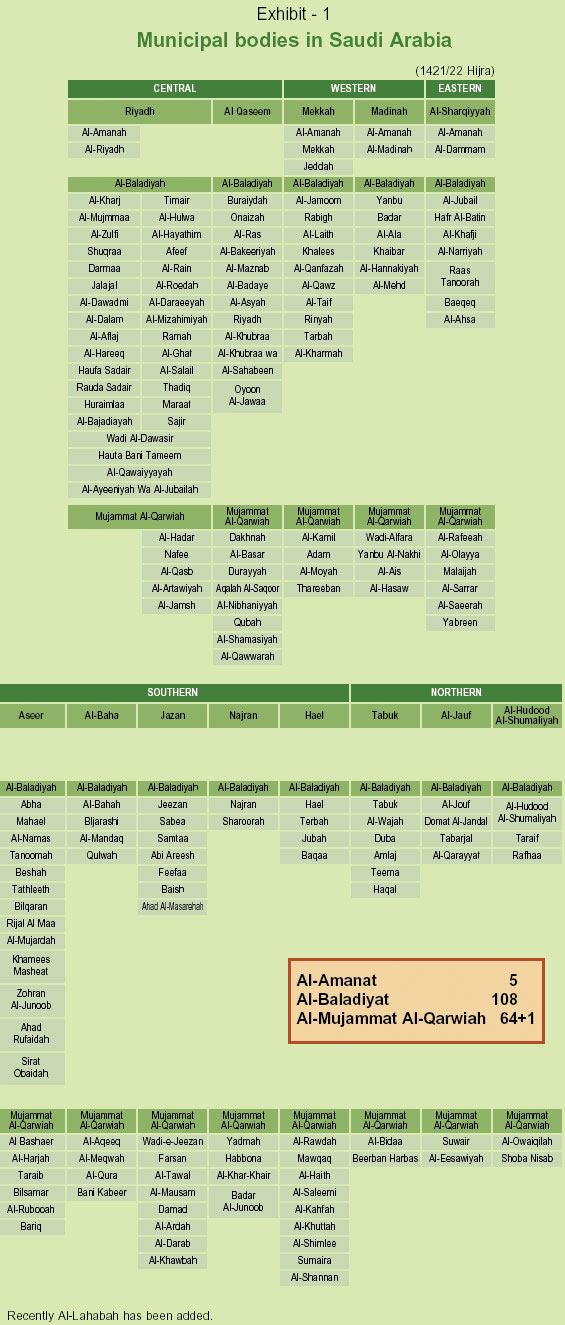
Broadly there are three types of municipalities:
1. Amanahs (5) that are generally established in bigger cities.
2. Baladiahs (108) that are generally in cities and towns
3. Mujammaatul Qarwiahs (65) for cluster of villages
The details of these municipal bodies are provided in Exhibit-1.
These municipalities are run by management and staff appointed by the government. For effective operation and management of the services entrusted to these bodies they are organized in various departments.
For development projects they have to prepare their annual budget, which are reviewed and scrutinized by MOMRA. These budgets are finally approved by the Ministry of Finance, which entitle these municipalities undertake development works in their areas.
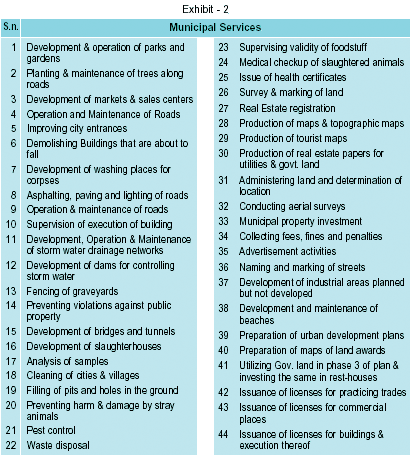
For better understanding the operation of a municipal body, one needs to distinguish between the functions and services. The activities generally performed in a municipality to support its operation inter alia include the following:
- Revenue Collection
- Financial Management and Accounting
- Personnel management
- Project management
- Public relation
- Survey and registering of commercial units
- Transport and Vehicle
- Heavy and Light Equipment operation
- Repair and maintenance of vehicles and equipment.
- Typing and printing of licenses, certificates, sketches and maps.
- Computer Services
- Security
- Cleaning of office
- Maintenance of office equipment
- Maintenance of office building
- Maintenance of archives and records
- Book-keeping
- Data entry
- Dispatching and Courier
- Legal services
- Media Campaign
- Drafting and designing
The list of services that can come under the preview of a municipal body is attached as Exhibit-2.
WHAT IS EXPECTED FROM PUBLIC REPRESENTATIVES?
Before entering into the era of democracy any candidate who desires to be a public representative should develop a conceptual basis for the changes to be brought in the system.
These changes are broadly discussed as follows:
Improvement in Efficiency
People are not the same everywhere within a country and they have varying needs for the public services that improve the welfare of local residents and promote local economic development. Sub-national governments are closer to the people, have good access to local information, and understand the local context well. If so, they can better identify the mix and level of services that their particular constituents need than can higherlevel governments, thus improving what economists call allocative efficiency.
There are, of course, a number of caveats. Some of the services local people want may best be provided at greater scale by a higher-level government, and some local services may affect other jurisdictions and should not be left to the control of a single local government.
The responsibility of a public representative is to identify and communicate the level of service required by those who have elected him and communicate adequately at the time of designing and developing and organizing the services.
Improved Governance
If local constituents see that their interactions with their local governments lead to decisions about local public services that are more consistent with their wishes than decisions made by higher-levels, they will feel better connected to local governments.
Being able to influence the course of public affairs in at least some small ways that directly affect them empowers people, giving them a sense of control and autonomy that they did not have before. Again, there are caveats. Local constituents should not necessarily have everything that they want, and certain important national goals may have to take precedence over local needs. Governance and collective action are not purely local.
The public representative therefore, needs to create a feeling amongst its constituents that at least the local decisions are according to their wishes and desires and they have better control over distribution and utilization.
Wherever, higher-level goals are in conflict with the local ambitions, they should be dealt tactfully through development of awareness amongst the masses.
Improved Equity
If the local governments are made aware of variations in local circumstances by their constituents, they are in the best position to more equitably distribute public resources within their own jurisdictions. They are, of course, constrained by their internal resources, so that redistribution from richer to poorer areas must be the responsibility of central governments.
In addition, local governments will not necessarily choose to pursue redistribution in their jurisdictions unless they are forced to do so by a broadly inclusive local political process or interventionist central government.
It is the responsibility of a local representative to know the variation of level of services within their region and make efforts when new allocations are made to improve the infrastructure facilities in the more deserving communities.
CONCLUSION
The pride that is accomplished with membership of a local council, no doubt attracts a number of competitors. However, anyone who is elected should have a clear concept of the role and responsibility of a local council as well as his duties by virtue of the confidence entrusted by public on him.
Furthermore the elected public representative should set its goals for accomplishment, otherwise he will be like a passenger of a vehicle for which he is not aware of the destination.
The second and foremost importance is presence of systems and procedures, rules and regulations for running a local council. There should be road map that provides the way the government is planning to enhance the public participation in future so that the councils can adopt a profile of truly representative public body.
© Saudi Commerce and Economic Review 2004




















